HelloGrowthCRM software
Built for real small-business sales teams
HelloGrowthCRM helps reps qualify faster, follow up on time, and close more deals—with practical automation in one place.
- AI lead scoring and pipeline visibility
- Built-in dialer, WhatsApp, and email automation
- Sales forecasting and RevOps-ready reporting
Managing Service Level Agreements (SLAs) for customer support refers to the process of defining, monitoring, and enforcing specific commitments between a business and its customers regarding support response and resolution times. In the context of growing Indian B2B businesses, SLA management in customer support India ensures that clients receive timely, consistent, and transparent service, which is crucial for building trust and maintaining long-term partnerships. Effective SLA management involves setting measurable targets, aligning cross-functional teams, and leveraging tools like HelloGrowthCRM’s AI-powered workflows to track performance and improve customer satisfaction.
Key Takeaways
- SLA management in customer support India is critical for B2B businesses to maintain service consistency and customer trust.
- Clear SLA targets should be aligned with client expectations and business capacities, considering Indian market nuances such as tier-2 city operations and communication preferences like WhatsApp.
- HelloGrowthCRM’s AI CRM features provide automation and real-time insights to enforce SLA adherence and streamline support workflows.
- Cross-functional collaboration between sales, support, and RevOps teams improves SLA performance and customer experience.
- Regular reporting, pipeline governance, and forecast hygiene help continuously improve SLA outcomes.
- Leveraging integrations with Indian payment gateways and lead sources ensures seamless end-to-end support beyond ticket management.
Why SLA Management in Customer Support Matters for Growing Indian B2B Businesses
In the intensely competitive Indian B2B market, businesses in cities like Mumbai, Pune, and Bengaluru must maintain high customer satisfaction to retain clients and expand revenue. As companies scale, manual tracking of customer support commitments becomes inefficient and error-prone. Poor SLA management can lead to missed deadlines, frustrated customers, and lost deals.
Service Level Agreements define measurable expectations such as "response within 2 hours" or "resolution within 1 business day"—key metrics that Indian clients value for predictability and professionalism. For example, a SaaS solution provider using HelloGrowthCRM in Bengaluru might commit to responding to Tier-1 customers within 30 minutes through WhatsApp or email to maintain their competitive edge.
By incorporating SLA management in customer support within a structured Revenue Operations (RevOps) framework, Indian B2B businesses create accountability and transparency across departments. Transparency is also vital for compliance with Indian data protection regulations like the DPDP Act 2023 and to reassure customers about their data privacy during support interactions.
Understanding SLA Components and Indian Market Context
Defining SLA Metrics
Common SLA components in Indian B2B customer support include:
- Response Time: How quickly support acknowledges a customer’s inquiry.
- Resolution Time: Total time taken to fix the reported issue.
- First Contact Resolution (FCR): Percentage of issues resolved in the first customer interaction.
- Escalation Timeframes: When to escalate unresolved issues internally.
- Availability: Support hours, often aligned with India Standard Time and regional holidays.
Aligning SLAs with Indian Business Realities
Growing Indian businesses face challenges such as:
- Diverse Client Locations: Clients may be spread across metro and tier-2 / tier-3 cities with varying internet reliability.
- Communication Channels: Indian clients frequently use WhatsApp alongside email and phone, demanding multi-channel support.
- GST and Payment Queries: Support teams may handle queries on GST invoice generation or UPI payment reconciliations.
- Local Lead Sources: Platforms like IndiaMART or JustDial generate leads requiring fast qualification and follow-up under SLA terms.
HelloGrowthCRM’s flexible Integrations and AI Lead Scoring automate routing and prioritization of such tickets, ensuring SLA compliance even as volumes grow.
The Role of HelloGrowthCRM in SLA Management
AI-Driven SLA Monitoring and Automation
HelloGrowthCRM’s AI CRM module monitors live ticket queues with automated SLAs tracking. It sends alerts for pending escalations and flags tickets breaching SLA deadlines, enabling proactive intervention.
Features like Email Automation streamline client communication with templated responses triggered by SLA milestones. Teams can update customers on expected resolution times without manual effort.
Cross-Functional RevOps for SLA Success
Integrating SLA management with RevOps practices ensures teams share data and insights for consistent delivery. HelloGrowthCRM supports cross-team dashboards highlighting support performance, forecast hygiene, and pipeline health metrics.
For instance, a Mumbai-based IT services company using HelloGrowthCRM’s Managed RevOps service discovered through reporting discipline that their escalation processes needed tightening to meet SLA targets consistently.
Common Challenges in SLA Management for Indian B2B Businesses
- Scaling Support Without Losing SLA Compliance: Manual tracking becomes unsustainable as ticket volume rises.
- Communication Gaps Across Channels: Ensuring SLA adherence when customers use WhatsApp alongside email or calls.
- Lack of Real-Time Visibility: Without a unified platform, delays or SLA breaches can go unnoticed.
- Compliance with Data Privacy: Aligning SLA commitments with DPDP Act 2023 guidelines on handling customer data.
- Aligning Multiple Stakeholders: Coordinating sales, support, and RevOps in geographically dispersed teams.
HelloGrowthCRM addresses these through AI automation, multi-channel integration, and unified reporting tools.
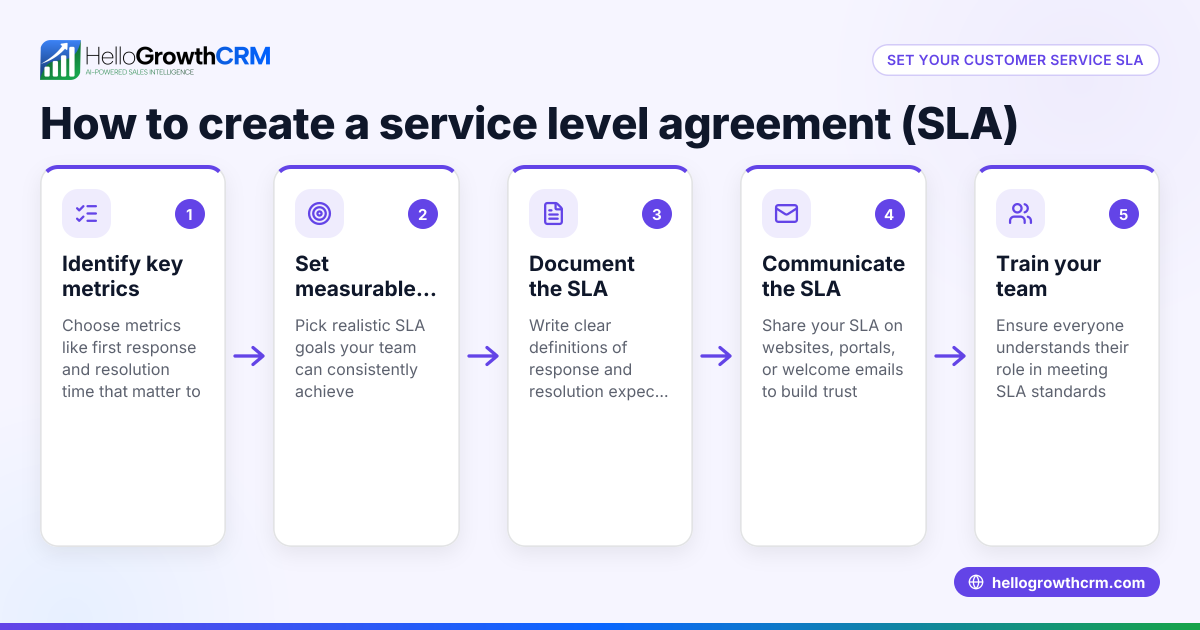
How to Manage SLAs for Customer Support in Growing Indian B2B Businesses: Step-by-Step
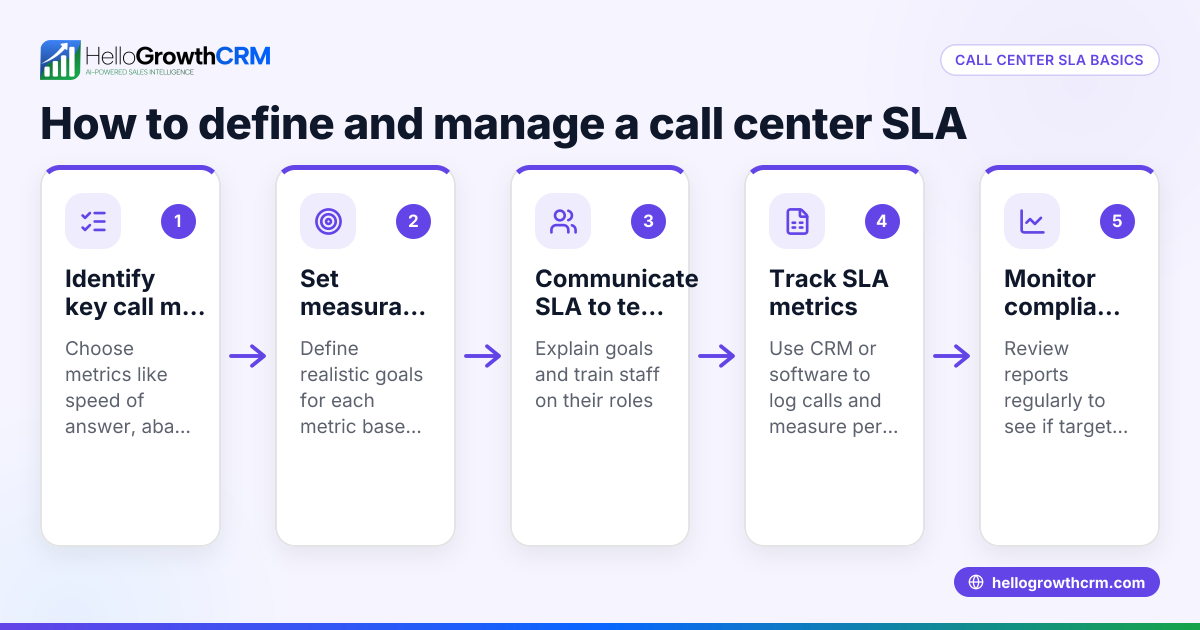
- Define Clear SLA Objectives
Start by specifying measurable SLA metrics tailored to your customers’ needs and your operational capacity. Include response and resolution times, supported hours, and escalation rules. - Map Customer Support Workflows in HelloGrowthCRM
Use HelloGrowthCRM’s workflow builder to set automated steps for ticket prioritization, routing, and escalation aligned with SLAs. Incorporate channels like WhatsApp and email for full coverage. - Integrate Indian Payment and Lead Platforms
Connect platforms like Razorpay for payment verification tickets and IndiaMART for lead sourcing with HelloGrowthCRM Integrations. This streamlines case creation and SLA tracking from the start. - Set Up Real-Time SLA Monitoring and Alerts
Activate AI-driven dashboards and alerts in HelloGrowthCRM to monitor SLA compliance. Ensure team members receive automated reminders before SLA deadlines approach. - Train Teams on SLA Standards
Conduct training sessions emphasizing SLA importance and using HelloGrowthCRM tools for compliance. Include RevOps for cross-department alignment on SLA governance. - Regular Reporting and Continuous Improvement
Use HelloGrowthCRM’s reporting discipline to analyze trends in SLA performance. Adjust SLAs and support processes as business scales or client expectations evolve.
Conclusion: Start Enforcing SLA Management with HelloGrowthCRM
SLA management in customer support India is a vital practice for growing B2B businesses to keep clients satisfied and operations scalable. By defining clear SLAs tailored to the Indian market and leveraging HelloGrowthCRM’s AI CRM features and RevOps integrations, teams can automate SLA tracking, ensure real-time accountability, and continuously improve service quality. Start your journey towards smarter SLA management today with HelloGrowthCRM and see how your customer support transforms into a revenue growth engine.
Explore HelloGrowthCRM’s Features or sign up for a Free Trial to experience easy SLA management and much more.
Frequently Asked Questions
Q: What is SLA management in customer support India?
A: SLA management in customer support India involves setting and maintaining commitments on response and resolution times tailored to Indian B2B customers. It ensures predictable, timely service delivery that meets client expectations within the local business context.
Q: Why are SLAs important for B2B businesses in India?
A: SLAs build trust by guaranteeing support standards. In India’s competitive market, this helps B2B companies retain clients spread across metros and tier-2 cities, reduce churn, and improve lifetime customer value.
Q: How does HelloGrowthCRM help with SLA compliance?
A: HelloGrowthCRM uses AI-driven insights and automated workflows to track SLA deadlines, send alerts for impending breaches, and enable multi-channel ticket management. This reduces manual effort and improves resolution speed.
Q: Can SLAs be customized for different Indian client segments?
A: Yes. SLAs should be tailored by client priority, location, or communication channel. HelloGrowthCRM supports customizable SLA policies and prioritizes tickets accordingly to meet diverse client needs.
Q: How do Indian laws like the DPDP Act 2023 affect SLA management?
A: The DPDP Act 2023 requires secure handling of customer data during support. SLA tools integrated with HelloGrowthCRM ensure compliance by controlling data access and maintaining audit trails alongside SLA tracking.
Q: What are some common SLA breaches in Indian B2B support?
A: Common breaches include delayed responses due to high ticket volumes, miscommunication across channels like WhatsApp, and lack of escalation in complex cases. Automated SLA alerts help minimize these risks.
Q: Is it possible to integrate HelloGrowthCRM with Indian payment and accounting systems?
A: Yes. HelloGrowthCRM supports integrations with popular Indian payment gateways like Razorpay and accounting tools like Tally, enabling end-to-end support workflows that respect SLA commitments.
Ready to streamline SLA management and grow your Indian B2B business? Try HelloGrowthCRM’s AI-powered platform now and take your customer support to the next level.
Implementation Checklist for How to Manage SLAs for Customer Support in Growing Indian B2B Businesses
Teams researching SLA management in customer support India usually need more than a high-level definition. They need a repeatable process, clear ownership, and a way to connect day-to-day execution back to pipeline quality and revenue outcomes. That is why the most useful version of this topic is practical: it should help a team decide what to standardize, what to automate, and what to measure first.
Start by deciding where SLA management in customer support India fits in the revenue workflow. For some teams it belongs near lead qualification, because better prioritization affects who gets attention first. For others it belongs in pipeline management, because the real problem is inconsistent stage movement, poor follow-up discipline, or weak forecast confidence. The exact placement matters because it determines which records, fields, and manager reviews should change after the process is introduced.
Step-by-step rollout model
- Define the business outcome the team wants from SLA management in customer support India. That could be faster speed-to-lead, better conversion from demo to opportunity, cleaner qualification, or fewer stalled deals.
- Identify which team owns the process day to day. A workflow with no owner usually becomes a dashboard topic instead of an execution habit.
- Decide which fields or signals are required. Keep the list narrow enough that reps can maintain it without turning the CRM into admin overhead.
- Add automations only after the workflow is clear. Good automation reduces repetitive work, but bad automation hides process problems and makes reporting less trustworthy.
- Review performance weekly. Teams improve faster when they inspect real records, not just summary charts.
What strong teams usually standardize
- A clear definition of when a lead, account, or deal qualifies for the next step
- Required fields that support follow-up, segmentation, and reporting
- Ownership rules for handoffs, reminders, and stage progression
- Manager review checkpoints for aging, conversion, and execution quality
- An escalation path for records that are blocked, stale, or missing context
Metrics to watch after rollout
When a team implements SLA management in customer support India well, performance should change in ways that are visible. Look at conversion rate between stages, response time, meeting creation, pipeline age, follow-up completion, and forecast confidence. If those numbers do not move after implementation, the process may be too theoretical, too hard to use, or not connected tightly enough to how reps actually work inside the CRM.
It is also useful to separate activity metrics from quality metrics. A team can appear busy while still failing to improve outcomes. Measuring both helps leadership understand whether SLA management in customer support India is increasing output only, or improving the quality of decisions and follow-through as well.
How HelloGrowthCRM supports this workflow
HelloGrowthCRM is most effective when the team uses it as an operating system rather than a contact database. The platform helps centralize lead records, activity history, communication, automation triggers, reporting, and follow-up actions in one place. That matters for SLA management in customer support India because it reduces the gap between strategy and execution. Reps can see the context, managers can inspect progress, and leaders can connect the process back to revenue performance.
For example, a team may start with a simple scoring or qualification framework, then connect it to follow-up tasks, reporting views, internal alerts, and manager dashboards. Another team may apply the same principle to messaging, meeting scheduling, outbound sequencing, or account prioritization. In each case, the system works best when the workflow is inspectable and the next step is obvious.
Common mistakes that reduce content quality and execution quality
One common mistake is treating SLA management in customer support India as a one-time setup instead of an ongoing operating discipline. Teams launch the framework, create a dashboard, and assume the problem is solved. In reality, the process needs feedback loops. Inputs drift, rep behavior changes, and the market evolves. Without review, even a good workflow loses accuracy.
Another mistake is overcomplicating the first version. Teams sometimes try to capture too many fields, too many exceptions, or too many automations before the basic operating model is stable. That creates resistance and lowers adoption. A better approach is to launch the smallest version that still produces measurable decisions, then add sophistication after the team trusts the workflow.
Practical FAQ extension
How long should a team give this process before judging results?
Most teams need a few weeks of consistent use before they can evaluate whether SLA management in customer support India is improving execution. The exact timing depends on deal cycle length and lead volume, but a workflow should usually be reviewed across multiple reporting intervals before large conclusions are drawn.
Does SLA management in customer support India matter only for large sales teams?
No. Smaller teams often benefit even more because a clear workflow prevents follow-up gaps and makes performance easier to inspect without adding management layers. The key is to keep the process proportional to team size.
What is the best first improvement to make?
Usually the best first improvement is clarity. Define the next step, the owner, and the required information. Once those are stable, automation and reporting become much more valuable.
Final execution notes for How to Manage SLAs for Customer Support in Growing Indian B2B Businesses
SLA management in customer support India becomes commercially valuable when it helps a team move faster with more confidence, not when it just adds vocabulary. The teams that get the best results usually connect workflow design, data hygiene, automation, and manager inspection into one rhythm. That is the lens readers should use when evaluating any approach connected to HelloGrowthCRM.
Frequently Asked Questions
Ready to put this into practice?
Set up your pipeline, WhatsApp follow-ups, and AI lead scoring in minutes — free, no credit card.
Try HelloGrowthCRM freeGet CRM tips in your inbox
Join thousands of sales professionals who get weekly insights on CRM strategy, AI automation, and pipeline optimization.

The HelloGrowthCRM team publishes guides on CRM strategy, AI sales tools, and revenue operations for small business sales teams.