HelloGrowthCRM software
Built for real small-business sales teams
HelloGrowthCRM helps reps qualify faster, follow up on time, and close more deals—with practical automation in one place.
- AI lead scoring and pipeline visibility
- Built-in dialer, WhatsApp, and email automation
- Sales forecasting and RevOps-ready reporting
Managing repeat customer complaints efficiently is crucial for maintaining your business reputation and customer loyalty in the UAE. The key is to identify the underlying cause, keep detailed records, respond quickly, and ensure the issue is fully resolved before closing the case. This article explains why repeat complaints occur, provides a step-by-step guide to handle them, illustrates with an example, highlights common pitfalls, and shows how HelloGrowthCRM supports this process.
Why this comes up / what goes wrong
Small and mid-sized UAE businesses often face repeat customer complaints because they lack a structured way to track and resolve issues. Complaints may come through WhatsApp, calls, or emails and get lost or delayed in follow-up. Without a clear system, the same problems reoccur, customers feel ignored, and trust erodes. Sales and service teams juggling multiple channels and spreadsheets find it hard to see the full history of customer issues, leading to repeated mistakes and unresolved problems.
Step-by-step
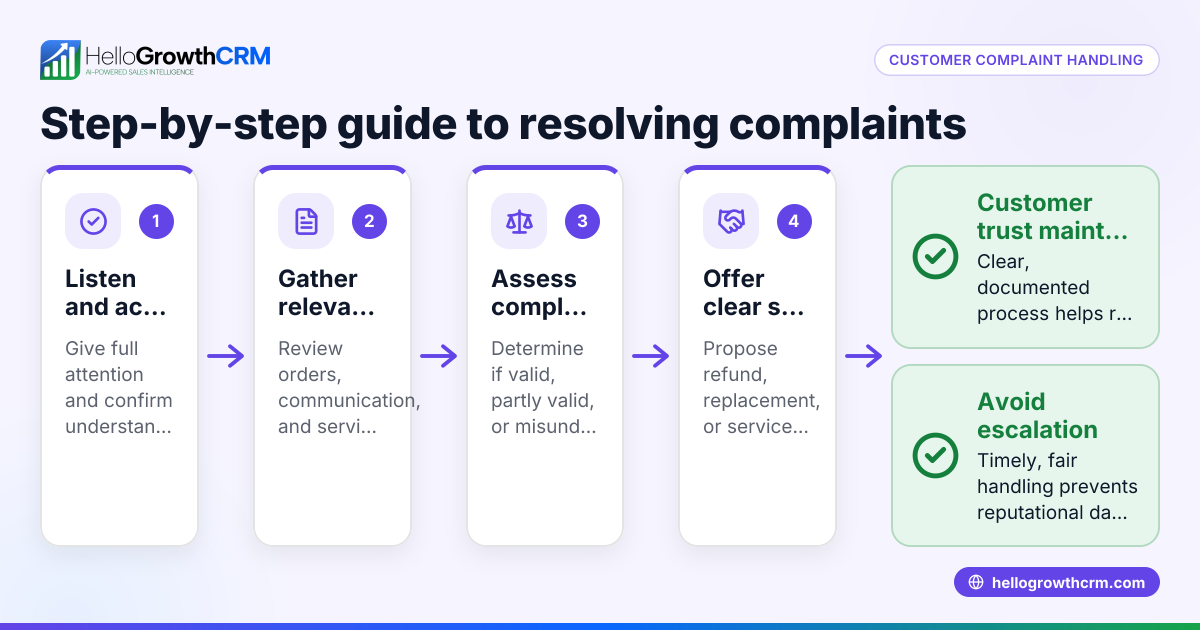
- Log every complaint clearly: Record the complaint details including customer name, contact, date, and issue description. Use a central system accessible by your team. Check that no complaint is missed or duplicated.
- Identify repeat complaints: Review complaint records weekly to spot customers or issues recurring more than once. Check if the problem relates to product, service, delivery, or communication.
- Analyse root causes: For repeat complaints, investigate what is causing the issue. This may involve speaking to staff, reviewing processes, or checking product quality. Confirm findings with evidence.
- Assign responsibility and deadlines: Allocate the complaint to a specific team member or department with a clear deadline for resolution. Check that the responsible party acknowledges and commits to the task.
- Respond promptly to customers: Contact the customer within 24 hours to acknowledge the complaint, explain the steps being taken, and provide an estimated resolution time. Check that communication is polite and clear.
- Implement corrective actions: Fix the root cause identified. This might mean product repair, staff training, process change, or refund. Check that the solution fully addresses the issue.
- Follow up with the customer: After resolution, contact the customer to confirm satisfaction and close the complaint. Check for any further concerns and offer assistance.
- Document resolution and feedback: Update the complaint record with actions taken and customer feedback. Check that this is visible to all relevant team members.
- Review trends monthly: Analyse complaint data for patterns and improvements needed in products or services. Check that findings lead to preventive measures.
- Train staff regularly: Use complaint cases to train your team on customer service and problem-solving. Check that training is documented.
Example (fictional figures)
A car rental company in Abu Dhabi receives a repeat complaint from a customer about late vehicle delivery.
- Complaint logged on 01/03/2024 with customer details and issue.
- Review shows this is the third similar complaint from the same customer in 3 months.
- Root cause found: delay in vehicle preparation due to staff shortage.
- Assigned to operations manager with a 7-day deadline.
- Customer contacted on 02/03/2024, informed of steps and apology.
- Staff hired and process improved by 10/03/2024.
- Customer contacted on 12/03/2024 to confirm satisfaction.
- Complaint marked resolved on 12/03/2024.
This example shows how following steps prevents further repeats and improves service.
Common mistakes
- Ignoring early complaints: Leads to escalation and repeats. Prevent by logging every complaint immediately.
- Poor communication: Customers feel neglected. Prevent by responding within 24 hours.
- No root cause analysis: Fixing symptoms not causes. Prevent by thorough investigation.
- Lack of accountability: Complaints get passed around. Prevent by assigning responsibility clearly.
- Not documenting resolutions: Causes repeated work. Prevent by updating complaint records.
- Failing to train staff: Same mistakes recur. Prevent by regular training sessions.
Doing this in HelloGrowthCRM
HelloGrowthCRM helps manage repeat customer complaints by keeping service requests linked to the same customer record as the deal. Its branded self-service customer portal allows customers to submit tickets directly, reducing delays. The tickets and knowledge base features help your team track, assign, and resolve complaints efficiently. Learn more about HelloGrowthCRM for the United Arab Emirates and its customer health score capabilities that support proactive service. The integrated WhatsApp and SMS CRM also streamlines communication for faster responses.
Frequently asked questions
How quickly should I respond to a repeat complaint? Respond within 24 hours to acknowledge the issue and inform the customer of your resolution plan. Prompt communication prevents frustration and shows professionalism.
What if the customer is still unhappy after resolution? Follow up again to understand their concerns and offer alternative solutions such as refunds or discounts. Document all interactions for future reference.
How can I identify if a complaint is a repeat? Maintain a central complaint log or CRM system and regularly review customer histories to spot recurring issues or customers.
Can I use WhatsApp to handle complaints effectively? Yes, using a CRM integrated with WhatsApp helps track conversations and ensures no complaint is lost or delayed, improving response times.
Why is root cause analysis important? It prevents the same problem from recurring by addressing the underlying issue rather than just the symptom.
Key takeaways
- Log every complaint in a central system accessible to your team.
- Identify repeat complaints through regular reviews.
- Analyse root causes and assign clear responsibility.
- Communicate promptly and follow up until resolved.
- Document resolutions and use data to prevent future issues.
- Use tools like HelloGrowthCRM’s customer portal and tickets for efficient complaint management.
Start managing repeat customer complaints effectively today by organising your process and using the right tools. To get started with a CRM that helps you track and resolve complaints seamlessly, Start on the Free Forever plan (200 leads, no credit card).
Ready to put this into practice?
Set up your pipeline, WhatsApp follow-ups, and AI lead scoring in minutes — free, no credit card.
Try HelloGrowthCRM freeGet CRM tips in your inbox
Join thousands of sales professionals who get weekly insights on CRM strategy, AI automation, and pipeline optimization.

The HelloGrowthCRM team publishes guides on CRM strategy, AI sales tools, and revenue operations for small business sales teams.