HelloGrowthCRM software
Built for real small-business sales teams
HelloGrowthCRM helps reps qualify faster, follow up on time, and close more deals—with practical automation in one place.
- AI lead scoring and pipeline visibility
- Built-in dialer, WhatsApp, and email automation
- Sales forecasting and RevOps-ready reporting
To set effective customer service SLA (Service Level Agreement) targets in Canada, you need to define measurable goals for response and resolution times that match your customers’ expectations and your team’s capacity. Then, track performance against these targets and refine them as your business grows. This article explains why SLA targets matter for small businesses, provides detailed steps to set them, includes a worked example with Canadian dollars, highlights common mistakes, and shows how HelloGrowthCRM can help manage service requests efficiently.
Why this comes up / what goes wrong
Many Canadian small business owners struggle with slow or inconsistent customer service because they don’t have clear SLA targets. Without these, customers wait too long for replies or issue resolution, leading to lost trust and sales. Often, service teams rely on informal methods like email or spreadsheets, which makes tracking SLA compliance difficult. Setting SLA targets helps you define what "good" service looks like, allocate resources properly, and improve customer satisfaction.
Step-by-step
- Identify customer service channels and request types
- List all channels your customers use (e.g., phone, email, WhatsApp).
- Categorize requests by type (e.g., product support, billing, complaints).
- Determine customer expectations for each request type
- Survey customers or use feedback to find acceptable response and resolution times.
- For example, urgent issues may require a response within 1 hour, routine questions within 24 hours.
- Assess your team’s capacity and resources
- Check how many requests your team can handle daily.
- Consider peak times and staffing levels.
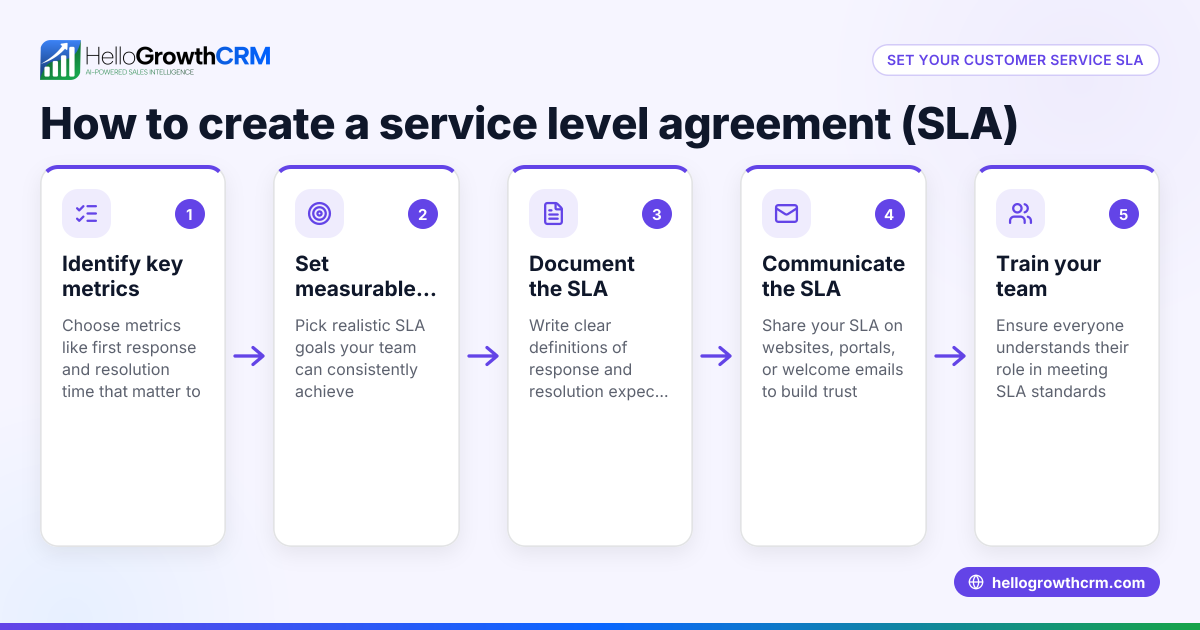
- Set measurable SLA targets
- Define response time targets (time to first reply).
- Define resolution time targets (time to close the request).
- Use clear time units (e.g., hours or business days).
- Document SLA targets clearly
- Write down targets in a service agreement or internal policy.
- Share with your team and customers.
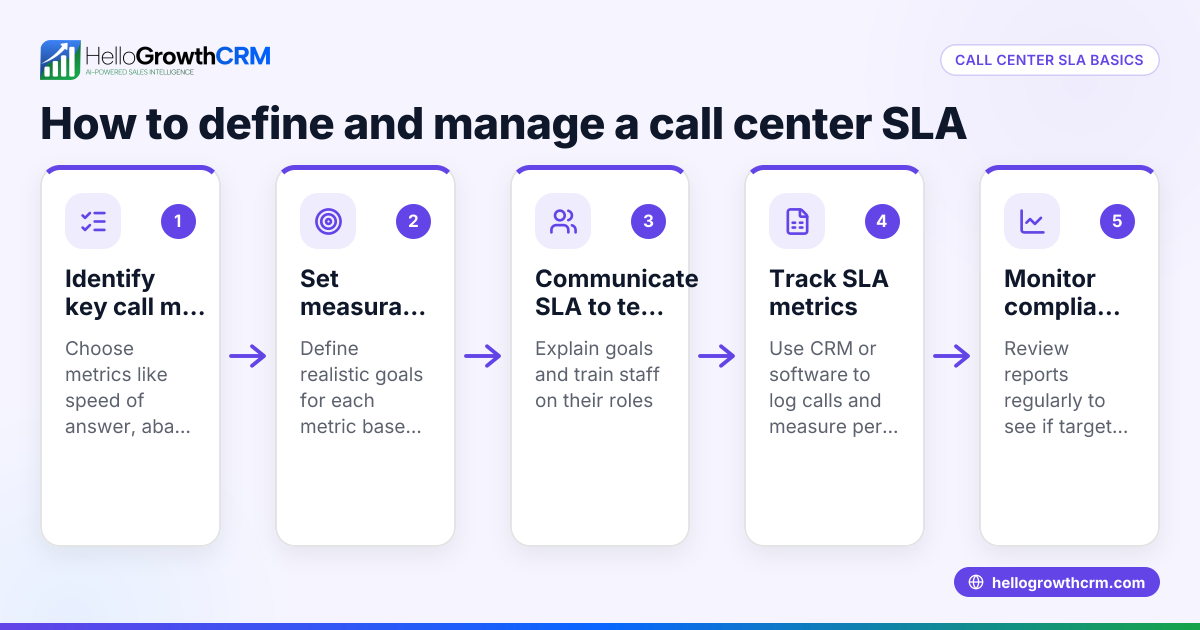
- Implement tracking and reporting tools
- Use software or spreadsheets to log request times and track SLA compliance.
- Monitor key metrics regularly.
- Review and adjust SLA targets periodically
- Analyze performance data monthly or quarterly.
- Adjust targets based on customer feedback and business changes.
- Communicate SLA commitments to customers
- Publish SLA targets on your website or customer portal.
- Set expectations during customer interactions.
For more on monitoring customer satisfaction and engagement, see customer health score.
Example (fictional figures)
An HVAC company in Surrey, British Columbia, wants to set SLA targets for its customer service team handling installation and repair requests.
- They receive about 100 service requests monthly.
- Customer feedback shows urgent repair requests should be answered within 2 hours and resolved within 24 hours.
- Installation inquiries can be answered within 24 hours and resolved within 3 business days.
Set targets:
- Urgent repair response time = 2 hours
- Urgent repair resolution time = 24 hours
- Installation inquiry response time = 24 hours
- Installation inquiry resolution time = 3 business days
Calculate capacity:
- Team works 8 hours/day, 5 days/week = 40 hours/week
- Average urgent repair requests = 40/month ≈ 10/week
- Average installation inquiries = 60/month ≈ 15/week
Check feasibility:
- Urgent repair: 10 requests × 2 hours response = 20 hours/week
- Installation: 15 requests × 1 hour response = 15 hours/week
Total response time needed = 20 + 15 = 35 hours/week, within 40-hour capacity.
Resolution times require follow-up work; ensure technicians’ schedules align.
Common mistakes
- Setting unrealistic targets: Avoid overly ambitious response times that your team cannot meet. Prevent by assessing actual workload and capacity.
- Not differentiating request types: Treating all requests the same ignores urgency differences. Prevent by categorizing and setting distinct SLAs.
- Lack of measurement: Without tracking SLA compliance, you won’t know if targets are met. Prevent by implementing tracking tools.
- Ignoring customer feedback: SLA targets should reflect customer expectations. Prevent by regularly gathering and incorporating feedback.
- Poor communication: Not sharing SLAs with customers or staff causes confusion. Prevent by documenting and publishing SLA policies.
- Using multiple disconnected tools: Managing SLAs across email, text, and spreadsheets leads to errors. Prevent by consolidating service requests in one system like HelloGrowthCRM.
See how SLA policies and support tickets work in HelloGrowthCRM for Canada.
Doing this in HelloGrowthCRM
HelloGrowthCRM helps small businesses manage customer service by keeping all service requests on the same customer record as the deal. Its branded self-service customer portal allows customers to submit tickets and access a knowledge base, reducing repetitive questions. Referral programme tracking and ticket management streamline service workflows. Using HelloGrowthCRM’s integrated tools helps your team meet SLA targets consistently. Learn more about the customer portal and ticket features at WhatsApp and SMS CRM.
Frequently asked questions
What is a good SLA target for customer service in Canada? Good SLA targets vary by industry and customer expectations. Many small businesses aim for first response times within 1-2 business hours for urgent issues and 24 hours for routine inquiries. Resolution times depend on issue complexity but often range from 24 hours to 3 business days. Adjust targets based on your capacity and customer feedback.
How do I measure if my SLA targets are being met? Track the timestamps of when a customer request is received, when the first response is sent, and when the issue is resolved. Calculate the time differences and compare them to your SLA targets. Use software tools or CRM systems to automate this tracking and generate reports.
Can I change SLA targets after setting them? Yes, SLA targets should be reviewed regularly and adjusted based on performance data, customer feedback, and changes in business capacity. Continuous improvement helps maintain realistic and effective service levels.
How do SLAs improve customer satisfaction? SLAs set clear expectations for response and resolution times, which builds trust with customers. Meeting or exceeding SLA targets shows reliability, reduces frustration, and encourages repeat business.
What if I don’t have enough staff to meet SLA targets? Consider prioritizing urgent requests, using a knowledge base to reduce repetitive tickets, or consolidating service requests in one system like HelloGrowthCRM to streamline ticket handling. Adjust SLA targets to realistic levels while planning to scale your team as needed.
See also customer health score for customer engagement tracking.
Key takeaways
- Define SLA targets based on customer needs and team capacity.
- Categorize requests by type and urgency for tailored SLAs.
- Track response and resolution times to measure SLA compliance.
- Communicate SLA commitments clearly to customers and staff.
- Review and adjust SLA targets regularly for continuous improvement.
- Use integrated CRM tools like HelloGrowthCRM to manage service requests efficiently.
Start setting your SLA targets today to improve customer service and satisfaction. Start on the Free Forever plan (200 leads, no credit card).
Ready to put this into practice?
Set up your pipeline, WhatsApp follow-ups, and AI lead scoring in minutes — free, no credit card.
Try HelloGrowthCRM freeGet CRM tips in your inbox
Join thousands of sales professionals who get weekly insights on CRM strategy, AI automation, and pipeline optimization.

The HelloGrowthCRM team publishes guides on CRM strategy, AI sales tools, and revenue operations for small business sales teams.