HelloGrowthCRM software
Built for real small-business sales teams
HelloGrowthCRM helps reps qualify faster, follow up on time, and close more deals—with practical automation in one place.
- AI lead scoring and pipeline visibility
- Built-in dialer, WhatsApp, and email automation
- Sales forecasting and RevOps-ready reporting
Tracking where your customers come from is essential to understand which marketing or sales efforts work best. Many small and mid-sized UK businesses struggle because they collect leads from multiple places—like web forms, WhatsApp, or referrals—but don’t record the source consistently. This leads to lost insights and wasted budget.
Why this comes up / what goes wrong
A small business owner in the UK might run campaigns on social media, Google ads, and offline events, but if the team only notes customer details without the acquisition source, it’s impossible to know which channel delivers the best return. Often, leads come in via WhatsApp messages or emails, and sales teams manually track them in spreadsheets or WhatsApp chats. This creates fragmented data and slow follow-up.
Without tracking acquisition sources, businesses can’t prioritise marketing spend or improve sales strategies. They also miss out on spotting referral opportunities or understanding the customer journey.
Step-by-step
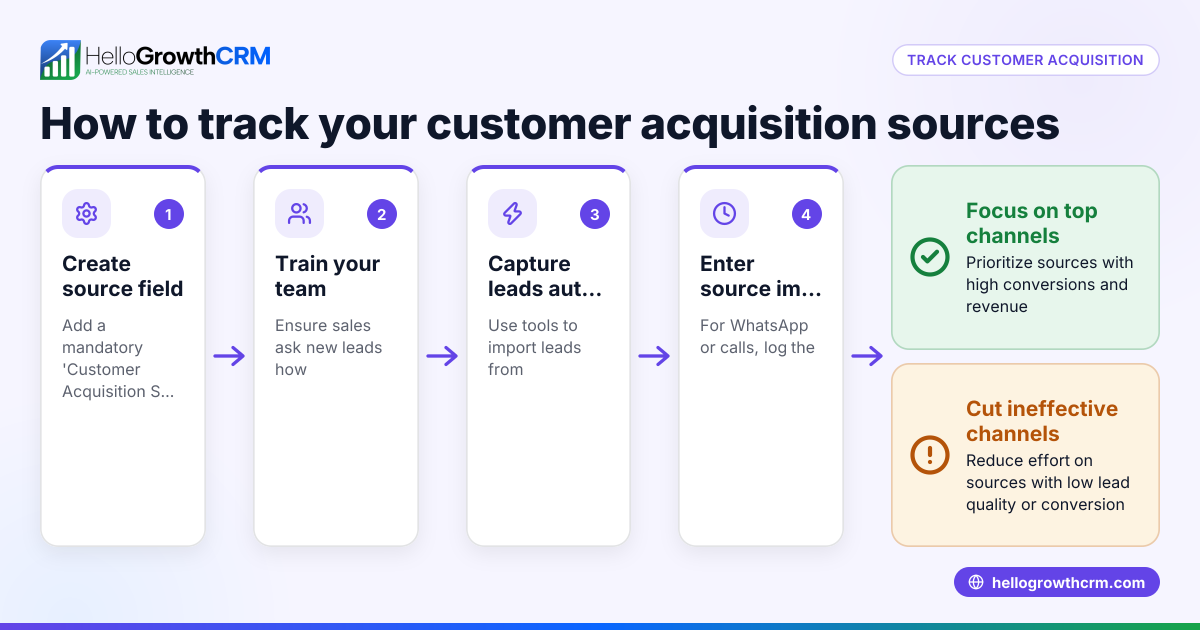
- Define your acquisition sources clearly: List all possible sources such as Google Ads, Facebook, referrals, website forms, WhatsApp enquiries, events, and email campaigns.
- Add source fields to your lead capture forms: Whether on your website or in manual intake forms, include a mandatory field like "How did you hear about us?" or "Acquisition source".
- Train your sales and marketing teams: Ensure every team member asks for and records the acquisition source at first contact. For WhatsApp and email leads, create a standard question script.
- Use a centralised system to record leads: Avoid spreadsheets by entering leads into a CRM or database with source tracking fields. This keeps all data in one place for easy reporting.
- Regularly audit your data: Weekly or monthly, check the acquisition source entries for accuracy and completeness. Follow up on missing or unclear entries.
- Analyse your data: Use reports to compare lead volume, conversion rates, and revenue by source. This will guide your marketing and sales focus.
- Adjust your marketing spend and sales efforts: Invest more in high-performing channels and improve or drop poor ones.
- Link acquisition sources to customer health: Track how customers from each source perform over time to spot trends in retention or upselling potential. Customer health score tools can help here.
Example (fictional figures)
A recruitment consultancy in Bristol wants to track where its new clients come from during April 2024.
- They identify three main sources: Google Ads, referrals, and LinkedIn.
- They add an "Acquisition source" field to their web form and train their team to ask all new leads.
- In April, they record:
- 30 leads from Google Ads
- 15 leads from referrals
- 5 leads from LinkedIn
Conversions:
- Google Ads: 30 leads × 20% conversion = 6 clients
- Referrals: 15 leads × 40% conversion = 6 clients
- LinkedIn: 5 leads × 10% conversion = 0.5 client (round to 1 for simplicity)
Revenue per client:
- Google Ads: £10,000
- Referrals: £15,000
- LinkedIn: £12,000
Calculate revenue by source:
- Google Ads: 6 × £10,000 = £60,000
- Referrals: 6 × £15,000 = £90,000
- LinkedIn: 1 × £12,000 = £12,000
Total revenue = £60,000 + £90,000 + £12,000 = £162,000
From this, the consultancy sees referrals bring the highest revenue despite fewer leads, so they decide to enhance their referral programme.
Common mistakes
- Not asking for acquisition source: Always ask at first contact to avoid guesswork. Train your team and automate prompts.
- Using inconsistent source names: Standardise source names to avoid duplicates like “Google”, “Google Ads”, or “Google PPC”. Use dropdowns where possible.
- Tracking sources only on web forms: Include offline and WhatsApp leads by asking and recording sources manually.
- Storing data in multiple disconnected places: Use a CRM to centralise data and improve follow-up speed. This avoids lost leads and errors.
- Ignoring data audits: Regularly check your source data for missing or incorrect entries to keep reports reliable.
- Not linking acquisition sources to customer outcomes: Track how leads from each source perform post-sale using tools like customer health score.
Doing this in HelloGrowthCRM
HelloGrowthCRM helps you track customer acquisition sources by keeping all customer interactions—including referrals, support tickets, and service requests—on the same customer record as the deal. Its customer portal supports referral programme tracking and enables self-service, making it easier to capture and manage acquisition data in one place. See more about how HelloGrowthCRM supports UK businesses at HelloGrowthCRM for the United Kingdom.
Frequently asked questions
How can I track acquisition sources from WhatsApp leads? Ask your sales team to record the acquisition source during the first WhatsApp conversation. Use a CRM that supports WhatsApp and SMS CRM features to log the source directly with the lead record. This avoids losing track of where the lead originated. See WhatsApp and SMS CRM for more.
What if customers don’t remember how they found us? If a customer is unsure, try to deduce the source based on timing or context, but mark it as "Unknown" rather than guessing. Encourage teams to capture source data as early as possible to reduce this problem.
Can I track offline acquisition sources? Yes. For offline leads from events or referrals, train your team to ask and record the source manually in your CRM or lead tracking system.
Why is it important to link acquisition sources to customer health? Knowing how customers from each source perform over time helps you focus on channels that bring not just leads but valuable, loyal customers. HelloGrowthCRM’s customer health score tools support this insight.
How often should I review acquisition source data? Review source data at least monthly to spot trends and adjust marketing spend or sales efforts promptly.
Key takeaways
- Always capture acquisition source at first contact using clear, standardised fields.
- Train teams and use centralised systems to avoid lost or fragmented data.
- Regularly audit and analyse source data to guide marketing and sales decisions.
- Link acquisition sources to customer health and revenue outcomes.
- Use tools like HelloGrowthCRM to keep all customer and acquisition data in one place.
Start tracking your customer acquisition sources today to improve your sales focus and marketing spend. To try this with a CRM that supports referrals, tickets and customer portals, start on the Free Forever plan (200 leads, no credit card).
Ready to put this into practice?
Set up your pipeline, WhatsApp follow-ups, and AI lead scoring in minutes — free, no credit card.
Try HelloGrowthCRM freeGet CRM tips in your inbox
Join thousands of sales professionals who get weekly insights on CRM strategy, AI automation, and pipeline optimization.

The HelloGrowthCRM team publishes guides on CRM strategy, AI sales tools, and revenue operations for small business sales teams.