HelloGrowthCRM software
Built for real small-business sales teams
HelloGrowthCRM helps reps qualify faster, follow up on time, and close more deals—with practical automation in one place.
- AI lead scoring and pipeline visibility
- Built-in dialer, WhatsApp, and email automation
- Sales forecasting and RevOps-ready reporting
Tracking where your customers come from helps you understand which marketing efforts work and which don’t. Many small US businesses lose leads or waste budget because they don’t track acquisition sources clearly. You might run sales over texts, emails, or spreadsheets, making it hard to connect the dots.
Why this comes up / what goes wrong
Small business owners often get leads from multiple channels—social media, Google ads, referrals, or walk-ins. Without a clear process, it’s easy to lose track of which channel brought the lead. This leads to inaccurate marketing spend decisions and missed growth opportunities. Tracking customer acquisition sources lets you focus on channels that bring the best leads and improve your sales follow-up.
Step-by-step
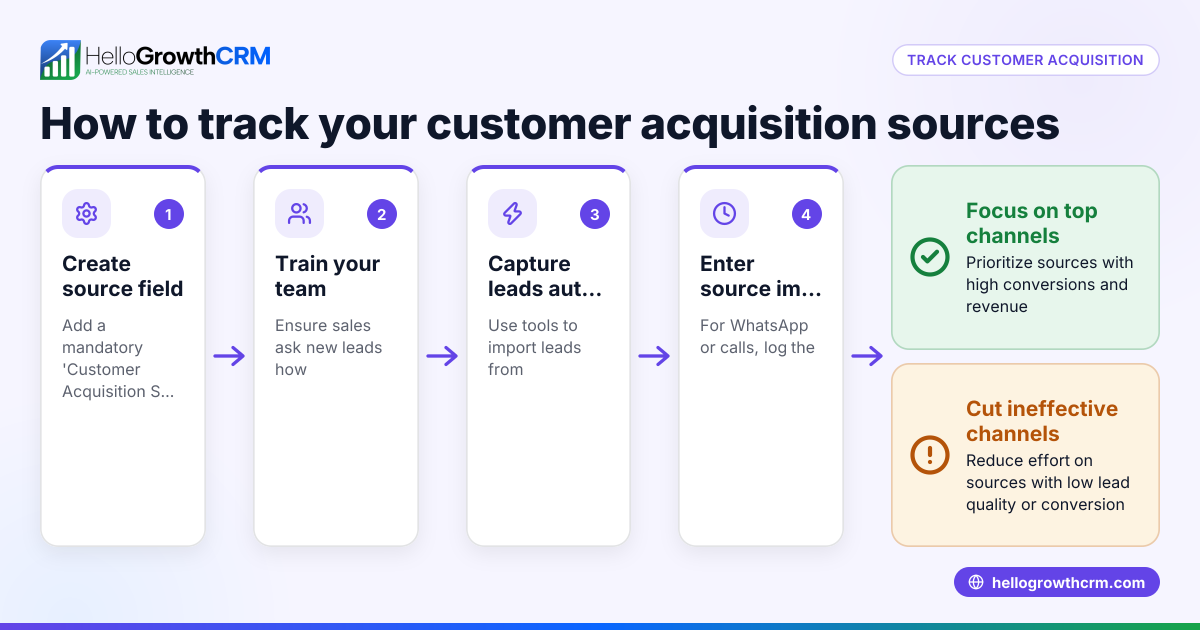
- Define your acquisition sources: List all the ways customers might find you, such as Facebook ads, Google search, referrals, website contact form, cold calls, or events.
- Add source fields to your lead capture: Whether on web forms, phone scripts, or email templates, include a field or question asking "How did you hear about us?" or use tracking parameters (e.g., UTM tags) on links.
- Record the source with each lead: Enter this source data into your CRM or spreadsheet immediately when a lead comes in.
- Use consistent naming: Standardize source names (e.g., always use "Google Ads" not "Google" or "AdWords") to avoid confusion.
- Track offline sources carefully: For walk-ins or phone calls, train your team to ask and record the source.
- Review and update sources regularly: Every month, check your list of sources to add new ones or remove inactive channels.
- Analyze conversion by source: Compare how many leads from each source turn into customers and the revenue they generate.
- Adjust marketing spend based on data: Shift budget to sources that bring high-quality leads.
- Keep source data linked to customer records: This helps with later customer service and referral tracking.
- Use technology to automate: Use a CRM that captures source data from web forms and integrates with your communication channels for accuracy.
Example (fictional figures)
A landscaping contractor in Charlotte, North Carolina, wants to track customer acquisition for Q1 2024.
- Total leads in Q1: 120
- Sources recorded:
- Google Ads: 50 leads
- Facebook Ads: 30 leads
- Referrals: 25 leads
- Website Contact Form (Organic): 15 leads
Conversion rates:
- Google Ads: 50 leads × 20% conversion = 10 customers
- Facebook Ads: 30 leads × 10% conversion = 3 customers
- Referrals: 25 leads × 40% conversion = 10 customers
- Website Contact Form: 15 leads × 15% conversion = 2 customers
Revenue per customer (average): $3,000
Revenue by source:
- Google Ads: 10 × $3,000 = $30,000
- Facebook Ads: 3 × $3,000 = $9,000
- Referrals: 10 × $3,000 = $30,000
- Website Contact Form: 2 × $3,000 = $6,000
This shows referrals and Google Ads bring equal revenue, but referrals convert better. The contractor can decide to invest more in referral programs and optimize Facebook Ads.
Common mistakes
- Not asking the source consistently: Prevent this by making source a mandatory field on all lead forms and phone scripts.
- Using inconsistent source names: Standardize naming conventions and train your team.
- Ignoring offline leads: Always ask walk-ins or phone callers and record their source.
- Not linking source data to customer records: Keep all data in one place to track lifetime value and referrals. See how HelloGrowthCRM keeps service requests on the same customer record as the deal for better tracking.
- Failing to analyze and act on data: Set a monthly review to adjust marketing spend based on source performance.
- Relying on spreadsheets without automation: Use tools like HelloGrowthCRM to capture and analyze sources automatically.
Doing this in HelloGrowthCRM
HelloGrowthCRM helps you keep all customer information in one place with its customer portal, referrals, tickets, and knowledge base. After the sale, service requests stay on the same customer record as the deal, ensuring you always know the original acquisition source and can track ongoing customer interactions. Learn more about the customer health score and how HelloGrowthCRM supports US businesses on HelloGrowthCRM for the United States. The platform also integrates WhatsApp and SMS for smooth communication: see WhatsApp and SMS CRM.
Frequently asked questions
How do I track customer acquisition sources without a CRM? You can use spreadsheets to record each lead’s source, but it requires consistent manual entry and regular review. Always ask leads how they found you and keep a dedicated column for source information.
What are the best acquisition sources for small businesses in the US? This depends on your industry and target market. Common sources include Google Ads, social media, referrals, and organic search. Tracking lets you identify which work best for your business.
How often should I review customer acquisition data? Review your data monthly to spot trends and adjust marketing spend accordingly. This keeps your strategy responsive and efficient.
Can I track offline leads like phone calls or walk-ins? Yes, train your team to ask where the lead heard about you and record it immediately. This data is as important as online sources.
What is the benefit of linking acquisition sources to customer service? Linking sources to customer records helps track the full customer journey, including referrals and repeat business. HelloGrowthCRM keeps service requests on the same record as the original deal for this reason.
Key takeaways
- Always collect and record customer acquisition sources at first contact.
- Use consistent naming and train your team to ask and log sources.
- Track both online and offline leads for a full picture.
- Regularly analyze source performance to optimize marketing spend.
- Link source data to customer records for better service and referral tracking.
- Consider using HelloGrowthCRM to automate and centralize tracking.
Start tracking your customer acquisition sources today to improve sales focus and grow your business. Start on the Free Forever plan (200 leads, no credit card).
Ready to put this into practice?
Set up your pipeline, WhatsApp follow-ups, and AI lead scoring in minutes — free, no credit card.
Try HelloGrowthCRM freeGet CRM tips in your inbox
Join thousands of sales professionals who get weekly insights on CRM strategy, AI automation, and pipeline optimization.

The HelloGrowthCRM team publishes guides on CRM strategy, AI sales tools, and revenue operations for small business sales teams.