HelloGrowthCRM software
Built for real small-business sales teams
HelloGrowthCRM helps reps qualify faster, follow up on time, and close more deals—with practical automation in one place.
- AI lead scoring and pipeline visibility
- Built-in dialer, WhatsApp, and email automation
- Sales forecasting and RevOps-ready reporting
Tracking solar project sales leads in the USA means capturing every lead inquiry, assigning responsibility, and moving leads through defined sales stages with follow-ups. This ensures no opportunity is lost due to overlooked or delayed responses. The following sections explain why this is important, how to do it step-by-step, provide an example with calculations, highlight common mistakes, and show how HelloGrowthCRM supports this process.
Why this comes up / what goes wrong
Small business owners and solar sales teams often struggle to track leads because inquiries come from multiple channels like web forms, calls, WhatsApp, or email. Without a system, leads get scattered in notebooks, spreadsheets, or text messages. This causes slow follow-up, lost leads, and miscommunication. Solar projects typically require detailed qualification such as project size, location, and budget, which can be missed without structured tracking. Sales teams also need to prioritize leads most likely to convert and keep track of quotations and follow-up dates.
Step-by-step
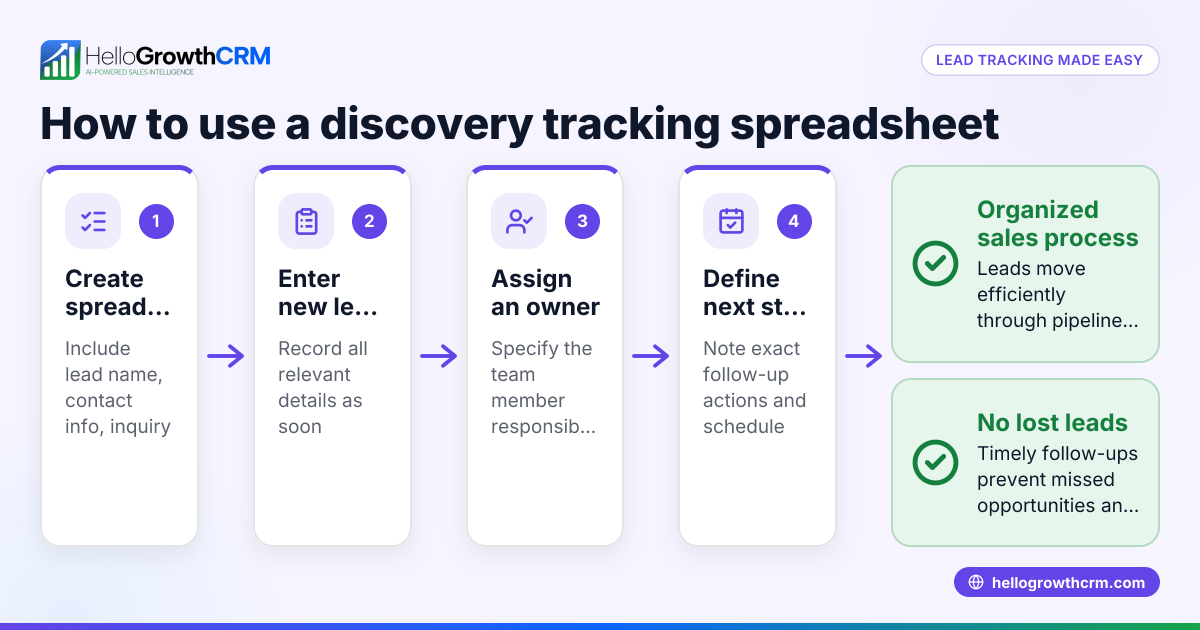
- Capture every lead inquiry: Record all incoming leads from web forms, phone calls, WhatsApp messages, or emails. Include contact info, project details (e.g., location, size in kW), and inquiry date.
- Assign a lead owner: Designate a specific salesperson responsible for each lead to ensure accountability.
- Qualify the lead: Check key details like solar system size, budget range, and installation timeline to assess if the lead fits your service.
- Enter the lead into a sales pipeline: Use stages such as New Lead, Contacted, Quote Sent, Negotiation, and Closed (Won/Lost).
- Set next steps and follow-up dates: For example, schedule a call or site visit within 3 days of initial contact.
- Prioritize leads: Focus on leads with higher potential value or readiness to buy first.
- Track quotations and proposals: Record when a quote is sent and set reminders to follow up.
- Update lead status regularly: Move leads through stages as progress happens or mark as lost if no response after attempts.
- Review pipeline weekly: Check for stalled leads and overdue follow-ups to stay on top of sales activity.
- Analyze sales data: Track conversion rates, average deal size, and sales cycle length to improve processes.
Example (fictional figures)
Solar Solutions AZ, a residential solar installer in Phoenix, Arizona, receives a lead on 04/10/2024 from a web form. The lead is for a 7 kW system installation.
- Lead capture: Contact info and project size recorded.
- Lead owner assigned: Sales rep John.
- Qualification: Budget $18,000; timeline 2 months.
- Pipeline stage: New Lead.
- Next step: Schedule a call by 04/13/2024.
John calls on 04/12/2024 and moves the lead to Contacted.
A quote is prepared and sent on 04/15/2024 for $17,500.
- Pipeline stage updated to Quote Sent.
- Follow-up set for 04/20/2024.
On 04/20/2024, John follows up; the client agrees to proceed.
- Pipeline stage moved to Closed Won.
Sales value calculation:
$17,500 (quoted price) × 1 (probability at Closed Won) = $17,500 expected revenue.
This process ensures no step is missed, and the lead is tracked from first contact to closing.
Common mistakes
- Not capturing all lead details upfront: Prevent by using a standard form or checklist to gather essential info at first contact.
- Failing to assign lead ownership: Prevent by clearly assigning each lead to a specific salesperson immediately.
- Ignoring follow-up scheduling: Prevent by setting automatic reminders for follow-up dates.
- Using scattered tracking methods (not centralized): Prevent by consolidating leads into one system or spreadsheet.
- Not prioritizing leads by potential: Prevent by qualifying leads and focusing on those with higher conversion likelihood first using tools like AI lead scoring.
- Forgetting to update lead status: Prevent by reviewing the sales pipeline regularly.
Doing this in HelloGrowthCRM
HelloGrowthCRM helps by capturing every enquiry from forms, calls, or WhatsApp as a lead with an owner and a next step, avoiding lost notes. Its AI lead scoring lets telecallers prioritize calling leads most likely to convert first. The Deals (pipeline) feature tracks opportunities from first contact through closing, showing quotations sent with follow-up dates so nothing is forgotten. Learn more about WhatsApp and SMS CRM and HelloGrowthCRM for the United States.
Frequently asked questions
How can I prioritize solar project leads effectively? Prioritize leads by qualifying key factors like budget, project size, and installation timeline. Using AI lead scoring tools can help rank leads by likelihood to convert, so sales teams call the best leads first.
What details should I capture for each solar project lead? Capture contact information, project location, system size in kW, budget range, installation timeline, and source of the lead. These details help qualify and prioritize leads.
How often should I follow up on solar leads? Follow-up should be scheduled within a few days after initial contact, then regularly based on the sales pipeline stage. Setting reminders prevents leads from going cold.
What is the best way to avoid losing leads in solar sales? Use a centralized system to capture and track every lead with assigned owners and next steps. Regularly review your pipeline to keep leads moving forward.
Can I track solar leads coming from WhatsApp messages? Yes, using CRM tools that integrate WhatsApp messages directly into the lead pipeline ensures no inquiry is missed or delayed.
Key takeaways
- Capture all solar project inquiries with key details immediately.
- Assign each lead a specific owner and set clear next steps.
- Use a sales pipeline to track lead stages and follow-up dates.
- Prioritize leads by potential using qualification or AI lead scoring.
- Review and update your pipeline regularly to avoid lost leads.
- Centralized tracking prevents missed opportunities and improves sales efficiency.
Start tracking your solar project sales leads today with an organized system. You can Start on the Free Forever plan (200 leads, no credit card) to try HelloGrowthCRM and manage your leads efficiently.
Ready to put this into practice?
Set up your pipeline, WhatsApp follow-ups, and AI lead scoring in minutes — free, no credit card.
Try HelloGrowthCRM freeGet CRM tips in your inbox
Join thousands of sales professionals who get weekly insights on CRM strategy, AI automation, and pipeline optimization.

The HelloGrowthCRM team publishes guides on CRM strategy, AI sales tools, and revenue operations for small business sales teams.