HelloGrowthCRM software
Built for real small-business sales teams
HelloGrowthCRM helps reps qualify faster, follow up on time, and close more deals—with practical automation in one place.
- AI lead scoring and pipeline visibility
- Built-in dialer, WhatsApp, and email automation
- Sales forecasting and RevOps-ready reporting
An incident management KPI (Key Performance Indicator) measures how effectively your business identifies, responds to, and resolves incidents such as IT outages, customer complaints, or operational issues. This helps you improve response times, reduce downtime, and increase customer satisfaction. This article explains why incident management KPIs matter, the key metrics to track, step-by-step guidance on implementing them, and common mistakes to avoid.
Why this comes up / what goes wrong
Small business owners often face unexpected issues that disrupt operations—like a website crash, a payment system failure, or a key employee absence. Without clear KPIs, it’s hard to measure how well your team handles these incidents. This can lead to slow responses, unresolved problems, frustrated customers, and lost revenue. You may find your team juggling incident details in notebooks, text messages, or spreadsheets, which slows follow-up and hides bottlenecks.
Tracking incident management KPIs helps you pinpoint delays, improve teamwork, and keep customers informed. For example, if your average incident resolution time is too long, you can assign more resources or improve communication. Without KPIs, you rely on guesswork instead of data to improve.
Step-by-step
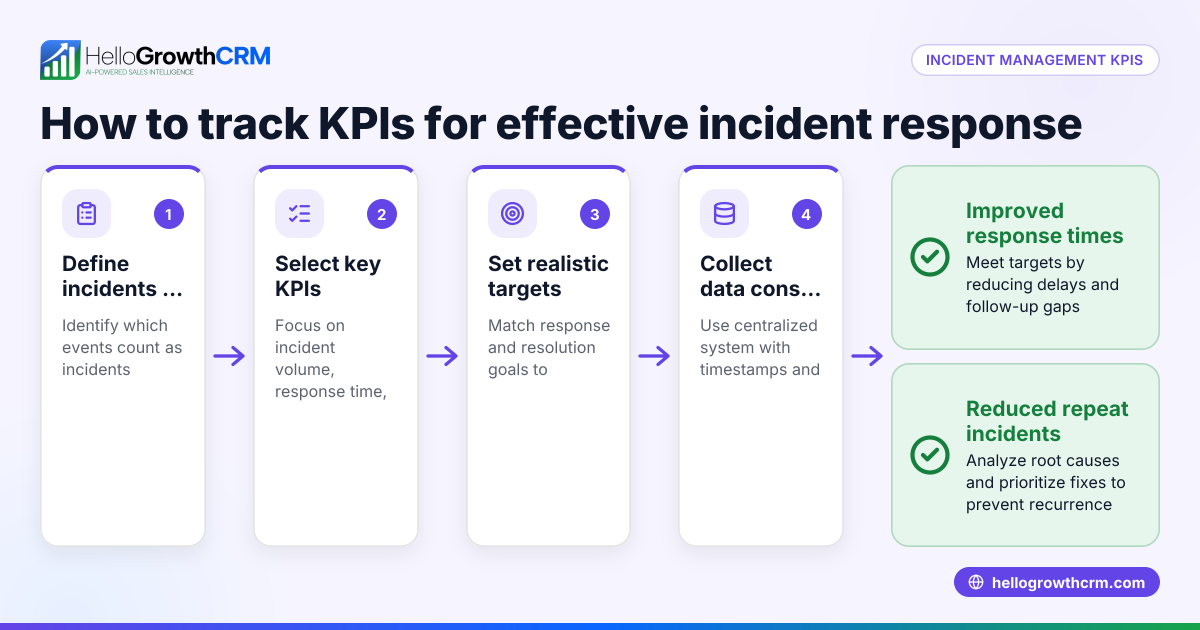
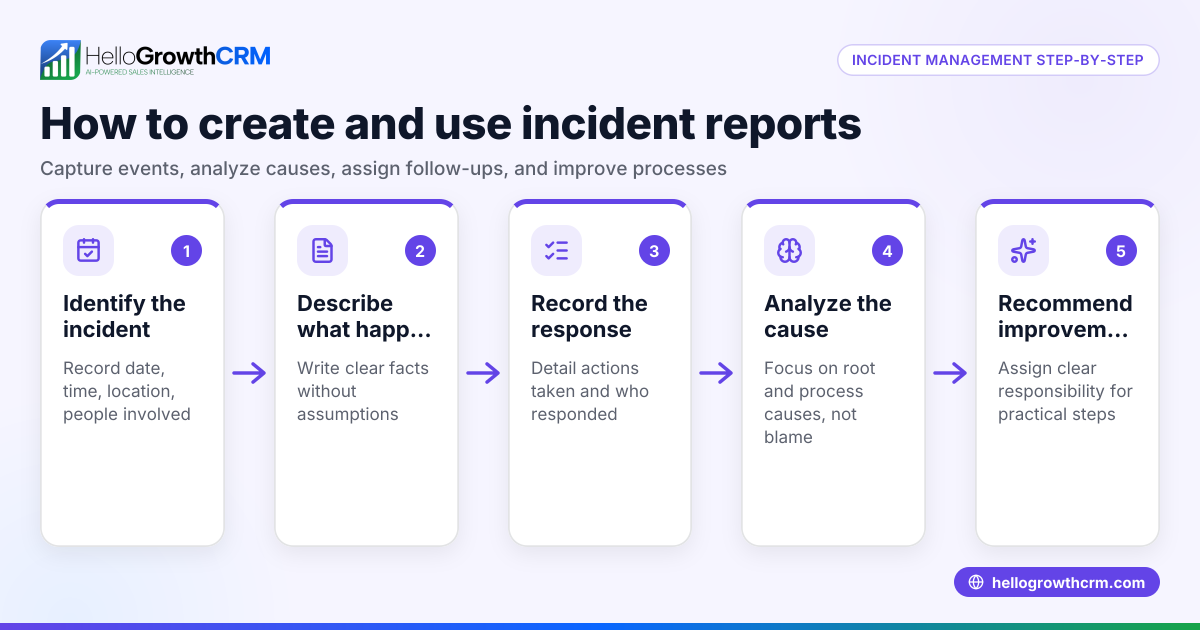
- Define what counts as an incident: Decide which issues need tracking. Examples include IT outages, customer complaints, or safety hazards. Check that your team agrees on these definitions.
- Choose your KPIs: Common incident management KPIs include:
- Incident response time: Time from incident report to first action.
- Incident resolution time: Time from report to full resolution.
- Number of incidents by type.
- Percentage of incidents resolved within target time.
- Customer satisfaction after incident.
- Set targets for each KPI: Define realistic goals based on your business size and complexity. For example, resolve 90% of incidents within 24 hours.
- Collect data consistently: Use a system to log every incident with timestamps, responsible team members, and actions taken. Avoid notebooks or spreadsheets that can be lost or delayed.
- Review KPIs regularly: Weekly or monthly, analyze your data to find trends or recurring issues. Check if you meet your targets and identify bottlenecks.
- Take action to improve: If KPIs show delays, assign clear owners to incidents, improve communication channels, or provide training.
- Communicate results: Share KPI reports with your team and stakeholders to promote accountability and continuous improvement.
Example (fictional figures)
A two-location dental practice in Columbus, Ohio, tracks incident management KPIs for IT system outages affecting appointment bookings.
- In March 2026, they logged 10 incidents.
- Average response time: 30 minutes.
- Average resolution time: 4 hours.
- Target resolution time: 3 hours.
- Customer satisfaction score after incidents: 80% positive.
Calculations:
Total response time = 10 incidents × 30 minutes = 300 minutes Average response time = 300 minutes ÷ 10 = 30 minutes
Total resolution time = 10 incidents × 4 hours = 40 hours Average resolution time = 40 hours ÷ 10 = 4 hours
Resolution time target = 3 hours
They missed the resolution target by 1 hour on average (4 hours - 3 hours = 1 hour). This shows the need to speed up fixes.
Common mistakes
- Not defining incidents clearly: Prevent this by agreeing on what counts as an incident upfront.
- Using manual or scattered tracking methods: Prevent by centralizing data collection in one system instead of notebooks or spreadsheets. HelloGrowthCRM leads capture can help here.
- Ignoring KPIs after setting them: Prevent by scheduling regular KPI reviews.
- Setting unrealistic targets: Prevent by basing targets on past performance and business capacity.
- Failing to assign ownership: Prevent by designating a responsible person for every incident.
- Not communicating results: Prevent by sharing KPI reports with your team.
Doing this in HelloGrowthCRM
HelloGrowthCRM helps you capture every incident-related inquiry or report as a lead with an owner and a next step, instead of losing details in notebooks or scattered messages. This keeps your incident data organized and actionable, improving follow-up speed and accountability. Learn more about HelloGrowthCRM for the United States and its WhatsApp and SMS CRM features that support quick communication. The built-in CRM dialer also helps you reach team members or customers fast during incidents.
Frequently asked questions
What is an incident management KPI? An incident management KPI is a measurable value that shows how well your business handles incidents, from detection to resolution. It helps you track response speed, resolution effectiveness, and customer impact.
Why are incident management KPIs important for small businesses? They provide data to improve how your team handles disruptions. Without KPIs, you risk slow fixes, unhappy customers, and repeated problems.
How do I start tracking incident management KPIs? Begin by defining incidents, choosing relevant KPIs, setting targets, and using a consistent system to log incidents. Regularly review the data to improve processes.
Can HelloGrowthCRM help with incident management? Yes, by capturing every inquiry or report as a lead with an owner and a next step, HelloGrowthCRM keeps incident details organized and speeds up follow-up.
What are common KPIs to track? Incident response time, resolution time, number of incidents, resolution rate within targets, and customer satisfaction are key KPIs.
Key takeaways
- Incident management KPIs measure how effectively your business handles issues.
- Define incidents clearly and choose KPIs like response and resolution times.
- Use a centralized system to track incidents and assign ownership.
- Review KPIs regularly and act on findings to improve.
- HelloGrowthCRM helps capture and organize incident reports as leads with owners and next steps.
Start tracking your incident management KPIs today to reduce downtime and improve customer satisfaction. To get started, try HelloGrowthCRM’s Free Forever plan (200 leads, no credit card).
Ready to put this into practice?
Set up your pipeline, WhatsApp follow-ups, and AI lead scoring in minutes — free, no credit card.
Try HelloGrowthCRM freeGet CRM tips in your inbox
Join thousands of sales professionals who get weekly insights on CRM strategy, AI automation, and pipeline optimization.

The HelloGrowthCRM team publishes guides on CRM strategy, AI sales tools, and revenue operations for small business sales teams.