HelloGrowthCRM software
Built for real small-business sales teams
HelloGrowthCRM helps reps qualify faster, follow up on time, and close more deals—with practical automation in one place.
- AI lead scoring and pipeline visibility
- Built-in dialer, WhatsApp, and email automation
- Sales forecasting and RevOps-ready reporting
KPIs for incident management are measurable indicators that help small and mid-sized businesses assess how effectively they handle unexpected problems or disruptions. These KPIs focus on the speed and quality of incident detection, response, and resolution to reduce negative impact on customers and operations.
Why this comes up / what goes wrong
Small-business owners often struggle to keep track of incidents because they rely on informal tools like text messages, email, and spreadsheets. Without clear KPIs, incidents may be overlooked, response times delayed, or problems unresolved. This can erode customer trust, increase costs, and lower team productivity. Especially for businesses without dedicated incident managers, missing or slow follow-up on incidents is common.
Step-by-step
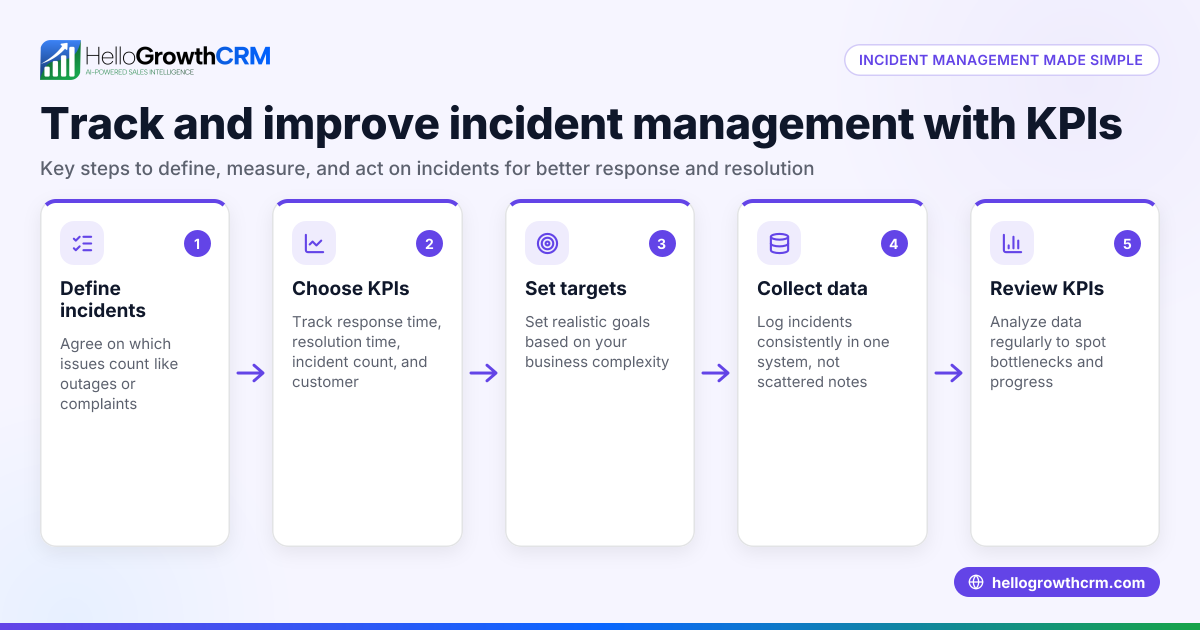
- Define what counts as an incident: Identify the types of events you want to track, such as customer complaints, equipment failures, or safety hazards. Confirm your team understands this definition clearly.
- Select key KPIs to measure: Typical KPIs include:
- Incident volume: total number of incidents reported.
- Incident response time: time from report to first action.
- Incident resolution time: time from report to full fix.
- Repeat incidents: number of incidents recurring within a timeframe.
- Incident backlog: number of unresolved incidents at a point. Check that you can collect data for these KPIs with your current tools.
- Set realistic targets for each KPI: For example, aim to respond to most incidents promptly and resolve a high percentage within a reasonable timeframe. Ensure targets match your team’s capacity.
- Collect incident data consistently: Use a centralized system to log incidents with timestamps and status updates. Verify data accuracy regularly.
- Review KPIs regularly: Analyze trends weekly or monthly to spot bottlenecks or recurring issues. Adjust your processes based on findings.
- Assign ownership and communicate results: Designate team members responsible for each incident. Share KPI reports to keep everyone informed and involved.
Using a CRM like HelloGrowthCRM can help you capture every enquiry or incident from forms, calls, or WhatsApp as a lead with an owner and a next step, instead of losing them in notes. Managed RevOps support can keep your follow-up queue active even without a dedicated sales manager. Learn more about HelloGrowthCRM for the United States, its WhatsApp and SMS CRM, and built-in CRM dialer.
Example (fictional figures)
A residential real-estate team in Phoenix, Arizona, tracks incidents related to client property issues reported through WhatsApp and email. In March 2026, they recorded 50 incidents.
- Incident volume = 50
- Target response time = 30 minutes
- Actual average response time = 45 minutes
- Target resolution time = 24 hours
- Actual average resolution time = 30 hours
- Repeat incidents = 5
- Incident backlog at month end = 3
Calculations:
Total response minutes = 45 minutes × 50 incidents = 2,250 minutes Average response time = 2,250 minutes ÷ 50 incidents = 45 minutes
Total resolution hours = 30 hours × 50 incidents = 1,500 hours Average resolution time = 1,500 hours ÷ 50 incidents = 30 hours
They identify a need to reduce response time by 15 minutes to meet targets and plan process improvements accordingly.
Common mistakes
- Unclear incident definitions: Prevent by documenting what qualifies as an incident and training your team.
- Tracking too many KPIs at once: Focus on 3-5 relevant KPIs to avoid data overload.
- Manual tracking prone to errors: Use a CRM or digital tool to capture incidents automatically and reduce mistakes.
- Ignoring repeat incidents: Analyze root causes and implement fixes to prevent recurrence.
- Failing to assign ownership: Designate responsible team members for follow-up and resolution.
- Skipping regular KPI reviews: Schedule weekly or monthly reviews to monitor progress and adjust.
To avoid these mistakes, consider systems like HelloGrowthCRM that organize leads and incidents with assigned owners and next steps, and offer Managed RevOps support for consistent follow-up. See more at HelloGrowthCRM for the United States.
Doing this in HelloGrowthCRM
HelloGrowthCRM captures every enquiry from forms, calls, or WhatsApp as a lead with an assigned owner and a next step, preventing incidents from being lost in notebooks. For founders without a sales manager, Managed RevOps provides weekly follow-up support to keep incident and lead queues current. This helps maintain accurate KPI tracking and speeds incident resolution. Learn about HelloGrowthCRM’s WhatsApp and SMS CRM and built-in CRM dialer features.
Frequently asked questions
What are the most important KPIs for incident management? Key KPIs include incident volume, response time, resolution time, repeat incidents, and backlog. These help measure how quickly and effectively your team handles incidents.
How can I measure incident response time without specialized software? You can track incident report and first action times manually using spreadsheets or simple digital forms. However, using a CRM like HelloGrowthCRM automates data capture and reduces errors.
Why track repeat incidents? Repeat incidents highlight unresolved root causes. Tracking them helps prioritize fixes that reduce recurring problems and improve service quality.
How often should I review incident management KPIs? Weekly or monthly reviews are best to identify trends and make timely improvements before issues escalate.
Can HelloGrowthCRM help with incident management KPIs? Yes, it captures every enquiry as a lead with ownership and next steps, helping you track incidents consistently and follow up promptly.
What is Managed RevOps and how does it help? Managed RevOps is a service where a revenue specialist supports your business by managing follow-up queues weekly, ensuring no incident or lead is overlooked, even if you don’t have a sales manager.
Key takeaways
- KPIs for incident management measure how well your business detects, responds to, and resolves incidents.
- Focus on a few key KPIs like incident volume, response time, resolution time, and repeat incidents.
- Use a centralized system to capture incidents and assign ownership to team members.
- Regularly review KPIs to identify bottlenecks and improve processes.
- Avoid common mistakes such as unclear definitions, manual tracking errors, and ignoring repeat incidents.
- HelloGrowthCRM offers lead capture and Managed RevOps to support incident follow-up and KPI tracking.
Start improving your incident management today. Start on the Free Forever plan (200 leads, no credit card).
Ready to put this into practice?
Set up your pipeline, WhatsApp follow-ups, and AI lead scoring in minutes — free, no credit card.
Try HelloGrowthCRM freeGet CRM tips in your inbox
Join thousands of sales professionals who get weekly insights on CRM strategy, AI automation, and pipeline optimization.

The HelloGrowthCRM team publishes guides on CRM strategy, AI sales tools, and revenue operations for small business sales teams.