HelloGrowthCRM software
Built for real small-business sales teams
HelloGrowthCRM helps reps qualify faster, follow up on time, and close more deals—with practical automation in one place.
- AI lead scoring and pipeline visibility
- Built-in dialer, WhatsApp, and email automation
- Sales forecasting and RevOps-ready reporting
An operational healthcare CRM is a software tool designed to manage patient leads, appointments, follow-ups, and communications efficiently for healthcare providers like clinics and diagnostic labs. This article explains why healthcare businesses need one, step-by-step how to evaluate and implement it, an example with Indian figures, common mistakes to avoid, and how HelloGrowthCRM supports healthcare teams with WhatsApp and AI features.
Why this comes up / what goes wrong
Healthcare business owners and accountants in India, such as those running small clinics or diagnostic labs, often struggle with managing patient inquiries and follow-ups. Common issues include losing leads due to slow responses, running sales and appointment bookings via WhatsApp or spreadsheets, and lacking a unified system to track patient journeys. Without a dedicated CRM tailored to healthcare operations, teams waste time on manual data entry and risk missing appointments or follow-ups, which can impact revenue and patient satisfaction.
Step-by-step
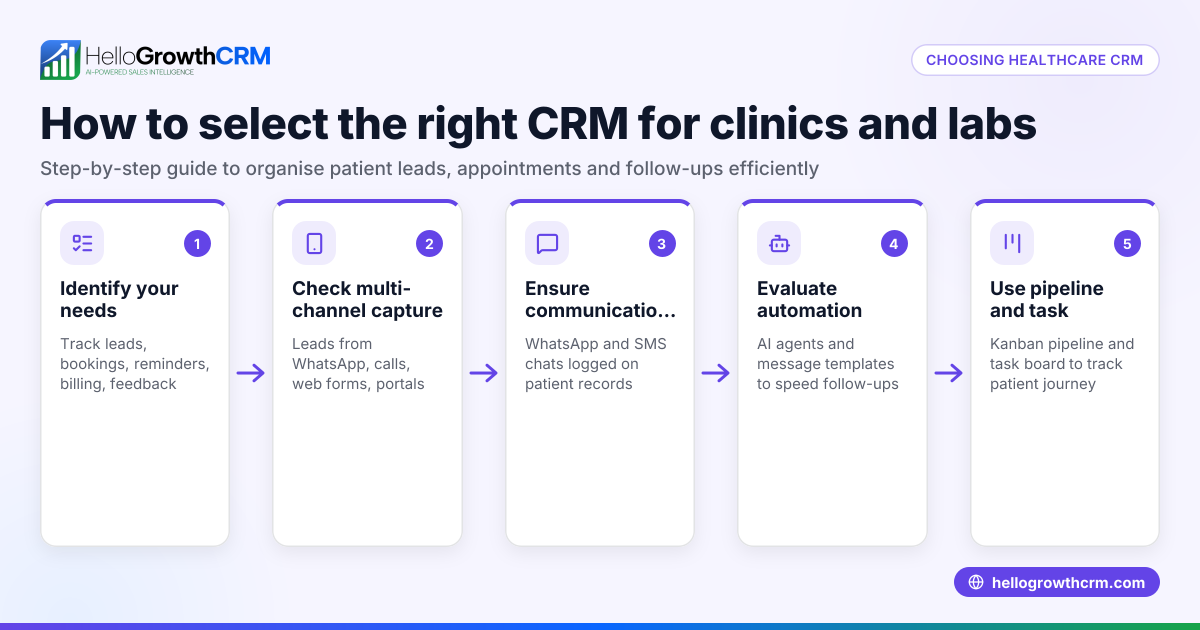
- Identify your healthcare business needs: Determine if you are a clinic, diagnostic lab, or other healthcare provider. List key workflows like lead capture, appointment scheduling, follow-ups, and patient communication channels.
- Check CRM compatibility with healthcare workflows: Ensure the CRM can handle patient leads, appointment pipelines, and communication via WhatsApp and SMS, as these are widely used in India.
- Evaluate automation features: Look for AI capabilities that can draft follow-up messages after calls or automate routine tasks, reducing manual workload.
- Assess ease of use for your team: The CRM should be simple enough for doctors, front desk staff, and telecalling teams to adopt without extensive training.
- Consider data privacy and compliance: Verify the CRM supports secure data handling suitable for healthcare information.
- Test lead capture sources: Check if the CRM can integrate or capture leads from platforms like IndiaMART, JustDial, or your website forms.
- Review communication logging: Confirm that WhatsApp conversations and SMS messages are logged on patient records for easy reference.
- Pilot with a small team: Use a free or trial plan to run a pilot with your team before full implementation.
- Train your team and monitor usage: Provide basic training and monitor how the team uses the CRM to ensure adoption.
- Analyze sales and appointment data: Use the CRM’s reporting features to identify bottlenecks and improve patient follow-up efficiency.
Example (fictional figures)
A diagnostic lab in Lucknow receives about 500 patient inquiries monthly. They want to track leads and follow-ups more efficiently.
- Lead capture from IndiaMART and website forms: 500 leads
- Current follow-up rate: 60% (300 patients contacted)
- Goal: Improve follow-up rate to 80% (400 patients contacted)
Cost of missed leads (assuming ₹1,000 average test revenue per patient):
Missed patients = 500 - 300 = 200
Potential revenue lost = 200 × ₹1,000 = ₹2,00,000
With CRM, follow-ups improve to 80%:
Patients contacted = 400
Additional patients contacted = 400 - 300 = 100
Additional revenue = 100 × ₹1,000 = ₹1,00,000
The CRM helps the lab increase revenue by ₹1,00,000 monthly by improving patient follow-ups.
Common mistakes
- Not automating follow-ups: Manually tracking leads and reminders leads to delays. Use CRM automation or AI agents to draft follow-ups.
- Using multiple disconnected tools: Running sales on WhatsApp and spreadsheets causes data silos. Choose a CRM that logs WhatsApp conversations on lead records.
- Ignoring team training: Without proper training, staff avoid using the CRM. Conduct simple, role-based training sessions.
- Overcomplicating workflows: Complex CRM setups discourage use. Start with essential pipelines and scale gradually.
- Neglecting data privacy: Failing to secure patient data risks compliance issues. Ensure the CRM supports secure data handling.
- Choosing a CRM without local support: Indian healthcare businesses benefit from CRMs that understand local lead sources and communication preferences.
Doing this in HelloGrowthCRM
HelloGrowthCRM supports healthcare teams with WhatsApp and SMS messaging where all WhatsApp conversations with a lead are logged on the lead record, making follow-ups easy and transparent. AI agents (in Beta on the Growth plan) draft follow-up messages after calls, so your reps only review and send, saving time. For small teams, the Free Forever plan allows two users to run their pipeline at no cost until they need calling or WhatsApp automation. Learn more about WhatsApp and SMS CRM and HelloGrowthCRM for India.
Frequently asked questions
What is an operational healthcare CRM? An operational healthcare CRM is software that manages patient leads, appointments, communications, and follow-ups specifically for healthcare providers like clinics and labs. It helps streamline workflows and improve patient engagement.
How does a healthcare CRM improve patient follow-up? By logging communications like WhatsApp messages and automating reminders or follow-ups with AI agents, a healthcare CRM ensures timely contact with patients, reducing missed appointments and lost revenue.
Can I use HelloGrowthCRM if my team is small? Yes, HelloGrowthCRM offers a Free Forever plan for two users with essential pipeline management features, perfect for small clinics or labs starting to organise their patient leads.
Does the CRM support lead capture from Indian platforms? HelloGrowthCRM can capture leads from IndiaMART, JustDial, and web forms, which are common lead sources for Indian healthcare businesses.
Is WhatsApp integration important for healthcare CRMs in India? Yes, WhatsApp is widely used by patients and healthcare providers in India. A CRM that logs WhatsApp conversations and supports messaging sequences improves communication efficiency.
How do AI agents help in healthcare CRM? AI agents can draft follow-up messages after calls, update records, and perform workflow steps autonomously, reducing manual effort for healthcare sales and telecalling teams.
Key takeaways
- Operational healthcare CRMs help clinics and labs manage patient leads, appointments, and communications efficiently.
- Essential features include WhatsApp and SMS logging, AI-assisted follow-ups, and lead capture from Indian platforms.
- Avoid common mistakes like manual follow-ups, disconnected tools, and lack of team training.
- HelloGrowthCRM offers WhatsApp-native CRM features and AI agents to support healthcare teams, with a Free Forever plan for small teams.
- Testing a CRM with a pilot and monitoring usage ensures better adoption and improved patient engagement.
To start organising your healthcare leads and improve patient follow-ups, Start on the Free Forever plan (200 leads, no credit card).
For more details on healthcare-specific solutions, see Clinics, labs and healthcare.
Ready to put this into practice?
Set up your pipeline, WhatsApp follow-ups, and AI lead scoring in minutes — free, no credit card.
Try HelloGrowthCRM freeGet CRM tips in your inbox
Join thousands of sales professionals who get weekly insights on CRM strategy, AI automation, and pipeline optimization.

The HelloGrowthCRM team publishes guides on CRM strategy, AI sales tools, and revenue operations for small business sales teams.