HelloGrowthCRM software
Built for real small-business sales teams
HelloGrowthCRM helps reps qualify faster, follow up on time, and close more deals—with practical automation in one place.
- AI lead scoring and pipeline visibility
- Built-in dialer, WhatsApp, and email automation
- Sales forecasting and RevOps-ready reporting
For small businesses in the United Arab Emirates, managing payment follow-ups effectively is essential to maintain cash flow and customer relationships. While spreadsheets are a common initial choice due to their familiarity and low cost, dedicated payment follow-up tools provide better organisation, automation, and accuracy.
Why this comes up / what goes wrong
Many small UAE business owners start with spreadsheets to track invoices and payment follow-ups because they are easy to set up and require no additional software. However, as the business expands beyond a handful of clients, spreadsheets become difficult to manage. Common problems include forgetting to follow up on overdue payments, inconsistent communication, lost email or WhatsApp threads, and trouble tracking invoice status. These issues lead to slower collections, cash flow challenges, and strained customer relationships.
Step-by-step
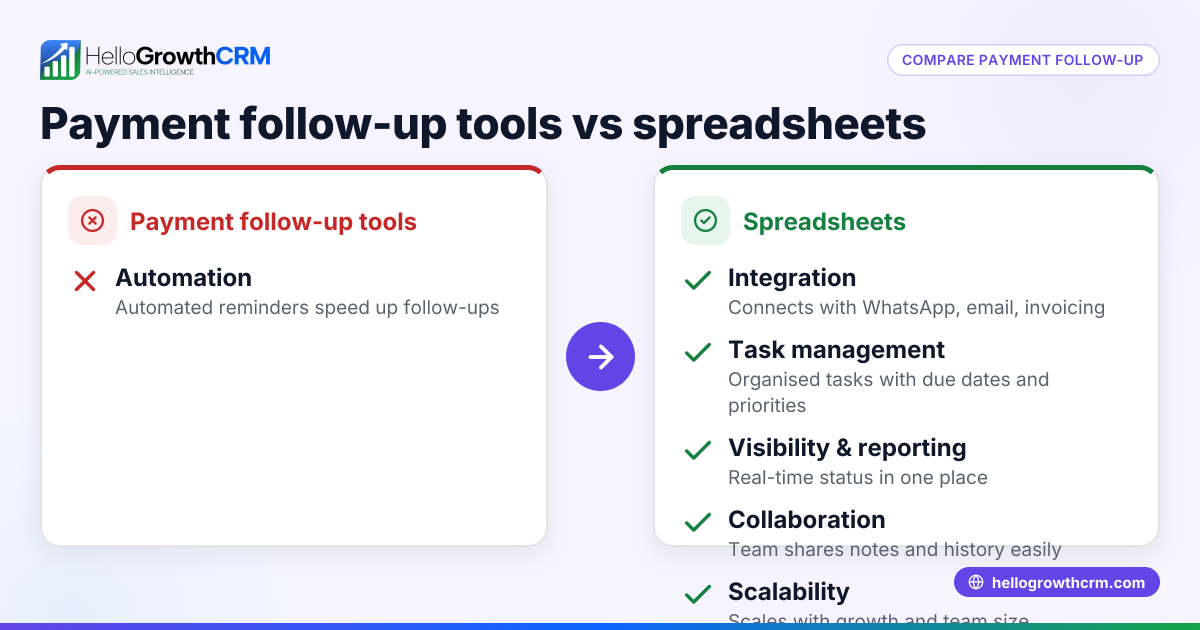
The table below compares payment follow-up using spreadsheets versus dedicated tools based on criteria important to small UAE businesses:
| Criteria | Spreadsheets | Dedicated Payment Follow-Up Tools |
|---|---|---|
| Ease of Setup | Simple, no cost, widely known | Requires initial setup and training |
| Organisation | Manual entry, prone to human error | Automated task boards and reminders |
| Follow-Up Reminders | Manual checks, easy to forget | Automated notifications and due dates |
| Communication Tracking | Separate apps (email, WhatsApp) | Interaction history linked to each client record |
| Invoice Status Visibility | Manual updates, often delayed | Real-time status (sent, viewed, paid) in one place |
| Scalability | Difficult beyond few clients | Designed for growing teams and volumes |
| Integration | Limited or none | Integrates with CRM, email, WhatsApp |
Who should pick which?
- Spreadsheets suit very small businesses with under 10 clients and simple invoicing.
- Dedicated payment follow-up tools benefit businesses with growing client lists, multiple team members, or those needing reliable reminders and communication tracking.
Example (fictional figures)
A business-setup consultancy in Business Bay, Dubai, issues AED 150,000 in invoices monthly. They track payments manually in a spreadsheet and send WhatsApp reminders.
- Month 1 invoices issued: AED 150,000
- Payments received on time: AED 120,000
- Late payments: AED 30,000
Because follow-ups are inconsistent, late payments often extend beyond 30 days, causing cash flow problems.
If they switch to a payment follow-up tool:
- Each invoice generates a follow-up task with a due date.
- Automated WhatsApp reminders are sent on day 10 and day 20 if unpaid.
- Payment status updates in real-time.
Result:
- On-time payments increase to AED 135,000
- Late payments reduce to AED 15,000
Calculations:
AED 120,000 + AED 15,000 = AED 135,000 (on-time payments after tool implementation)
AED 30,000 - AED 15,000 = AED 15,000 (reduction in late payments)
This improvement occurs because the system ensures no invoice is forgotten and reminders are timely.
Common mistakes
- Relying solely on memory or manual checks
- Prevent by using task boards or reminders to schedule follow-ups.
- Mixing communication channels without tracking
- Prevent by logging all calls, messages, and emails in one system.
- Not updating invoice status promptly
- Prevent by linking invoice status to follow-up tasks for real-time visibility.
- Using complex spreadsheets that team members avoid
- Prevent by choosing user-friendly tools accessible to the whole sales or accounts team.
- Ignoring follow-up after initial contact
- Prevent by setting multiple reminders and escalating overdue payments.
Doing this in HelloGrowthCRM
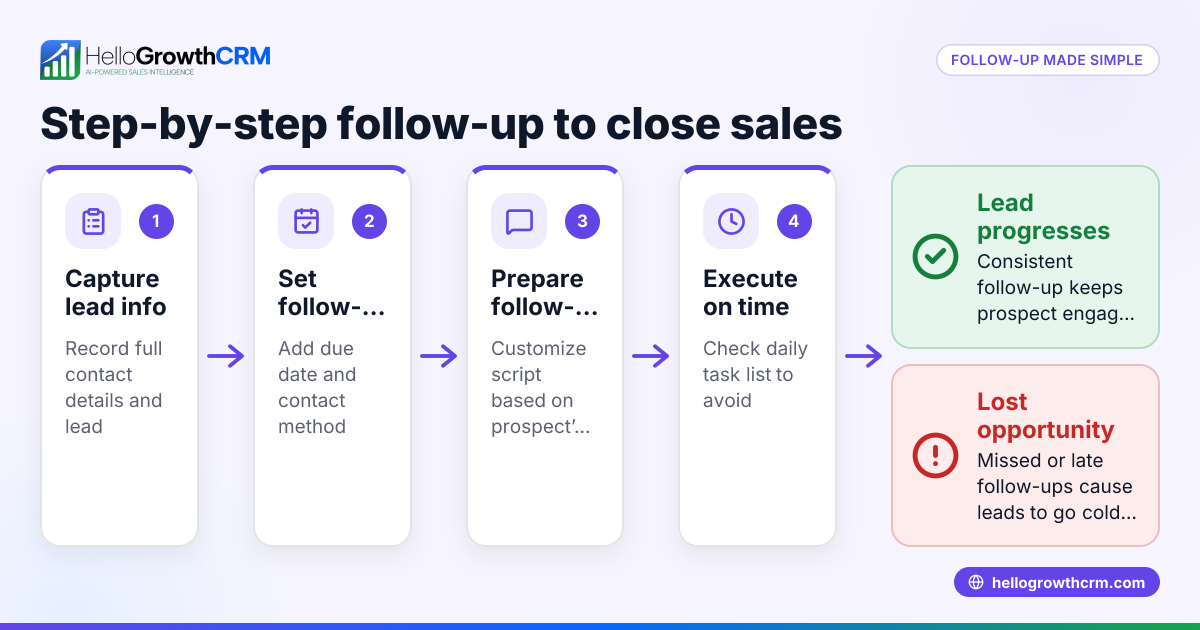
HelloGrowthCRM offers activities and task boards where each payment follow-up becomes a task with a due date. Your team sees the day’s calls and reminders as a list, not relying on memory. The quotation, proposal, invoice, and payment status are all visible on the same deal screen as the follow-up task, keeping everything organised and reducing errors. This helps ensure timely payment follow-ups and better cash flow management. Learn more about activities and task boards and quotes, proposals, invoices and payments received.
Frequently asked questions
What are the advantages of using a CRM over spreadsheets for payment follow-up? A CRM automates reminders, centralises communication, tracks invoice status in real time, and provides task boards for follow-up. This reduces missed payments and errors common with spreadsheets.
Can spreadsheets work for small UAE businesses? Yes, if your client list is very small and invoicing is simple. However, as your business grows, spreadsheets often become inefficient and error-prone.
How does HelloGrowthCRM help with payment follow-up? It turns each follow-up into a task with a due date, shows the day’s calls and reminders, and links invoices and payments to deals for easy tracking.
Is it difficult to switch from spreadsheets to a CRM? Switching requires initial setup and training but can save time and reduce errors long-term. HelloGrowthCRM offers user-friendly interfaces and email automation and sequences to ease the transition.
How can I measure if my payment follow-up is effective? Track metrics like days sales outstanding (DSO), percentage of on-time payments, and follow-up task completion rates. A customer health score tool can also help monitor client payment behaviour.
Key takeaways
- Spreadsheets are simple but prone to errors and missed follow-ups as your business grows.
- Dedicated payment follow-up tools improve organisation, reminders, and communication tracking.
- Businesses with multiple clients or team members benefit most from specialised tools.
- HelloGrowthCRM provides task boards and invoice status tracking to streamline payment follow-ups.
- Avoid common mistakes by automating reminders and centralising communication.
Start managing your payment follow-ups more efficiently by trying HelloGrowthCRM. Start on the Free Forever plan (200 leads, no credit card).
Ready to put this into practice?
Set up your pipeline, WhatsApp follow-ups, and AI lead scoring in minutes — free, no credit card.
Try HelloGrowthCRM freeGet CRM tips in your inbox
Join thousands of sales professionals who get weekly insights on CRM strategy, AI automation, and pipeline optimization.

The HelloGrowthCRM team publishes guides on CRM strategy, AI sales tools, and revenue operations for small business sales teams.