HelloGrowthCRM software
Built for real small-business sales teams
HelloGrowthCRM helps reps qualify faster, follow up on time, and close more deals—with practical automation in one place.
- AI lead scoring and pipeline visibility
- Built-in dialer, WhatsApp, and email automation
- Sales forecasting and RevOps-ready reporting
For many small businesses in the United Kingdom, deciding how to manage payment follow-up is critical. Payment follow-up systems specifically designed for tracking invoices and reminders provide features that spreadsheets lack, such as automated task management, status tracking, and integration with sales workflows. Spreadsheets are widely used due to their simplicity and low cost but can lead to errors and delays.
Why this comes up / what goes wrong
Small business owners often start with spreadsheets because they are familiar and readily available. However, as sales volumes grow and payment follow-up becomes more complex, spreadsheets can cause problems such as:
- Missing overdue payments because reminders are not automated or visible.
- Difficulty tracking which invoices have been sent, viewed, or paid.
- Manual updating that wastes time and risks errors.
- Lack of integration with sales and customer communication, especially if sales run on WhatsApp, email, or phone.
This leads to lost cash flow, strained customer relations, and extra admin work.
Step-by-step
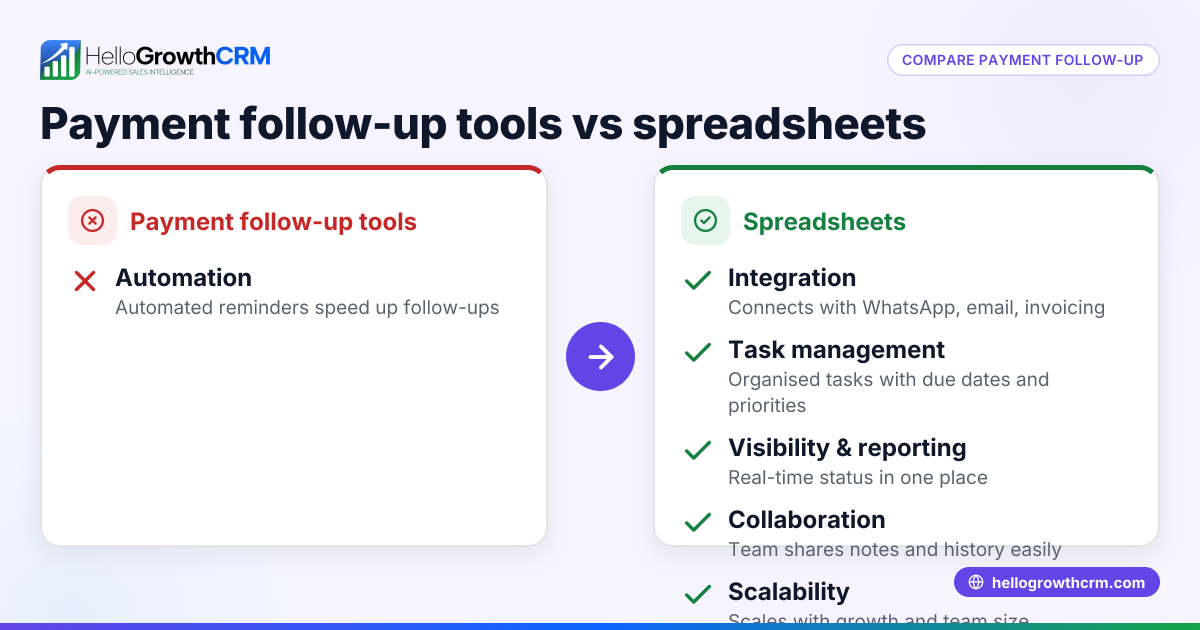
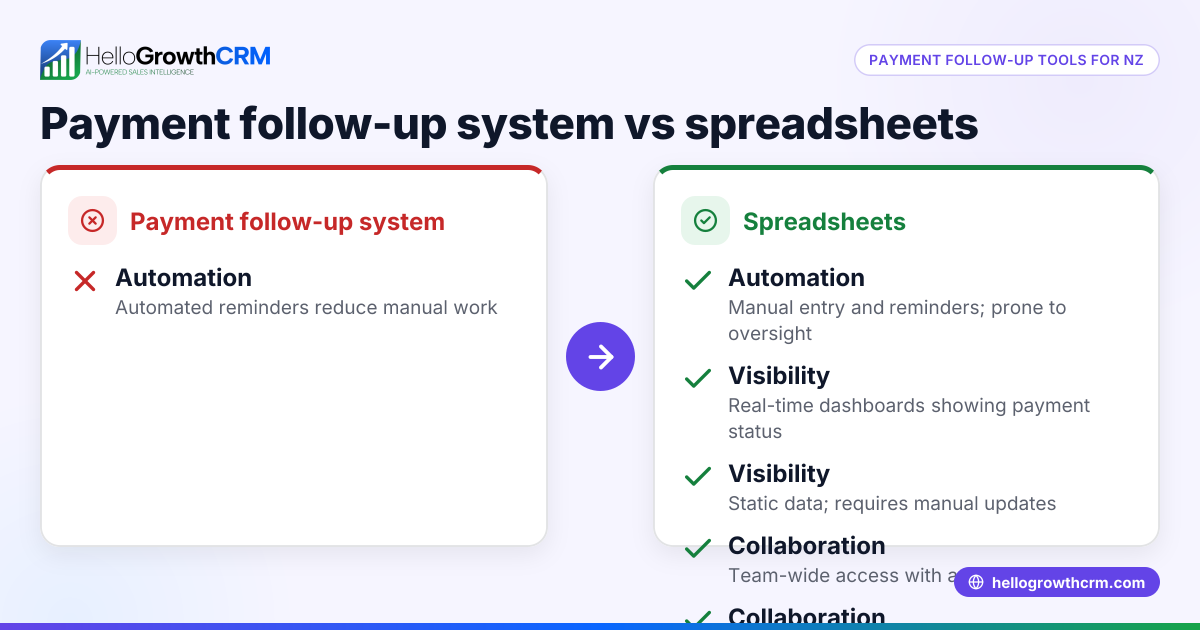
The following table compares payment follow-up systems with spreadsheets on key criteria relevant to UK small businesses:
| Criteria | Payment Follow-Up Systems | Spreadsheets |
|---|---|---|
| Organisation | Centralised task boards with due dates | Manual rows, no automated reminders |
| Tracking payment status | Invoice status visible (sent, viewed) | Manual notes, prone to oversight |
| Integration with sales tools | Linked to deals, calls, WhatsApp | Separate from sales communication |
| Automation | Tasks and reminders created automatically | Manual updates and checks |
| Collaboration | Team-wide visibility and handoffs | File sharing needed, version issues |
| Scalability | Handles growing leads and invoices | Becomes unwieldy as data grows |
| Accuracy and error risk | Lower due to automation | High due to manual entry |
Who should pick which?
- Payment follow-up systems suit businesses with multiple customers, frequent invoices, or sales teams needing coordinated communication. They reduce missed payments and save time.
- Spreadsheets may suffice for very small businesses with few invoices and simple follow-up needs, but risk errors as volume grows.
Example (fictional figures)
A solar-panel installer in Glasgow issues 30 invoices monthly, each averaging £2,500. They currently use spreadsheets but want to estimate the cost of missed payments due to slow follow-up.
Assume 10% of invoices are paid late due to manual tracking delays.
Monthly invoiced amount: £2,500 × 30 = £75,000
Late payment amount (10%): £75,000 × 10% = £7,500
Assuming late payments delay cash flow by 15 days, the cost of delayed funds at an illustrative interest rate of 5% per annum:
Annual interest on late payments: £7,500 × 5% = £375
Daily cost: £375 ÷ 365 = £1.03
Cost for 15 days delay: £1.03 × 15 = £15.45
This simple calculation shows the cash flow impact of slow payment follow-up. A dedicated system could reduce late payments and improve this.
Common mistakes
- Relying solely on spreadsheets without reminders leads to forgotten follow-ups. Prevent by setting calendar alerts or switching to a system with task boards.
- Not updating payment status promptly causes confusion. Prevent by logging payments immediately and centralising records.
- Using multiple disconnected tools (WhatsApp, email, spreadsheets) fragments information. Prevent by consolidating communication and follow-up in one platform.
- Failing to assign follow-up tasks clearly results in no one taking responsibility. Prevent by using task boards with due dates and ownership.
- Ignoring overdue payments until too late delays recovery. Prevent by scheduling regular follow-ups and automated reminders.
Doing this in HelloGrowthCRM
HelloGrowthCRM offers activities and task boards where each payment follow-up becomes a task with a due date, ensuring daily calls and reminders are a list, not a memory test. It also integrates quotes, proposals, invoices, and payments received directly from the deal record. The quotation status (sent, viewed, accepted) is visible alongside follow-up tasks, helping your team stay organised and responsive. Learn more about these features on activities and task boards and quotes, proposals, invoices and payments.
Frequently asked questions
Is a spreadsheet enough for payment follow-up in a small UK business? Spreadsheets can work for very small businesses with few invoices and customers. However, they lack automation and integration, which increases the risk of missed payments as business grows.
How can I avoid losing track of payments when using spreadsheets? Use clear columns for payment status, set calendar reminders for follow-ups, and regularly update the sheet. Consider combining spreadsheets with communication tools or upgrading to a CRM. For automated communication, see email automation and sequences.
What are the benefits of using a CRM for payment follow-up? A CRM centralises customer data, automates reminders, links invoices to deals, and provides task boards for follow-up. This reduces errors and improves cash flow.
Can HelloGrowthCRM integrate with WhatsApp for payment follow-up? Yes, HelloGrowthCRM is WhatsApp-native and supports integrated communication, making follow-up quicker and more organised.
How do task boards improve payment follow-up? Task boards organise follow-ups as tasks with due dates and ownership, providing visibility to the whole team and preventing tasks from being forgotten.
To explore how HelloGrowthCRM compares to other tools, visit compare CRMs.
Key takeaways
- Payment follow-up systems reduce missed payments and improve organisation compared to spreadsheets.
- Spreadsheets may work for very simple needs but become inefficient as sales grow.
- Task boards and automated reminders help ensure follow-ups happen on time.
- Integrating payment follow-up with sales communication (WhatsApp, calls) streamlines processes.
- HelloGrowthCRM offers task boards and quoting features to manage follow-ups effectively.
Start managing your payment follow-up more efficiently today. Start on the Free Forever plan (200 leads, no credit card).
Ready to put this into practice?
Set up your pipeline, WhatsApp follow-ups, and AI lead scoring in minutes — free, no credit card.
Try HelloGrowthCRM freeGet CRM tips in your inbox
Join thousands of sales professionals who get weekly insights on CRM strategy, AI automation, and pipeline optimization.

The HelloGrowthCRM team publishes guides on CRM strategy, AI sales tools, and revenue operations for small business sales teams.