HelloGrowthCRM software
Built for real small-business sales teams
HelloGrowthCRM helps reps qualify faster, follow up on time, and close more deals—with practical automation in one place.
- AI lead scoring and pipeline visibility
- Built-in dialer, WhatsApp, and email automation
- Sales forecasting and RevOps-ready reporting
If your team has outgrown basic pipeline tracking, a Pipedrive alternative for US B2B sales teams should do three things better: route leads fast, score them with real sales context, and give leaders forecast control they can trust. The right system should also fit how American B2B teams actually sell, using email, phone, meetings, QuickBooks, Stripe, and clear owner accountability.
Key takeaways
- Many sales teams leave Pipedrive when lead assignment, qualification, and forecasting become too manual.
- A strong replacement should support lead routing rules, AI-based prioritization, and manager-friendly forecast controls.
- US B2B teams need tools that work with email, calling, compliance expectations, and common finance and ops systems.
- Forecast accuracy depends on clean stages, required fields, and rep accountability, not just dashboard design.
- An ai pipedrive alternative can help reps focus on the best accounts instead of chasing every new lead equally.
- HelloGrowthCRM combines CRM software with managed RevOps for teams that want setup and process support, not just another tool.
Why US B2B sales teams start looking for a Pipedrive alternative
Pipedrive works well for many teams at the start. It gives sales reps a clear pipeline and a simple way to move deals forward. That is often enough when the company is small, lead volume is low, and the founder still watches every opportunity personally.
The problem shows up when growth creates complexity.
A team in Chicago may have inbound demo requests, partner referrals, outbound sequences, and trade show leads arriving at the same time. A manufacturer in Detroit may need territory-based assignment, product-line ownership, and handoffs between sales development and account executives. A services company in Houston may need stronger forecast review, source tracking, and better qualification before reps spend hours on bad-fit accounts.
At that point, teams are not just managing deals. They are managing flow.
That flow includes:
- Where new leads come from
- Who owns them first
- How fast someone responds
- Which leads deserve rep time
- How opportunities move between stages
- How leaders inspect pipeline quality
- How forecasts get locked and reviewed
When those steps live in spreadsheets, inbox rules, or rep memory, the CRM stops being the source of truth. Reps update it late. Managers stop trusting it. Forecast calls turn into opinion battles.
That is why many leaders search for a Pipedrive alternative. They do not always want more software. They want more control.
What should a Pipedrive alternative for US B2B sales teams do better?
It should improve the parts of revenue operations that break first: lead routing, prioritization, and forecast discipline. A CRM that only stores contacts and deals will not solve those problems.
Here is what to look for.
1. Smarter lead routing
Lead assignment should not depend on whoever notices the notification first.
US B2B teams often need routing based on:
- State or region
- Industry
- company size
- Product interest
- Existing account ownership
- Inbound versus outbound source
- Named account rules
- Round-robin distribution
If a new lead from Texas should go to one rep and a manufacturing lead over a certain size should go to another, the CRM should handle that automatically. Fast routing matters because response time affects conversion, especially for demo requests and hand-raisers.
2. AI lead scoring that reflects sales reality
Basic scoring often fails because it is too simple. It may only count email opens or form fills. That is not enough for B2B sales.
A better system should use broader signals, such as:
- Firmographic fit
- Source quality
- Product interest
- Buying behavior
- Sales engagement activity
- Historical conversion patterns
- Stage progression trends
This helps reps focus on leads with both fit and intent. That matters when your team has limited selling time and needs to protect rep productivity.
3. Forecast control for managers
A forecast is not useful if reps can move deals freely without structure.
Managers need controls such as:
- Standard stage definitions
- Required fields before stage movement
- Weighted pipeline views
- Commit and best-case categories
- Roll-up views by rep, team, and source
- Activity visibility tied to open opportunities
- Change tracking over time
Without these controls, every rep interprets the pipeline differently. One rep treats a first meeting like a real opportunity. Another waits until pricing is sent. The result is a forecast that looks polished but means very little.
4. Automation that reduces admin work
Good automation should remove repetitive work, not create brittle workflows nobody wants to maintain.
Look for automation around:
- Lead capture
- Follow-up sequences
- Task creation
- Stage-based reminders
- Handoff alerts
- Stalled deal triggers
- Renewal or expansion tasks
This keeps reps selling instead of clicking.
Is Pipedrive enough once your team has SDRs, AEs, and managers?
Usually not for long. Once roles split across lead qualification, opportunity ownership, and forecast review, teams need stronger process control, cleaner handoffs, and better reporting. That is where a more structured CRM and RevOps setup starts to matter.
When a founder-led sales motion becomes a real team, informal habits stop scaling. SDRs need clear criteria for when a lead becomes a meeting. AEs need confidence that assigned leads fit their patch. Managers need visibility into which stage movements are real and which are just optimism.
This is where many teams hit friction with simpler CRM setups.
Common pain points after the first growth stage
Here are the issues that usually trigger a CRM review:
- Leads sit unassigned too long
Fast inbound follow-up slips when ownership is unclear. - Reps work low-quality accounts
Everyone gets leads, but not all leads deserve the same effort. - Forecasts depend on rep judgment alone
Managers cannot inspect enough detail to coach risk early. - Pipeline stages become inconsistent
Teams use the same stage names differently. - Reporting takes too much cleanup
RevOps or sales leaders export data just to answer basic questions. - Automation is too light or too messy
Either nothing happens automatically, or workflows become hard to manage.
These are not edge cases. They are normal signs that the team needs a system designed for revenue execution, not just opportunity tracking.
How does better lead routing help US B2B sales teams?
Better lead routing gets the right lead to the right rep fast, with fewer manual handoffs. That improves speed to lead, reduces territory conflict, and increases the odds that qualified demand reaches a seller who can actually close it.
The impact is practical. Imagine a software company getting 40 inbound leads a week. If reps self-select leads or a manager manually assigns them twice a day, some of the best opportunities wait too long. Others go to the wrong owner. That creates slower follow-up and lower confidence across the team.
What strong lead routing looks like
A better setup usually includes:
- Instant assignment based on clear rules
- Fallback logic when a rep is unavailable
- Named account protection for existing ownership
- Round-robin balancing where fairness matters
- Alerts and tasks triggered at assignment
- Source-aware routing so urgent hand-raisers get priority
This matters in US sales teams where territory and account ownership often drive compensation and accountability. Routing mistakes do not just waste time. They can create internal conflict.
Lead routing should connect to response workflows
Routing alone is not enough. The assigned rep should immediately get the next action.
That could mean:
- A call task due today
- An introductory email
- A text or WhatsApp touch where appropriate
- A meeting booking step
- A manager alert if no activity happens in a set time
That is one reason many teams look for a system with built-in automation and integrations rather than trying to patch together several tools.
Why does AI scoring matter more than basic lead scoring?
AI scoring helps reps spend time where the probability of conversion is highest, not just where activity looks busy. For growing B2B teams, that means fewer wasted touches, better qualification, and more predictable pipeline creation.
Basic lead scoring often rewards shallow behavior. A prospect clicks one email or visits a pricing page, and the score jumps. But in B2B sales, that does not always mean real buying intent.
A stronger approach looks at combinations of signals.
What AI scoring should consider
Good scoring should weigh:
- Company fit
- Buying behavior
- Source quality
- Rep engagement history
- Similar past wins
- Similar past losses
- Response patterns across segments
For example, an operations leader from a mid-market manufacturer in Detroit who requests a demo and replies to outreach may deserve faster attention than a student who downloads a guide using a personal email address.
That sounds obvious. But without AI assistance, teams often rely on broad rules that miss this nuance.
AI scoring should support rep decisions, not replace them
The goal is not to let software close deals. The goal is to reduce wasted effort.
Reps should still be able to review why a lead is prioritized. Managers should still inspect whether scores align with reality. The best systems make scoring transparent enough to coach from, while still saving time.
If your team wants this type of prioritization inside the CRM, AI lead scoring is worth evaluating closely.
What forecast control should sales leaders expect?
Sales leaders should expect clear stage definitions, required data at key points, and forecast categories that reps and managers use consistently. Forecast control means less guessing, better inspection, and fewer surprises at the end of the quarter.
Forecasting fails when CRM hygiene is optional.
A dashboard cannot rescue bad process. If close dates are stale, stage criteria are vague, and next steps are missing, the forecast turns into a confidence exercise rather than an operating tool.
The building blocks of forecast control
A solid setup includes these pieces:
Consistent opportunity stages
Each stage should mean one thing. Not three different things depending on the rep.
For example:
- Discovery completed
- Qualified opportunity
- Proposal sent
- Legal or procurement review
- Verbal agreement
- Closed won or closed lost
These should match your sales motion. They should not be copied from a template if they do not reflect how your buyers buy.
Required fields and validation
Before a deal moves forward, the CRM should require the data leadership needs.
That often includes:
- Close date
- Deal amount
- Decision process
- Next step
- Primary contact
- Source
- Forecast category
This keeps pipeline reviews grounded in facts.
Manager-level visibility
Managers should be able to see:
- Stage movement by rep
- Slipped close dates
- Stalled deals
- Activity gaps
- Changes in forecast category
- Coverage against quota
That level of visibility helps coaching happen before the quarter is lost.
Rep accountability
Reps should update opportunities as part of normal workflow, not as a separate admin project every Friday afternoon.
That is easier when the CRM is simple to use and connected to communication tools like email automation, calling, and calendar activity.
How HelloGrowthCRM compares for teams that need more control
HelloGrowthCRM is built for growing B2B sales teams that want more than pipeline visibility. It combines CRM, automation, AI support, and RevOps help in one system.
That makes it relevant when your team needs process improvement, not just a new interface.
Where it fits better than a basic pipeline tool
HelloGrowthCRM is a good fit when you need:
- Automated lead capture and assignment
- AI-based prioritization inside the CRM
- Pipeline controls for cleaner forecasting
- Communication tools tied to the record
- Reporting that leaders can trust
- RevOps support to set it up well
For teams that want a more structured AI CRM, this matters because software alone rarely fixes sales process issues. The setup, field design, routing logic, and reporting standards all matter too.
Why managed RevOps can matter
Many SMB and mid-sized B2B teams do not have a large internal RevOps function. The sales leader may own process, reporting, forecasting, tool decisions, and rep coaching all at once.
That is a lot.
In that situation, a platform with features plus managed support can reduce time to value. Instead of buying software and then figuring out the operating model later, the team can build routing, lifecycle stages, and reporting with help.
A better fit for operational maturity
HelloGrowthCRM may be the stronger choice if your current pain sounds like this:
- "Leads are coming in, but follow-up is inconsistent."
- "Reps work too many weak opportunities."
- "Forecast calls take too long."
- "Managers do not trust stage definitions."
- "We need a CRM the team will actually keep updated."
Those are operating problems. They need operating solutions.
How to choose the right Pipedrive alternative for your team
Do not choose based on feature count alone. Choose based on the sales process problems you need to fix in the next 12 months.
A practical evaluation process helps.
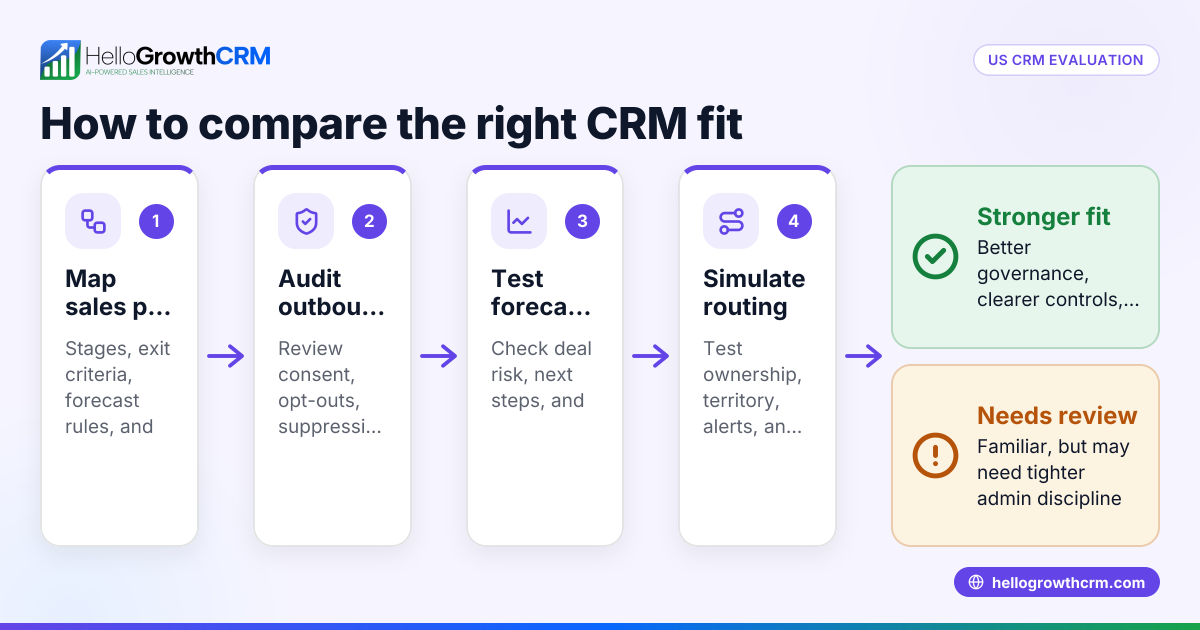
1. Start with the bottleneck
Ask which problem hurts revenue most right now:
- Slow lead response
- Low meeting-to-opportunity conversion
- Weak qualification
- Unreliable forecast
- Poor rep adoption
- Manual reporting
That bottleneck should guide the shortlist.
2. Map your lead flow
Before buying anything, document:
- Lead sources
- Assignment rules
- Qualification criteria
- Handoff points
- Required rep actions
- Manager review steps
This makes product evaluation easier and exposes process gaps early.
3. Test real use cases, not just demos
Use examples from your actual team.
For instance:
- Route a healthcare lead in Texas to the right rep
- Score an inbound request versus a cold outbound response
- Require next step and close date before moving a deal
- Review forecast changes by rep over the last 30 days
If the system struggles with those tests, it will struggle in production.
4. Check integration fit
For US B2B companies, common integrations may include:
- Google Workspace or Microsoft 365
- QuickBooks
- Stripe
- Calendar and meeting tools
- ERP systems for manufacturers
- Marketing form sources
A CRM should fit the rest of your stack, not force manual workarounds.
5. Look at adoption risk
A CRM can have strong features and still fail if reps avoid it.
Ask:
- Is the workflow simple?
- Does activity capture reduce admin?
- Can managers inspect pipeline without chasing reps?
- Will forecasting become clearer week to week?
If the answer is no, keep looking.
Common migration mistakes to avoid
Switching CRMs can improve execution fast. It can also create new mess if the rollout is rushed.
Avoid these mistakes.
Copying old pipeline problems into the new tool
Do not migrate every field, stage, and custom habit without review. Keep what supports decisions. Remove what creates noise.
Overbuilding automation on day one
Start with the workflows that protect revenue:
- Lead assignment
- Fast follow-up
- Stage requirements
- Forecast categories
- Stalled deal alerts
You can add more later.
Ignoring manager workflows
A CRM should work for leaders, not just reps. Forecast review, pipeline inspection, and coaching views need to be part of the setup from the start.
Skipping data cleanup
Ready to put this into practice?
Set up your pipeline, WhatsApp follow-ups, and AI lead scoring in minutes — free, no credit card.
Try HelloGrowthCRM freeGet CRM tips in your inbox
Join thousands of sales professionals who get weekly insights on CRM strategy, AI automation, and pipeline optimization.

The HelloGrowthCRM team publishes guides on CRM strategy, AI sales tools, and revenue operations for small business sales teams.