HelloGrowthCRM software
Built for real small-business sales teams
HelloGrowthCRM helps reps qualify faster, follow up on time, and close more deals—with practical automation in one place.
- AI lead scoring and pipeline visibility
- Built-in dialer, WhatsApp, and email automation
- Sales forecasting and RevOps-ready reporting
HelloGrowthCRM vs HubSpot for US mid-market sales teams comes down to control, speed, and cost: HelloGrowthCRM is usually the better fit for teams that need tighter pipeline governance, clearer outbound guardrails, and predictable total cost in USD, while HubSpot often suits teams that prioritize broad ecosystem familiarity and marketing depth.
Key Takeaways
- HelloGrowthCRM is stronger when RevOps leaders need strict stage governance, forecast hygiene, and rep-level process control.
- HubSpot is widely known in US SaaS, but cost can rise fast as teams add seats, reporting needs, and sales automation.
- For American outbound teams, CAN-SPAM and TCPA expectations make audit trails, consent capture, and channel controls critical.
- HelloGrowthCRM aligns well with mid-market finance stacks that depend on Stripe and QuickBooks.
- Buyers with SOC 2 expectations should compare not just security claims, but admin controls, data access, and workflow discipline.
- If your team is migrating from spreadsheets or a loose HubSpot setup, HelloGrowthCRM often gives better sales execution with less operational drift.
What is the real difference between HelloGrowthCRM and HubSpot for US mid-market sales teams?
HelloGrowthCRM vs HubSpot for US mid-market sales teams is mainly a choice between execution-first sales control and broader all-in-one familiarity: HelloGrowthCRM is built for disciplined pipeline management and RevOps visibility, while HubSpot is often easier to recognize internally because many US teams already know its interface and ecosystem.
For a US mid-market sales org, the debate is rarely about whether both tools can store contacts and deals. They can. The real issue is how well they help your team run a clean revenue process every week.
That means comparing:
- Pipeline stage governance
- Forecast hygiene
- Lead routing logic
- Outbound compliance controls
- Security and buyer trust
- Total cost in USD over 12 to 24 months
In practice, I see New York and Austin SaaS teams start this evaluation after one of three triggers:
- Forecast calls become argument-driven instead of data-driven
- Reps skip stages and close-date hygiene falls apart
- Leadership wants tighter controls without adding another ops tool
HelloGrowthCRM is designed to solve those sales execution issues directly. Features like AI Pipeline Management, AI Deal Insights, and Sales Forecasting help RevOps teams enforce process rather than just report on the mess after it happens. If you want a broader product tour, the Features page is the best starting point.
Which platform is better for pipeline governance and forecast hygiene?
HelloGrowthCRM is generally better for pipeline governance and forecast hygiene because it is easier to enforce stage entry criteria, surface risk signals, and drive rep accountability inside the core sales workflow, while HubSpot can work well but often needs stricter admin discipline to stay clean at scale.
Pipeline governance means more than naming stages. It means each stage has:
- Clear exit criteria
- Required fields
- Expected next steps
- Stage aging thresholds
- Forecast category logic
- Manager inspection rules
When I have audited pipelines like this for US B2B SaaS teams, the biggest issue is usually not missing dashboards. It is weak stage discipline. Reps move deals forward too early. Close dates slip silently. Qualification fields stay blank. Forecast calls become anecdotal.
Where HelloGrowthCRM stands out
HelloGrowthCRM is built for teams that want process enforcement inside daily execution. With Sales Task Boards, AI Lead Scoring, and Deal Risk Agent, managers can see which deals are stuck, under-qualified, or moving without required proof.
In one rollout we did with a 12-person sales team selling into New York financial services firms, we reduced “mystery commit” deals by forcing MEDDPICC checkpoints before a deal could sit in late-stage forecast views. That did not require a separate governance layer. It lived in the CRM workflow.
Where HubSpot works well
HubSpot can support structured pipelines, especially for teams already standardized on the HubSpot ecosystem. It is familiar to many SDRs and marketers. That matters during onboarding.
But HubSpot setups often drift when:
- Multiple pipelines evolve without shared rules
- Required fields are not tied tightly to inspection routines
- Forecasting depends more on manager notes than deal evidence
For teams under 25 reps, that drift may be manageable. Above that, expect RevOps overhead to rise unless your admin model is tight.
How do HelloGrowthCRM and HubSpot compare on CAN-SPAM and TCPA controls?
HelloGrowthCRM and HubSpot both support compliant outbound operations, but HelloGrowthCRM is often easier for sales-led teams that need channel-by-channel controls, clearer consent handling, and better operational guardrails for email, calling, and messaging under US CAN-SPAM and TCPA expectations.
This is not legal advice. Your counsel should review your workflows. Still, the CRM choice matters because your platform shapes how reps contact buyers and how well you can prove control.
The FTC’s CAN-SPAM guidance explains the rules for commercial email, including truthful headers, clear identification, and opt-out handling. For calling and text outreach, teams should also align workflows to consent and dialing practices shaped by TCPA risk.
What US sales teams should look for
For outbound governance, compare whether the CRM can support:
- Consent and subscription status capture
- Channel-specific suppression logic
- Call and SMS audit trails
- Rep-level permissions
- Central templates and approved messaging
- Easy opt-out enforcement
HelloGrowthCRM’s sales workflow is strong here because outbound activity can sit close to the record, not scattered across tools. Products like Email Automation, CRM Dialer, WhatsApp & SMS CRM, and Smart Inbox help teams control who contacted whom, when, and through which channel.
Why this matters operationally
In one Austin SaaS migration, the pain was not campaign strategy. It was proof. The team could not easily show why a prospect was contacted by email after opting out of another sequence tool. Once messaging, call tasks, and suppression logic moved into a more unified setup, rep errors dropped.
For calling and texting programs, the FCC maintains TCPA resources. Your CRM should not encourage gray-area outreach patterns.
Which platform fits SOC 2-conscious US buyers better?
HelloGrowthCRM and HubSpot can both be used in SOC 2-conscious environments, but HelloGrowthCRM is the better fit when buyers need to see disciplined access, process enforcement, and cleaner operational data, while HubSpot often benefits from its market familiarity during procurement and security reviews.
A lot of mid-market SaaS buyers in San Francisco, New York, and Boston ask about SOC 2 early. They want proof that your team can handle customer data responsibly.
The point is not just whether a vendor mentions SOC 2. It is whether your CRM setup supports sound controls around:
- User access
- Workflow permissions
- Auditability
- Data minimization
- Approval processes
- Integration governance
The NIST Cybersecurity Framework is still a useful reference point for US operators because it emphasizes identifying, protecting, detecting, responding, and recovering. In CRM terms, that means knowing where customer data lives and who can act on it.
Security reviews are also process reviews
When security questionnaires hit procurement, messy CRM operations become visible fast. If reps export lists freely, use shadow texting tools, or bypass approved workflows, risk goes up.
HelloGrowthCRM helps reduce that drift by keeping pipeline, outreach, and routing logic inside one controlled environment, especially when paired with Managed RevOps for admin oversight. If you need to assess baseline readiness, the RevOps Maturity Assessment is a practical starting point.
How do lead routing, integrations, and the finance stack compare?
HelloGrowthCRM and HubSpot both connect to core US business tools, but HelloGrowthCRM is usually better for sales-led lead routing and revenue execution, especially when your team depends on fast handoffs, clear ownership rules, and finance visibility across Stripe and QuickBooks.
Routing is where revenue leaks start. A CRM can look fine in demos and still fail when inbound demo requests, partner leads, and expansion signals all need different paths.
Lead routing for US mid-market teams
Good routing should account for:
- Territory or segment
- Company size
- Product line
- Existing account ownership
- Response-time SLA
- Round-robin fairness
HelloGrowthCRM supports this model well through Territory Management, Meeting Scheduler, and Revenue Attribution. Teams that need custom automations can also connect through Zapier and review All Integrations.
Stripe and QuickBooks fit
US mid-market finance teams often default to Stripe for billing and QuickBooks for accounting. That stack matters because sales operations often need to connect booked revenue, payment status, and customer expansion signals back into the CRM.
HelloGrowthCRM’s Stripe and QuickBooks integrations support that operational loop well. That is useful for customer handoff, renewal prioritization, and account health tracking through Customer Health Score.
HubSpot can also fit this stack, but many teams still end up adding extra logic or middleware as the sales process becomes more complex.
What does total cost in USD look like for each platform?
Total cost in USD is usually lower and more predictable with HelloGrowthCRM for sales-focused mid-market teams, while HubSpot can become significantly more expensive as companies add paid seats, deeper automation, reporting needs, and adjacent hubs to cover sales, marketing, and service requirements.
The biggest mistake in CRM comparisons is looking only at list price. RevOps buyers should model total cost across:
- Software subscription
- Implementation time
- Admin overhead
- Workflow sprawl
- Add-on tools
- Rep productivity loss from poor process fit
Comparison table: HelloGrowthCRM vs HubSpot
| Category | HelloGrowthCRM | HubSpot |
|---|---|---|
| Core fit | Sales execution and RevOps control | Broad CRM familiarity and multi-hub expansion |
| Pipeline governance | Strong native focus on stage discipline and deal risk | Good, but often needs tighter admin governance |
| Forecast hygiene | Built for inspection, risk signals, and rep accountability | Useful reporting, but quality depends on setup discipline |
| CAN-SPAM/TCPA operations | Strong for sales-led email, call, and messaging controls | Capable, especially for marketing-led programs |
| Lead routing | Strong for ownership, SLA, and territory-driven routing | Good, with flexibility across broader GTM workflows |
| Stripe + QuickBooks alignment | Good fit for US mid-market finance workflows | Can fit well, but may need more layered setup |
| Cost predictability | Typically more predictable for sales teams | Can rise as hubs, seats, and features expand |
| Best for | Mid-market teams that want CRM discipline | Teams that value ecosystem familiarity |
HubSpot reports more than 248,000 customers across over 135 countries. That scale helps explain its buyer familiarity in the US.
That said, familiarity is not the same as fit. HelloGrowthCRM is our product, so we are biased toward execution-first sales teams. Still, that bias is grounded in a real pattern: when pipeline quality is the main problem, a sales-governance-first CRM usually wins.
If you want to estimate financial upside before switching, the CRM ROI Calculator can help frame the business case in USD.
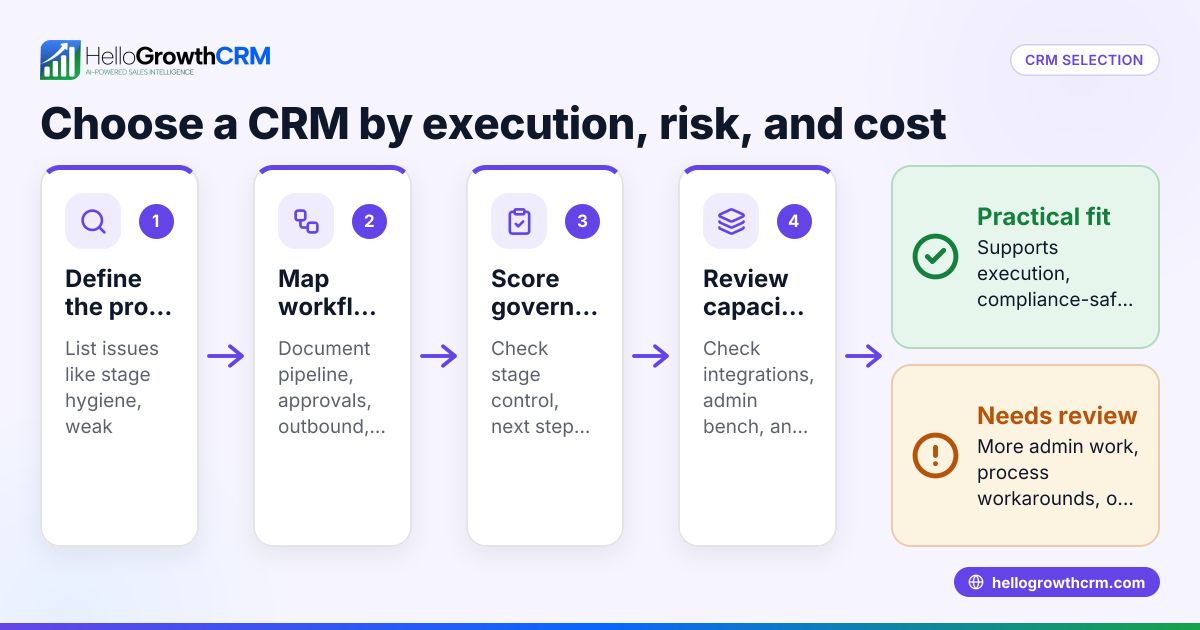
How to evaluate HelloGrowthCRM vs HubSpot for your US sales team: Step-by-Step
Evaluating HelloGrowthCRM vs HubSpot for a US mid-market sales team works best when you test real process friction, not surface features: map your pipeline rules, outbound compliance needs, routing logic, finance integrations, and admin workload, then score each platform against those operating requirements.
- Map your sales process
Document stages, exit criteria, MEDDPICC fields, forecast categories, and stage aging rules. If this is unclear today, your CRM problem is partly a process problem. - Audit outbound controls
Review email, call, and text workflows against CAN-SPAM and TCPA expectations. Check opt-outs, consent status, suppression logic, and template approvals. - Test a real forecast review
Run last quarter’s commit deals through each platform. Ask whether managers can inspect risk, next steps, and close-date movement quickly. - Simulate lead routing
Route inbound demo requests by territory, company size, and named-account ownership. Time how fast each system assigns, alerts, and schedules follow-up. - Check finance and handoff workflows
Validate how Stripe and QuickBooks data appear in the CRM. Make sure booked customers, payment issues, and renewal signals are visible to sales and CS. - Model 24-month total cost in USD
Include licenses, admin labor, training, middleware, and lost productivity. A cheaper line item can still be more expensive operationally. - Run a controlled pilot
Use one pod or region first. The best pilot group is often 8 to 15 reps with one manager and one RevOps owner.
For teams that want a guided evaluation, booking a Demo or starting a Free Trial gives you a faster way to test these workflows in a live US sales context.
If your team cares most about governed pipeline execution, practical outbound controls, and predictable cost, HelloGrowthCRM is usually the stronger choice for American mid-market sales teams. You can review Pricing, explore the full AI CRM, or start a Free Trial to see how it fits your process.
About the author
Jordan Hale is a Sales Operations Lead at HelloGrowthCRM with 10 years of experience in B2B SaaS revenue operations. He has led CRM redesigns covering pipeline governance, lead routing, and forecast process for mid-market teams across New York and Austin. One project that shaped this article was a migration for a 35-rep SaaS company moving from a loose multi-tool setup into a governed sales workflow tied to Stripe, QuickBooks, and manager-led forecast inspection.
Frequently Asked Questions
Q: Is HelloGrowthCRM better than HubSpot for mid-market sales teams in the United States?
A: Yes, HelloGrowthCRM is often better than HubSpot for US mid-market sales teams when the main need is stronger pipeline control, forecast discipline, and outbound governance. HubSpot remains a solid option for teams that value ecosystem familiarity and broader marketing coverage.
Q: Why do RevOps teams compare HelloGrowthCRM and HubSpot?
A: RevOps teams compare HelloGrowthCRM and HubSpot because both can run sales operations, but they differ in how tightly they enforce process and control cost. The real comparison is execution quality, not just contact and deal storage.
Q: Is HubSpot more expensive than HelloGrowthCRM?
A: Yes, HubSpot can be more expensive than HelloGrowthCRM once teams add seats, automation, reporting depth, and multiple hubs. Total cost should include admin overhead, extra tools, and the operational cost of weak process fit.
Q: Which CRM is better for CAN-SPAM and TCPA-conscious outbound teams?
A: HelloGrowthCRM is often better for CAN-SPAM and TCPA-conscious outbound teams because it keeps sales communication workflows closer to the core CRM record and makes controls easier to manage. Legal review is still necessary for your exact email, call, and text use cases.
Q: Can HelloGrowthCRM integrate with Stripe and QuickBooks?
A: Yes, HelloGrowthCRM can integrate with Stripe and QuickBooks for US finance and revenue workflows. That helps teams connect booked revenue, billing status, and customer handoff data to sales and customer success actions.
Q: Is HubSpot still a good choice for US SaaS companies?
A: Yes, HubSpot is still a good choice for many US SaaS companies, especially those that want a familiar brand and broader marketing tooling. It is strongest when the company has enough admin discipline to keep pipelines and reporting clean.
Q: What should I test in a HelloGrowthCRM vs HubSpot pilot?
A: You should test pipeline stage rules, forecast inspection, lead routing, outbound suppression logic, and finance integrations in a HelloGrowthCRM vs HubSpot pilot. Avoid judging either platform on dashboard aesthetics alone.
Q: How long does a CRM migration usually take for a mid-market sales team?
A: A CRM migration for a mid-market sales team usually takes a few weeks to a few months, depending on process complexity and data quality. Teams with multiple pipelines, custom routing, and finance integrations should expect more planning and testing.
Frequently Asked Questions
Ready to put this into practice?
Set up your pipeline, WhatsApp follow-ups, and AI lead scoring in minutes — free, no credit card.
Try HelloGrowthCRM freeGet CRM tips in your inbox
Join thousands of sales professionals who get weekly insights on CRM strategy, AI automation, and pipeline optimization.

The HelloGrowthCRM team publishes guides on CRM strategy, AI sales tools, and revenue operations for small business sales teams.