HelloGrowthCRM software
Built for real small-business sales teams
HelloGrowthCRM helps reps qualify faster, follow up on time, and close more deals—with practical automation in one place.
- AI lead scoring and pipeline visibility
- Built-in dialer, WhatsApp, and email automation
- Sales forecasting and RevOps-ready reporting
Probing questions for sales are open-ended questions that dig deeper into a prospect’s situation, challenges, and goals. Unlike simple yes/no questions, they encourage prospects to share detailed information that reveals their true needs and buying motivations. This deeper understanding helps you tailor your sales approach, build trust, and increase the chance of closing deals.
Why this comes up / what goes wrong
Small business owners and sales teams often struggle because they ask too few probing questions. Without these questions, sales conversations stay superficial and fail to uncover the real reasons a prospect might buy or hesitate. For example, a small distributor might ask, "What do you need?" but miss questions like, "What problems have you faced with your current supplier?" This misses the chance to identify pain points and build rapport.
Another common issue is slow or disorganized follow-up. When salespeople don’t capture or act on insights gained from probing questions, leads cool off or get lost. Without a clear process to track conversations and next steps, opportunities slip away.
Step-by-step
- Prepare your probing questions before the call or meeting. Focus on open-ended questions that encourage detailed responses rather than yes/no answers. Check that your questions relate to common customer challenges and goals.
- Begin by building rapport and understanding the prospect’s current situation. Use a friendly tone and ask about their business context to make them comfortable.
- Ask probing questions to explore challenges and needs. For example: "Can you describe any difficulties you’ve had with your current solution?" or "What impact do these challenges have on your business?" Check for both operational and emotional factors.
- Listen carefully and take notes. Confirm your understanding by summarizing key points and asking if you missed anything important.
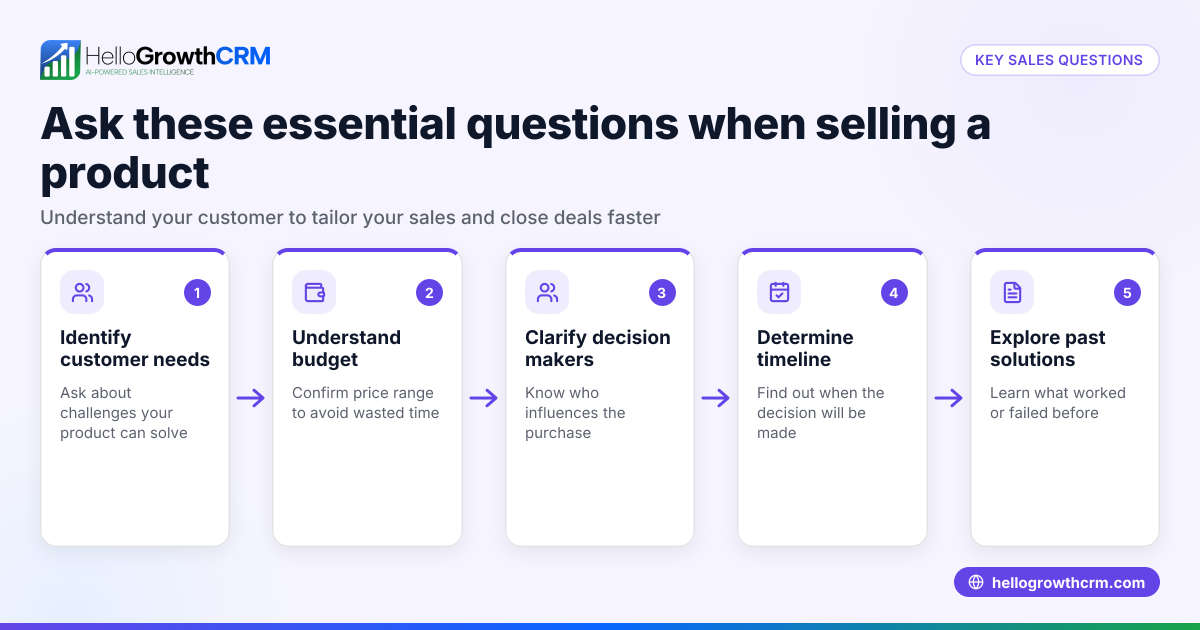
- Identify the decision-making process and timeline. Ask, "Who else is involved in this decision?" and "When do you need to decide?" This ensures you know the next steps.
- Tailor your solution and proposal based on the answers. Align your offer with the prospect’s priorities and pain points.
- Set clear follow-up actions and dates. Confirm when and how you will next contact the prospect to keep the process moving.
Example (fictional figures)
Consider a two-location dental practice in Columbus, Ohio, looking for new patient scheduling software. The sales rep asks probing questions:
- "What issues do you have with your current scheduling system?"
- "How much time does your staff spend managing appointments each week?"
The practice replies: "We spend about 10 hours a week manually rescheduling and handling no-shows, which costs us staff overtime and lost revenue."
Calculation:
10 hours × $25/hour staff cost = $250
Assuming lost revenue from no-shows is $1,000 per week,
$250 + $1,000 = $1,250 weekly cost
Annual cost: $1,250 × 52 weeks = $65,000
This insight helps the sales rep show how their scheduling software can save the practice $65,000 annually by reducing manual work and no-shows.
Common mistakes
- Asking only closed-ended questions: Prevent this by preparing open-ended questions that invite detailed answers.
- Not actively listening: Prevent by taking notes and confirming your understanding during the conversation.
- Skipping follow-up steps: Prevent by setting clear next actions and follow-up dates.
- Trying to sell before understanding needs: Prevent by focusing first on probing questions to gather insights.
- Ignoring decision timelines and stakeholders: Prevent by asking who else is involved and when decisions are expected.
Doing this in HelloGrowthCRM
HelloGrowthCRM helps you manage probing questions and follow-up by tracking deals in a pipeline with stages like 'quote sent' and follow-up dates, so no lead is forgotten. For founders without a sales manager, Managed RevOps provides a dedicated specialist who works the follow-up queue every week, ensuring timely contact. Field sales reps can log visits and activities from their phones, and managers see daily progress, helping tailor sales conversations based on real-time data. Learn more about HelloGrowthCRM for the United States, its WhatsApp and SMS CRM, and the built-in CRM dialer.
Frequently asked questions
What are some examples of probing questions for sales? Probing questions include "What challenges are you currently facing?", "How does this issue affect your business?", and "What would an ideal solution look like for you?" These questions help uncover deeper needs beyond surface facts.
Why are probing questions important in sales? They reveal the prospect’s true pain points and buying motivations, enabling you to tailor your offer and build trust. Without them, sales conversations can be shallow and less effective.
How do I avoid sounding pushy when asking probing questions? Phrase questions naturally and show genuine interest. Use open-ended questions and listen carefully to responses. Avoid rapid-fire or overly personal questions.
Can HelloGrowthCRM help with managing sales follow-up? Yes, HelloGrowthCRM tracks deals, stages, and follow-up dates so you never miss a chance to connect. Managed RevOps offers weekly follow-up support for founders without sales managers.
What is the best way to prepare probing questions? Research common challenges in your target market and focus on questions that invite detailed answers. Practice phrasing them naturally to encourage conversation.
Key takeaways
- Probing questions uncover a prospect’s real needs and challenges.
- Use open-ended questions and active listening to gather insights.
- Confirm understanding and decision timelines to plan next steps.
- Avoid common mistakes like asking only yes/no questions or skipping follow-up.
- HelloGrowthCRM helps track deals, follow-ups, and field visits to support effective sales conversations.
Start improving your sales conversations today. Start on the Free Forever plan (200 leads, no credit card).
Ready to put this into practice?
Set up your pipeline, WhatsApp follow-ups, and AI lead scoring in minutes — free, no credit card.
Try HelloGrowthCRM freeGet CRM tips in your inbox
Join thousands of sales professionals who get weekly insights on CRM strategy, AI automation, and pipeline optimization.

The HelloGrowthCRM team publishes guides on CRM strategy, AI sales tools, and revenue operations for small business sales teams.