HelloGrowthCRM software
Built for real small-business sales teams
HelloGrowthCRM helps reps qualify faster, follow up on time, and close more deals—with practical automation in one place.
- AI lead scoring and pipeline visibility
- Built-in dialer, WhatsApp, and email automation
- Sales forecasting and RevOps-ready reporting
Quantitative forecasting uses numbers and statistical methods to estimate future business outcomes like sales revenue. It depends on measurable data such as historical sales, orders, and market trends instead of subjective opinions or gut feelings.
Why this comes up / what goes wrong
UK small business owners often need to forecast sales to manage cash flow, stock levels, staffing, and growth plans effectively. Without reliable forecasts, businesses risk ordering too much or too little stock, over- or understaffing, missing sales targets, or running into cash flow problems. Many owners guess future sales based on experience or simple averages, which can be inaccurate and lead to poor decisions. Quantitative forecasting offers a data-driven, repeatable way to improve accuracy and confidence in planning.
Step-by-step
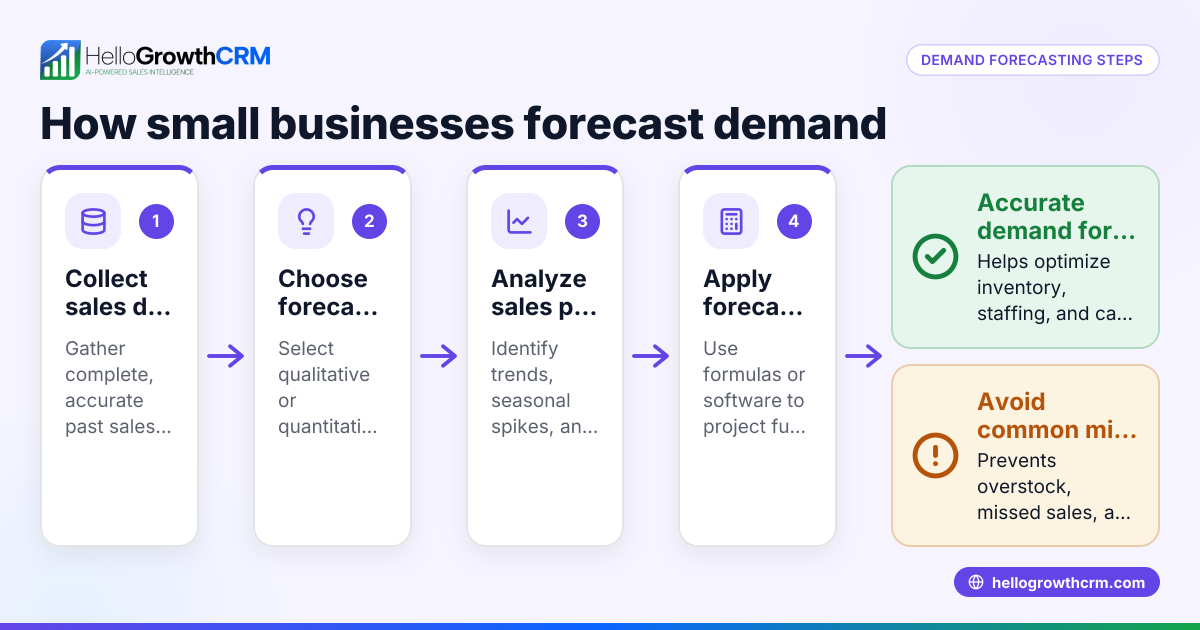
- Collect historical data: Gather past sales figures, order volumes, or lead conversion numbers from your records. Check that the data is complete, consistent, and covers a relevant period.
- Select a forecasting method: Common quantitative methods include moving averages, exponential smoothing, or regression analysis. Choose one that fits your data size, pattern, and business needs.
- Calculate the forecast: Use the chosen method on your historical data to estimate future sales. This can be done with spreadsheet formulas or simple software tools.
- Validate the forecast: Compare your forecasted figures against actual sales from recent periods to check accuracy. Adjust your method or parameters if the forecast is off.
- Apply the forecast for planning: Use the forecast to decide stock orders, staffing levels, marketing budgets, and cash flow projections.
- Update regularly: Refresh your data and recalculate forecasts monthly or quarterly to include recent sales and market changes.
- Monitor your sales pipeline: Track where deals are in the sales process and which stages cause delays to refine your forecasts and identify risks early.
For more on sales projections, see our sales forecasting page.
Example (fictional figures)
A recruitment consultancy in Bristol wants to forecast sales for Q3 2026. They have monthly sales data for Q1 and Q2:
- January 2026: £48,000
- February 2026: £52,000
- March 2026: £50,000
- April 2026: £55,000
- May 2026: £58,000
- June 2026: £60,000
They decide to use a simple 3-month moving average to forecast July, August, and September 2026.
Step 1: Calculate July forecast: £55,000 + £58,000 + £60,000 = £173,000 £173,000 ÷ 3 = £57,666.67
Step 2: Calculate August forecast: £58,000 + £60,000 + £57,666.67 = £175,666.67 £175,666.67 ÷ 3 = £58,555.56
Step 3: Calculate September forecast: £60,000 + £57,666.67 + £58,555.56 = £176,222.23 £176,222.23 ÷ 3 = £58,740.74
So the forecasts are:
- July 2026: £57,667
- August 2026: £58,556
- September 2026: £58,741
This data-driven forecast helps plan recruitment consultant targets, marketing spend, and cash flow.
Common mistakes
- Using insufficient or poor-quality data: Prevent this by collecting complete, clean historical sales data.
- Choosing the wrong forecasting method: Prevent by understanding your data pattern and consulting simple guides or experts.
- Ignoring recent market changes: Prevent by updating forecasts regularly and including new information.
- Relying only on forecasts without monitoring sales pipeline: Prevent by tracking deal stages and adjusting forecasts accordingly.
- Not validating forecasts against actual sales: Prevent by comparing past forecasts with actual results and refining your methods.
Explore how an AI CRM like HelloGrowthCRM can help avoid these mistakes with automated insights.
Doing this in HelloGrowthCRM
HelloGrowthCRM offers pipeline forecast and AI insights that project expected close amounts based on current pipeline stage, velocity and historical conversion patterns. This lets you see which stage deals are stalling in without building a spreadsheet. You get AI-generated analysis of pipeline health, rep performance and revenue signals, helping you refine your quantitative forecasts and focus on deals that matter. Learn more on our sales forecasting page.
Frequently asked questions
What is the difference between quantitative and qualitative forecasting? Quantitative forecasting uses numerical data and statistics to predict outcomes, while qualitative forecasting relies on expert opinions, market research and intuition. Quantitative methods are more objective but need reliable data.
How often should I update my quantitative forecast? It’s best to update forecasts monthly or quarterly as new sales data and market conditions become available. Regular updates keep your planning accurate and responsive.
Can small businesses do quantitative forecasting without special software? Yes, small businesses can use spreadsheets like Excel to apply simple methods such as moving averages or linear regression. However, software like HelloGrowthCRM can automate data capture and provide AI insights, saving time.
How does sales pipeline data improve quantitative forecasting? Sales pipeline data shows where deals are in the sales process and their likelihood to close. Incorporating this data helps adjust forecasts for deal velocity and probability, making predictions more accurate.
Is quantitative forecasting reliable for new businesses with little data? It’s more challenging because of limited historical data, but you can start with qualitative methods and gradually incorporate quantitative techniques as data grows.
For more on forecasting and pipeline management, visit HelloGrowthCRM for the United Kingdom.
Key takeaways
- Quantitative forecasting uses numerical data and statistics to predict future sales.
- Collect clean historical sales data and choose a suitable forecasting method.
- Regularly update and validate forecasts against actual sales.
- Monitor sales pipeline stages to refine forecasts and spot stalled deals.
- Avoid common mistakes like poor data quality and ignoring market changes.
- HelloGrowthCRM’s pipeline forecast and AI insights help automate and improve your sales predictions.
Start improving your sales forecasting today. Start on the Free Forever plan (200 leads, no credit card).
Ready to put this into practice?
Set up your pipeline, WhatsApp follow-ups, and AI lead scoring in minutes — free, no credit card.
Try HelloGrowthCRM freeGet CRM tips in your inbox
Join thousands of sales professionals who get weekly insights on CRM strategy, AI automation, and pipeline optimization.

The HelloGrowthCRM team publishes guides on CRM strategy, AI sales tools, and revenue operations for small business sales teams.