HelloGrowthCRM software
Built for real small-business sales teams
HelloGrowthCRM helps reps qualify faster, follow up on time, and close more deals—with practical automation in one place.
- AI lead scoring and pipeline visibility
- Built-in dialer, WhatsApp, and email automation
- Sales forecasting and RevOps-ready reporting
A rule based chatbot is a software tool that automates conversations using fixed decision trees or scripted responses. Unlike AI chatbots that learn from data, rule based chatbots follow set rules to guide user interactions. Many small-business owners ask about "rule based chatbot" regulations because they want to ensure their automated messaging complies with laws governing customer communication and data privacy.
Why this comes up / what goes wrong
Small business owners often deploy chatbots on websites, social media, or messaging platforms like WhatsApp to engage customers, qualify leads, or provide support. However, they may be unsure if there are specific legal rules they must follow when using chatbots, especially regarding consumer protection, privacy, or telemarketing laws. Ignoring applicable regulations can lead to complaints, fines, or loss of customer trust. For instance, sending unsolicited messages without consent or failing to disclose a chatbot’s automated nature may violate laws like the Telephone Consumer Protection Act (TCPA) or Federal Trade Commission (FTC) rules. (docs.fcc.gov)
Many small businesses run sales and customer communication on WhatsApp, SMS, and email. Without proper consent and disclosure, they risk violating telemarketing and spam laws. Also, managing leads and messaging on spreadsheets or text messages can cause slow follow-up and lost leads.
Step-by-step
There is currently no single federal "rule based chatbot" regulation. However, small businesses using chatbots should follow these general guidelines covering automated messaging and customer communication in the US:
- Identify if your chatbot sends automated marketing or promotional messages to customers or prospects. If yes, telemarketing and spam laws like the TCPA and CAN-SPAM Act may apply.
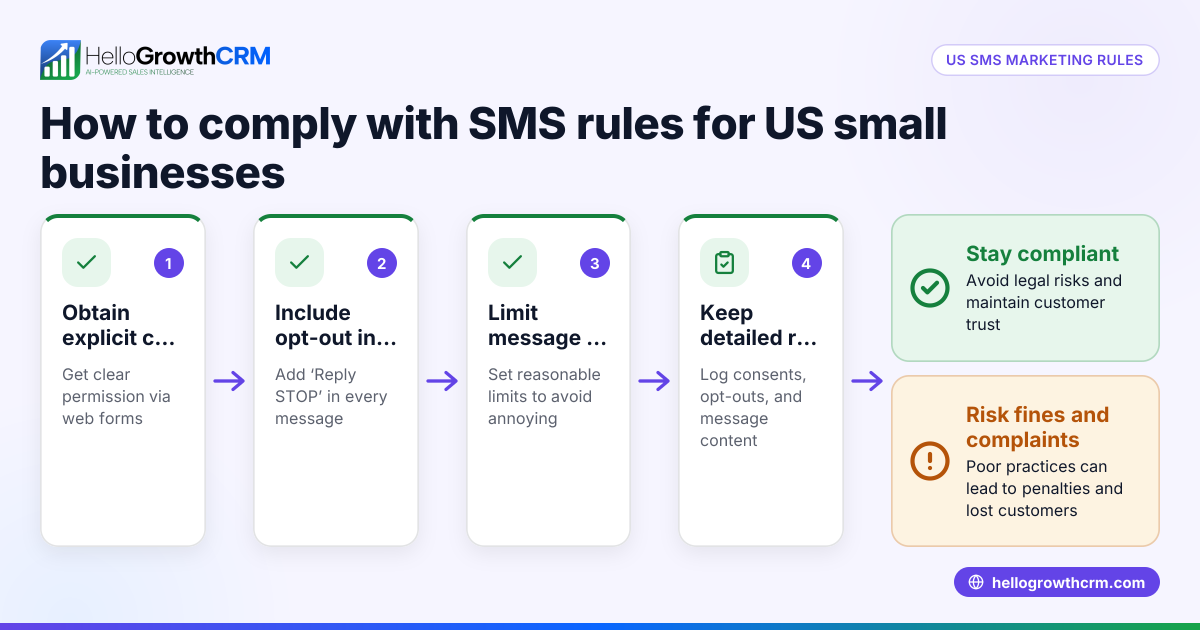
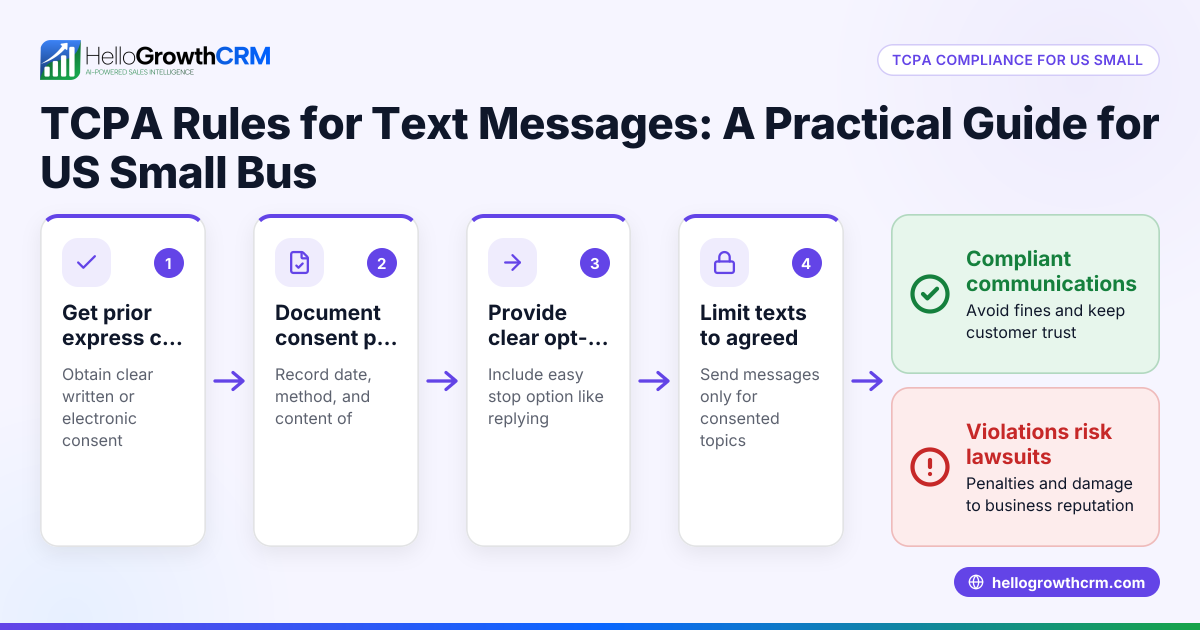
- Obtain clear, documented consent before sending marketing messages via SMS, WhatsApp, or email. Consent must be explicit and verifiable.
- Disclose clearly that users are interacting with a chatbot, not a human, to avoid deceptive practices.
- Provide an easy opt-out mechanism for recipients to stop receiving automated messages at any time.
- Protect any personal data collected by the chatbot according to privacy laws such as the California Consumer Privacy Act (CCPA).
- Regularly review your chatbot scripts, message flows, and data handling to ensure ongoing compliance with current laws and platform policies.
Deadlines and specific thresholds depend on your business size, communication type, and state laws. Because US chatbot regulation is evolving, consult legal counsel for up-to-date advice.
For managing leads and communications effectively, consider tools like HelloGrowthCRM for the United States, which supports WhatsApp and SMS compliance best practices via its WhatsApp and SMS CRM and a built-in CRM dialer.
Example (fictional figures)
Imagine a B2B software reseller in Denver, Colorado, using a rule based chatbot to qualify leads via WhatsApp and SMS. They plan to send promotional messages to 5,000 contacts starting 07/01/2026.
- The reseller obtains express written consent from each contact before sending messages: 5,000 consents documented.
- They include a clear disclosure in the chatbot script: "You are chatting with an automated assistant."
- They provide an opt-out keyword "STOP" allowing recipients to opt out anytime.
- They review data handling policies to comply with CCPA for Colorado residents.
Calculating potential message volume and opt-outs:
Total contacts = 5,000 Assumed opt-out rate = 10% Opt-outs = 5,000 × 10% = 500 Messages sent after opt-outs = 5,000 - 500 = 4,500
By following these steps, the reseller reduces the risk of violating TCPA or privacy laws and maintains customer trust.
Common mistakes
- Failing to obtain explicit consent before sending automated marketing messages. Prevent this by implementing opt-in forms on your website and recording consent clearly.
- Not disclosing that users are interacting with a chatbot, leading to deceptive practices. Prevent this by adding chatbot disclosure messages in all conversations.
- Ignoring opt-out requests, which can result in complaints and penalties. Prevent this by automating opt-out processing promptly.
- Collecting personal data without proper privacy notices or safeguards. Prevent this by providing clear privacy policies and securing data storage.
- Using outdated chatbot scripts that do not comply with updated regulations or platform terms. Prevent this by scheduling regular compliance reviews.
- Managing leads and messages on spreadsheets or text messages, causing slow follow-up and lost leads. Prevent this by using CRM tools designed for WhatsApp and SMS communication, like HelloGrowthCRM for the United States.
Frequently asked questions
What is a rule based chatbot? A rule based chatbot operates using predefined decision trees and scripted responses rather than AI learning. It guides users through fixed dialogs based on their inputs.
Are there US laws specifically regulating rule based chatbots? Currently, no US federal law uniquely regulates rule based chatbots. However, general laws like the TCPA, CAN-SPAM Act, FTC regulations, and privacy laws apply to chatbot communications.
Do I need consent to send chatbot messages? Yes. Consent is required before sending marketing messages via SMS, WhatsApp, or email to comply with telemarketing and spam laws.
Must I disclose that users are chatting with a bot? Yes. Transparency is important to avoid deceptive trade practices. Inform users clearly that they are interacting with an automated system.
How can I handle opt-outs effectively? Provide simple opt-out options such as replying "STOP" and automate the process to ensure timely removal from messaging lists.
How can I manage chatbot leads and messages efficiently? Using CRM tools like HelloGrowthCRM for the United States helps organize leads captured from web forms and messaging platforms, automate follow-ups, and maintain compliance with messaging rules.
Key takeaways
- No specific US federal "rule based chatbot" law exists, but general telemarketing and privacy laws apply.
- Obtain explicit consent before sending automated marketing messages.
- Disclose chatbot usage clearly to users to avoid deceptive practices.
- Provide and respect opt-out mechanisms promptly.
- Regularly review chatbot scripts and data handling for compliance.
- Use CRM tools that support compliant messaging workflows to reduce risk.
Start managing your leads and messaging with confidence. Start on the Free Forever plan (200 leads, no credit card).
Ready to put this into practice?
Set up your pipeline, WhatsApp follow-ups, and AI lead scoring in minutes — free, no credit card.
Try HelloGrowthCRM freeGet CRM tips in your inbox
Join thousands of sales professionals who get weekly insights on CRM strategy, AI automation, and pipeline optimization.

The HelloGrowthCRM team publishes guides on CRM strategy, AI sales tools, and revenue operations for small business sales teams.