HelloGrowthCRM software
Built for real small-business sales teams
HelloGrowthCRM helps reps qualify faster, follow up on time, and close more deals—with practical automation in one place.
- AI lead scoring and pipeline visibility
- Built-in dialer, WhatsApp, and email automation
- Sales forecasting and RevOps-ready reporting
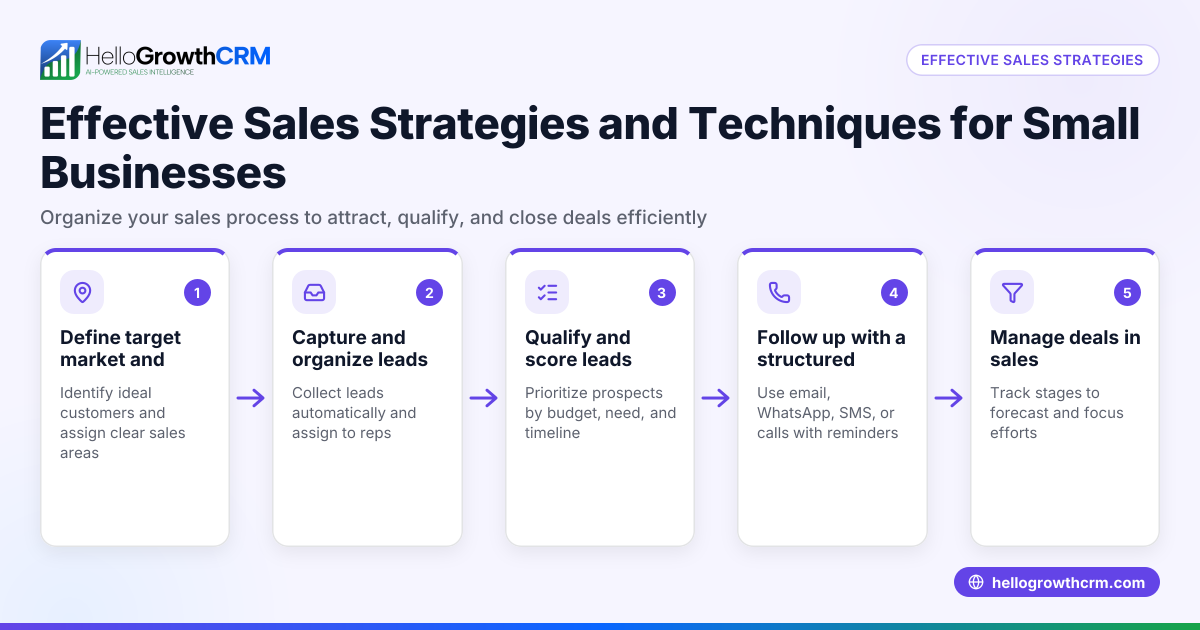
A sales account strategy is a structured approach to managing your most important or promising customers and prospects. It focuses your sales efforts on accounts that matter most to your business goals, guiding how you allocate resources, communicate, and follow up to close deals and grow revenue.
Why this comes up / what goes wrong
Small business owners often face challenges like losing leads due to slow follow-up, juggling sales communications across text messages, email, and spreadsheets, and lacking a clear plan for key accounts. Without a sales account strategy, sales efforts can be scattered, important opportunities missed, and customer relationships underdeveloped. This leads to inconsistent revenue and wasted time.
Step-by-step
- Identify Your Key Accounts
- List customers or prospects with the highest revenue potential or strategic value.
- Check their buying history, industry, and fit with your product or service.
- Segment Accounts by Priority and Needs
- Group accounts by size, industry, or buying stage.
- Determine which require personalized attention versus automated outreach.
- Set Clear Goals for Each Account
- Define what success looks like: a closed deal, upsell, or renewal.
- Assign measurable targets like deal size or sales cycle length.
- Develop Customized Engagement Plans
- Plan communication channels (WhatsApp, SMS, email).
- Schedule follow-ups and content tailored to the account’s needs.
- Assign Responsibilities and Territories
- Allocate accounts to specific sales reps or teams.
- Use tools to track visits, calls, and activities for accountability.
- Use a Pipeline to Track Progress
- Move deals through stages from initial contact to close.
- Update follow-up dates to avoid losing momentum.
- Review and Adjust Regularly
- Analyze what’s working and what isn’t.
- Refine your strategy based on results and feedback.
Example (fictional figures)
A B2B software reseller in Denver, Colorado, targets 10 key accounts for Q3 2026. The owner wants to grow revenue by $500,000 from these accounts.
- Current revenue from these accounts: $1,200,000
- Goal: increase by $500,000
Step 1: Identify accounts with highest potential
- Account A: $300,000 current revenue
- Account B: $250,000
- Account C: $200,000
Step 2: Segment accounts
- Account A and B are large enterprises needing personalized demos
- Account C is a medium business suited for automated sequences
Step 3: Set goals
- Account A: $400,000 revenue target
- Account B: $350,000
- Account C: $250,000
Step 4: Engagement plan
- Schedule weekly WhatsApp check-ins for Account A and B
- Email drip campaigns for Account C
Step 5: Assign reps
- Rep 1 handles Account A and B
- Rep 2 manages Account C
Step 6: Track pipeline
- Deals at different stages with follow-up reminders
Step 7: Review monthly
- Adjust messaging and offers based on feedback
Common mistakes
- Neglecting follow-up schedules: Prevent by setting reminders and using a pipeline tool like HelloGrowthCRM’s Deals (pipeline) to track follow-ups.
- Assigning accounts without clear ownership: Prevent by defining territories and responsibilities to avoid confusion.
- Using generic communication for all accounts: Prevent by segmenting accounts and customizing engagement plans.
- Ignoring data and feedback: Prevent by regularly reviewing pipeline progress and adjusting your strategy.
- Overloading reps with too many accounts: Prevent by balancing workloads and using field operations tools to monitor visits and activities.
Doing this in HelloGrowthCRM
HelloGrowthCRM supports your sales account strategy with features like Deals (pipeline), where a quotation sent last week appears as a deal at the "quote sent" stage with a follow-up date to ensure no opportunity is forgotten. For businesses with field sales teams, Territories, field operations and commissions allow reps to log visits from their phones while managers see daily activity, helping assign and track account ownership. Founders without a sales manager can use Managed RevOps to have a revenue specialist manage follow-up queues weekly, keeping your key accounts moving forward. Learn more about WhatsApp and SMS CRM, built-in CRM dialer, and HelloGrowthCRM for the United States.
Frequently asked questions
What is the difference between account strategy and sales strategy? A sales account strategy focuses on managing individual high-value accounts with tailored plans, while a sales strategy covers overall sales goals and methods for the entire business.
How often should I review my sales account strategy? Review your strategy monthly or quarterly to track progress, update goals, and adjust tactics based on new data or market changes.
Can small businesses benefit from a sales account strategy? Yes, even small businesses benefit by focusing efforts on the most promising customers, improving follow-up, and increasing sales efficiency.
What tools help implement a sales account strategy? CRM software like HelloGrowthCRM helps track deals, assign territories, schedule follow-ups, and manage communications across WhatsApp, SMS, and email.
How do I prioritize accounts for my sales strategy? Prioritize based on revenue potential, strategic fit, buying readiness, and past engagement to focus resources on accounts with the highest return.
Key takeaways
- A sales account strategy targets your most valuable or promising customers with tailored plans.
- Identify, segment, and set clear goals for each key account.
- Use pipelines and follow-up schedules to keep deals progressing.
- Assign clear ownership and use field operations tools for accountability.
- Regularly review and adjust your strategy based on data.
- HelloGrowthCRM offers features that support pipeline tracking, territory management, and managed follow-up.
Start building your sales account strategy today to improve your sales focus and results. You can Start on the Free Forever plan (200 leads, no credit card) with HelloGrowthCRM to organize your deals and follow-ups efficiently.
Ready to put this into practice?
Set up your pipeline, WhatsApp follow-ups, and AI lead scoring in minutes — free, no credit card.
Try HelloGrowthCRM freeGet CRM tips in your inbox
Join thousands of sales professionals who get weekly insights on CRM strategy, AI automation, and pipeline optimization.

The HelloGrowthCRM team publishes guides on CRM strategy, AI sales tools, and revenue operations for small business sales teams.