HelloGrowthCRM software
Built for real small-business sales teams
HelloGrowthCRM helps reps qualify faster, follow up on time, and close more deals—with practical automation in one place.
- AI lead scoring and pipeline visibility
- Built-in dialer, WhatsApp, and email automation
- Sales forecasting and RevOps-ready reporting
Sales forcasting is the process of estimating your future sales revenue using current sales data, pipeline information, and market trends. It helps you plan business resources and make informed decisions. This article covers why sales forcasting is important for small businesses, how to create a forecast step-by-step, an example with realistic numbers, common mistakes to avoid, and how HelloGrowthCRM features support your forecasting efforts.
Why this comes up / what goes wrong
Small-business owners often struggle with unpredictable cash flow and missed sales targets because they don’t know what to expect in coming weeks or months. Without sales forcasting, it’s hard to plan inventory, budget for expenses, or assign sales resources effectively. Leads may be forgotten or followed up too late, causing lost revenue. Sales teams running on text messages, email, and spreadsheets find it challenging to keep track of opportunities or predict close dates. This leads to reactive, rather than proactive, sales management.
Step-by-step
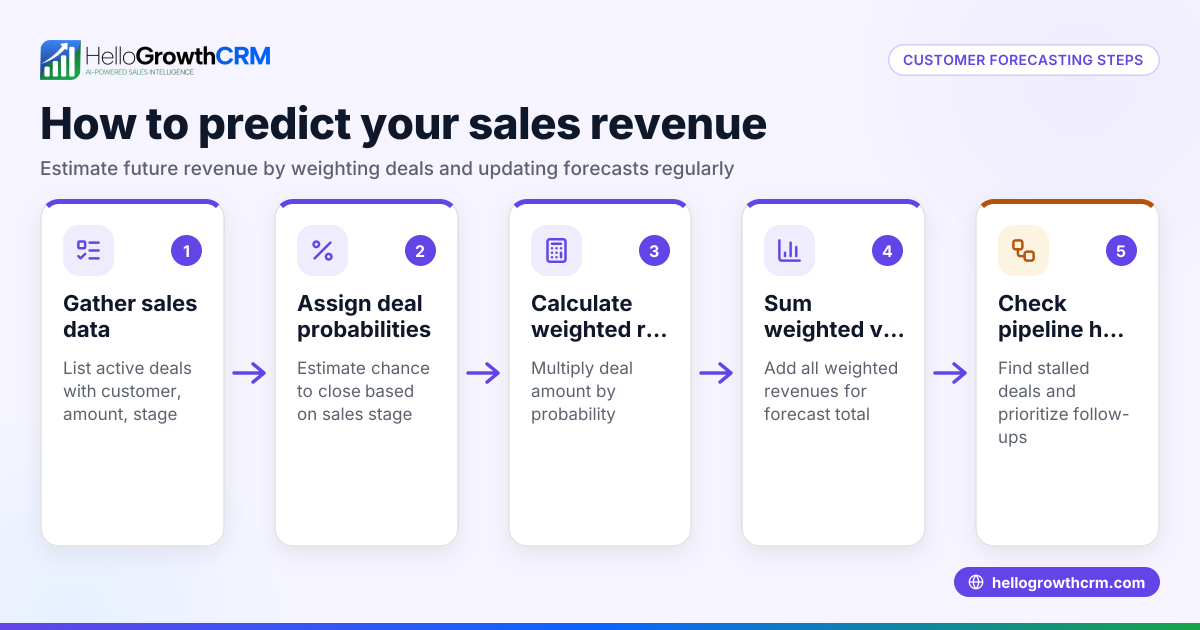
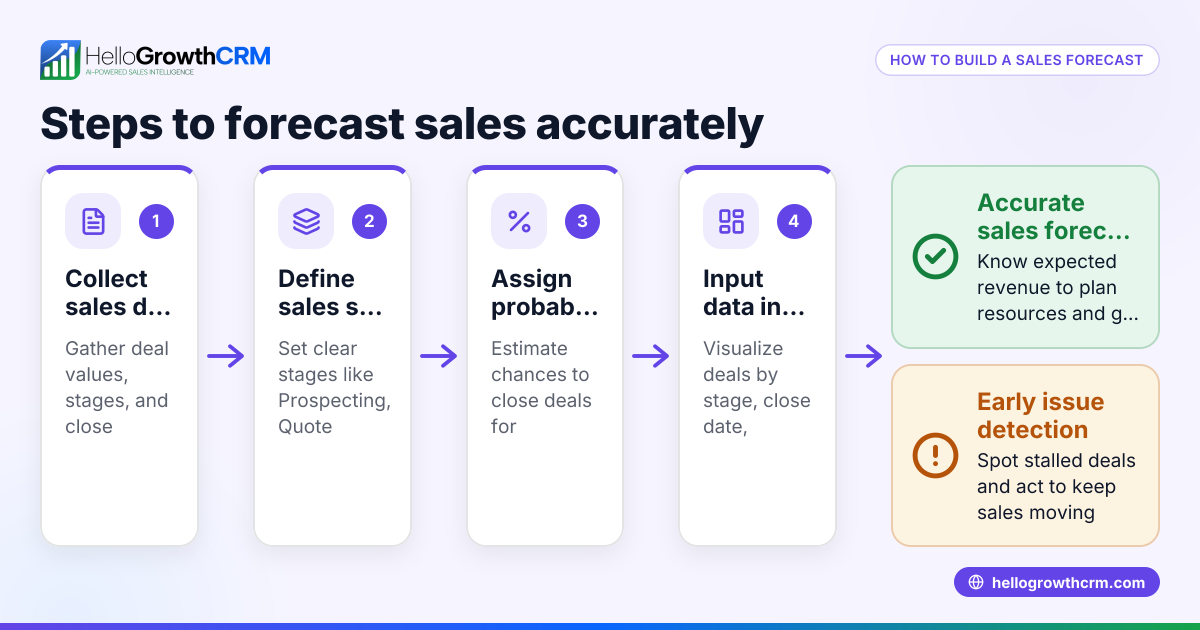
- Gather your sales data: Collect recent sales figures, current deals, and pipeline stages. Check your CRM or sales tracking tool for open opportunities.
- Segment your pipeline: Group deals by stage (e.g., prospecting, quote sent, negotiation). Verify each deal’s expected close date and estimated value.
- Assign probabilities: Estimate the chance each deal will close based on stage and past conversion rates. For example, deals at 'quote sent' stage often have a moderate chance to close.
- Calculate weighted values: Multiply each deal’s value by its probability to get a weighted revenue figure.
- Sum weighted values by time period: Add weighted revenues for deals expected to close in each future month or quarter.
- Review historical trends: Compare your forecast to past sales to adjust for seasonality or market changes.
- Set follow-up tasks and reminders: Ensure no deal is forgotten by scheduling follow-ups in your CRM.
- Update regularly: Review and revise your forecast weekly or monthly as deals progress or new information arrives.
- Communicate the forecast: Share sales forecasts with your team to align efforts and resources.
- Check assumptions: Periodically validate your probabilities and close dates against actual outcomes to improve accuracy.
For more on managing deals and follow-ups, see built-in CRM dialer and WhatsApp and SMS CRM.
Example (fictional figures)
A B2B software reseller in Denver, Colorado, is forecasting sales for Q3 2026.
- Deal 1: $50,000, at 'quote sent' stage, 50% probability, expected close 08/15/2026
- Deal 2: $30,000, at 'negotiation' stage, 70% probability, expected close 09/05/2026
- Deal 3: $20,000, at 'prospecting' stage, 20% probability, expected close 09/20/2026
Calculations:
Deal 1 weighted value: $50,000 × 50% = $25,000
Deal 2 weighted value: $30,000 × 70% = $21,000
Deal 3 weighted value: $20,000 × 20% = $4,000
Sum for August: $25,000 (Deal 1)
Sum for September: $21,000 + $4,000 = $25,000
Total forecasted sales for Q3 2026: $25,000 + $25,000 = $50,000
This forecast helps the reseller plan inventory and staffing for the quarter.
Common mistakes
- Ignoring pipeline stages: Treating all deals equally skews forecasts. Prevent by assigning probabilities per stage.
- Not updating forecasts regularly: Old data leads to inaccurate predictions. Schedule weekly updates.
- Overestimating deal close dates: Being too optimistic delays action. Use realistic close dates based on history.
- Forgetting follow-ups: Lost deals hurt revenue. Use CRM reminders to stay on top.
- Not reviewing forecast accuracy: Without feedback, forecasting won’t improve. Track actuals vs forecast monthly.
- Relying on spreadsheets alone: Manual tracking causes errors and delays. Use a CRM with pipeline management like HelloGrowthCRM.
See HelloGrowthCRM for the United States for tools that help avoid these mistakes.
Doing this in HelloGrowthCRM
HelloGrowthCRM offers a Deals (pipeline) feature that tracks open opportunities from first contact to close. For example, a quotation sent last week appears as a deal at the 'quote sent' stage with a follow-up date, so it is not forgotten. This helps you keep your forecast accurate and your sales process on track. Learn more at HelloGrowthCRM Deals (pipeline).
Frequently asked questions
What is the difference between sales forecasting and pipeline management? Sales forecasting estimates future revenue based on pipeline data and probabilities. Pipeline management tracks the status and progress of individual deals. Both work together to create accurate forecasts.
How often should I update my sales forecast? Ideally, update your forecast weekly or at least monthly. Frequent updates reflect changes in deal status and improve accuracy.
Can small businesses do sales forecasting without a CRM? Yes, but it is more error-prone and time-consuming. Using a CRM like HelloGrowthCRM helps automate tracking, reminders, and calculations.
What if my sales forecast is consistently wrong? Review your assumptions about deal probabilities and close dates. Check for missing deals or inaccurate data entry. Adjust based on historical results.
How does HelloGrowthCRM support sales forecasting? It provides a pipeline view with deal stages, follow-up dates, and probability tracking to keep your forecast current and actionable.
Key takeaways
- Sales forcasting predicts future revenue using current deals and probabilities.
- Segment your pipeline and assign realistic probabilities per stage.
- Calculate weighted deal values and sum them by expected close date.
- Update forecasts regularly and review accuracy to improve.
- Use CRM tools like HelloGrowthCRM to track deals, set reminders, and avoid lost leads.
Start improving your sales forcasting today. Start on the Free Forever plan (200 leads, no credit card).
Ready to put this into practice?
Set up your pipeline, WhatsApp follow-ups, and AI lead scoring in minutes — free, no credit card.
Try HelloGrowthCRM freeGet CRM tips in your inbox
Join thousands of sales professionals who get weekly insights on CRM strategy, AI automation, and pipeline optimization.

The HelloGrowthCRM team publishes guides on CRM strategy, AI sales tools, and revenue operations for small business sales teams.