HelloGrowthCRM software
Built for real small-business sales teams
HelloGrowthCRM helps reps qualify faster, follow up on time, and close more deals—with practical automation in one place.
- AI lead scoring and pipeline visibility
- Built-in dialer, WhatsApp, and email automation
- Sales forecasting and RevOps-ready reporting
A sales forecast spreadsheet template UK is a practical tool that helps small and mid-sized businesses organise their sales pipeline, estimate future revenue, and plan cash flow. It typically includes columns for client names, deal stages, expected close dates, deal values in GBP, and probabilities for closing each deal. Using such a template reduces guesswork and supports better business decisions.
Why this comes up / what goes wrong
Many UK business owners rely on scattered WhatsApp messages, emails, and basic spreadsheets to track sales leads. Without a consistent and structured sales forecast template, it’s easy to lose track of deals, miss follow-ups, and produce inaccurate revenue predictions. These issues cause cash flow problems and hinder growth. A ready-to-use sales forecast spreadsheet template UK helps solve these problems by organising your pipeline data clearly and consistently.
Step-by-step
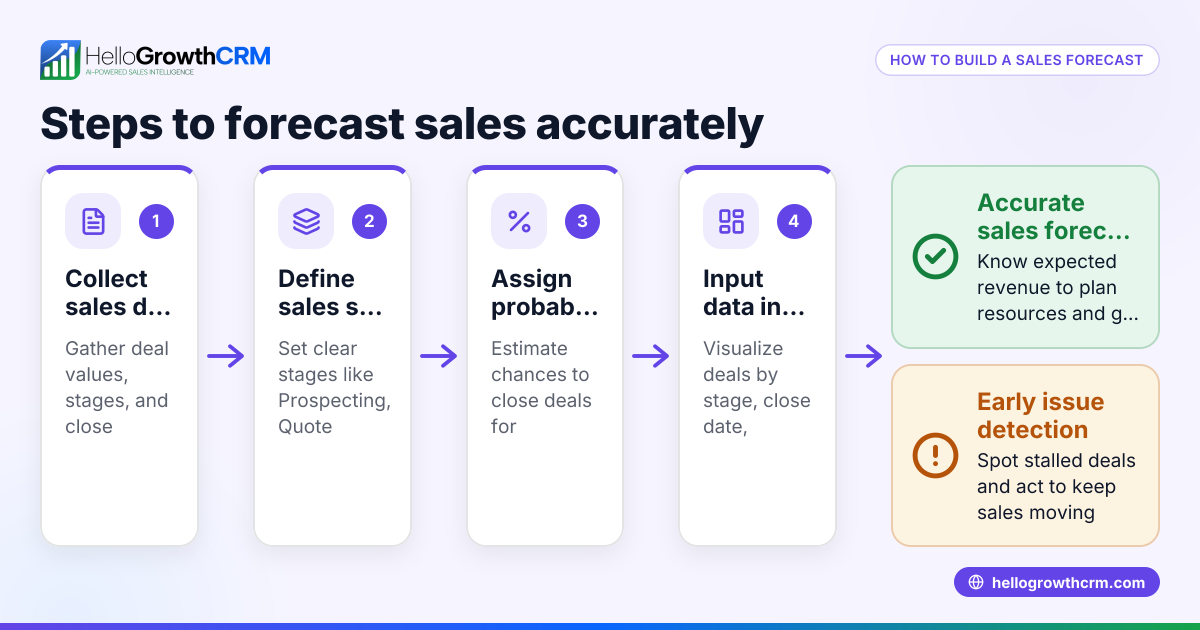
- Download a UK-specific sales forecast spreadsheet template. Choose one that includes client name, deal stage, expected close date (DD/MM/YYYY), deal value in GBP, and deal probability percentages.
- Input your current sales pipeline data. Add each lead or opportunity with details such as client name, product or service, expected close date, and estimated sale value.
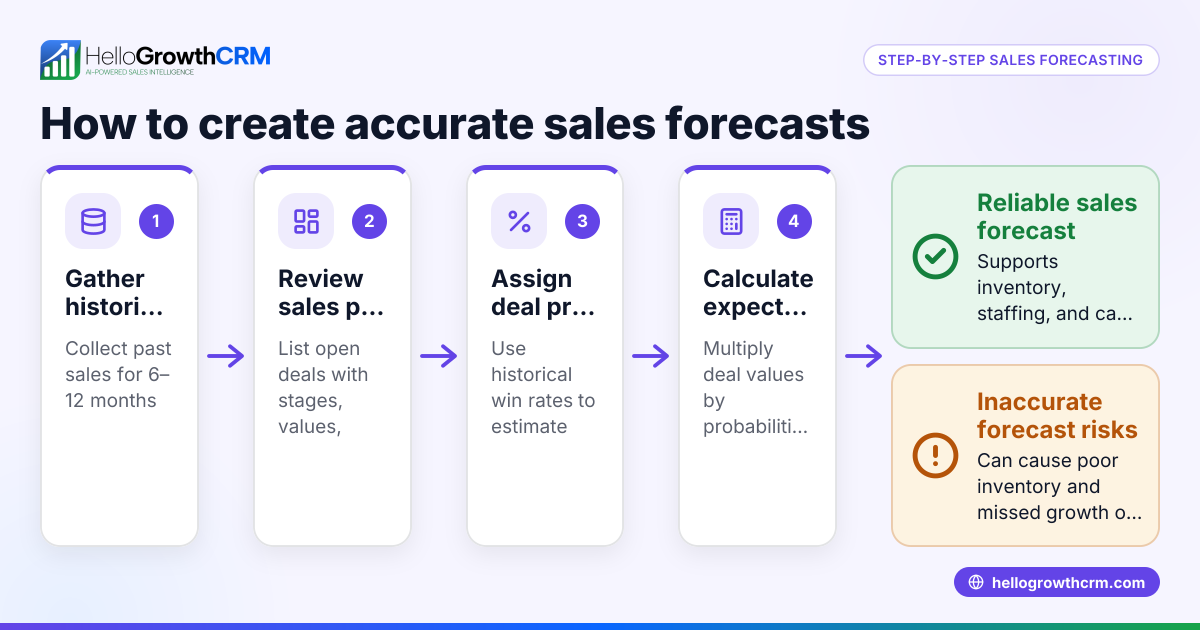
- Assign probabilities to each deal stage. For example, ‘initial contact’ might be 10%, ‘quote sent’ 50%, and ‘negotiation’ 75%. This helps weight your forecast realistically.
- Calculate weighted forecast values. Multiply each deal’s value by its probability to get a weighted expected revenue figure.
- Summarise weighted values by month or quarter. This breakdown shows expected sales over time, aiding cash flow planning.
- Review and update your forecast regularly. Update deal stages, probabilities, and expected close dates weekly or monthly to keep the forecast accurate.
- Cross-check forecast against actual sales monthly. Adjust your probabilities and assumptions to improve forecast reliability.
- Use consistent UK formats. Always use GBP for currency and DD/MM/YYYY for dates to avoid confusion.
- Download complementary sales templates and tools. Free resources at HelloGrowthCRM include pipeline templates and follow-up cadence templates to support your spreadsheet approach (/tools).
Example (fictional figures)
A Manchester letting agency forecasts sales for Q3 2024:
| Deal | Stage | Probability | Value (£) | Weighted Value (£) |
|---|---|---|---|---|
| A | Quote sent | 50% | 15,000 | 15,000 × 50% = 7,500 |
| B | Negotiation | 75% | 20,000 | 20,000 × 75% = 15,000 |
| C | Initial contact | 10% | 10,000 | 10,000 × 10% = 1,000 |
Total weighted forecast for Q3 2024: 7,500 + 15,000 + 1,000 = £23,500
This forecast enables the agency to plan cash flow and allocate resources effectively for the quarter.
Common mistakes
- Overestimating probabilities: Prevent this by basing percentages on historical sales data rather than optimism.
- Ignoring deal stages: Track each opportunity’s progress to avoid lumping all leads together, which distorts forecasts.
- Failing to update regularly: Update your spreadsheet weekly or monthly to reflect changes in your sales pipeline.
- Not scheduling follow-ups: Include follow-up dates in your template to prevent deals from stalling.
- Using inconsistent currency or date formats: Always use GBP and UK date format (DD/MM/YYYY) to avoid confusion.
- Relying solely on spreadsheets: Manual entry risks errors and missed opportunities; consider tools that automate tracking and reminders, such as free sales templates and calculators available at HelloGrowthCRM (/tools).
Doing this in HelloGrowthCRM
HelloGrowthCRM offers free sales tools, templates and calculators that you can download without creating an account, including follow-up cadence and pipeline templates to complement your spreadsheet approach (/tools). Its pipeline forecast and AI insights feature helps identify where deals are stalling without building spreadsheets (/product/sales-forecasting). The Deals (pipeline) feature tracks open opportunities from first contact through to close, showing quotations at the 'quote sent' stage with follow-up dates so nothing is forgotten (/product/ai-crm). These tools reduce manual work and improve forecast accuracy.
Frequently asked questions
What should a UK sales forecast spreadsheet include? It should include client name, deal stage, expected close date in DD/MM/YYYY format, deal value in GBP, and probability percentages for each stage. This allows calculation of weighted expected revenue.
How often should I update my sales forecast spreadsheet? Update it weekly or at least monthly to reflect changes in deal status, client interest, and new leads. Regular updates increase forecast reliability.
Can I use HelloGrowthCRM templates to start my sales forecast? Yes, HelloGrowthCRM provides free sales templates and calculators available without signing up (/tools). These templates help organise your pipeline and follow-ups.
How does probability affect sales forecasting? Probability weights each deal’s value by its chance of closing, producing a more realistic expected revenue figure. Overestimating probabilities leads to inflated forecasts.
Is it better to use a spreadsheet or a CRM for sales forecasting? Spreadsheets are flexible but require manual updates and risk errors. A CRM automates data capture, provides AI insights, and tracks deals with reminders, reducing manual work and improving accuracy (/product/ai-crm).
What are the benefits of AI insights in sales forecasting? AI insights analyse pipeline health, rep performance, and revenue signals to highlight stalled deals or forecast accuracy issues, helping you focus efforts where needed (/product/sales-forecasting).
Key takeaways
- Use a structured UK sales forecast spreadsheet template with deal stages, probabilities, and expected close dates.
- Assign realistic probabilities to each deal stage to calculate weighted expected revenue.
- Update your forecast regularly to reflect pipeline changes and improve accuracy.
- Avoid common errors like overestimating probabilities, ignoring follow-ups, and inconsistent formats.
- Complement spreadsheets with free sales tools and pipeline templates from HelloGrowthCRM (/tools).
- Consider using HelloGrowthCRM’s pipeline forecast and Deals features for automated tracking and AI insights (/product/sales-forecasting, /product/ai-crm).
Start your sales forecasting with confidence using a clear spreadsheet template and supported by HelloGrowthCRM’s free resources. Start on the Free Forever plan (200 leads, no credit card).
Ready to put this into practice?
Set up your pipeline, WhatsApp follow-ups, and AI lead scoring in minutes — free, no credit card.
Try HelloGrowthCRM freeGet CRM tips in your inbox
Join thousands of sales professionals who get weekly insights on CRM strategy, AI automation, and pipeline optimization.

The HelloGrowthCRM team publishes guides on CRM strategy, AI sales tools, and revenue operations for small business sales teams.