HelloGrowthCRM software
Built for real small-business sales teams
HelloGrowthCRM helps reps qualify faster, follow up on time, and close more deals—with practical automation in one place.
- AI lead scoring and pipeline visibility
- Built-in dialer, WhatsApp, and email automation
- Sales forecasting and RevOps-ready reporting
Sales OKRs are a goal-setting framework that helps sales teams define clear objectives and measurable key results to track progress. They focus your sales efforts on priorities such as increasing revenue, improving conversion rates, or expanding customer accounts. This article covers why sales OKRs matter for small businesses, how to create them in practical steps, a worked example with realistic figures, common mistakes to avoid, and how HelloGrowthCRM supports managing sales activities aligned with OKRs.
Why this comes up / what goes wrong
Small business owners often struggle with sales growth because their teams lack clear, measurable goals. Without sales OKRs, sales efforts can be scattered, follow-ups may be missed, and it becomes hard to track progress or hold the team accountable. Many small businesses rely on informal methods like spreadsheets, texts, or email chains, which do not provide visibility or structure. This leads to lost leads, inconsistent pipelines, and unpredictable revenue. Sales OKRs provide focus and accountability by defining what success looks like and how to measure it.
Step-by-step
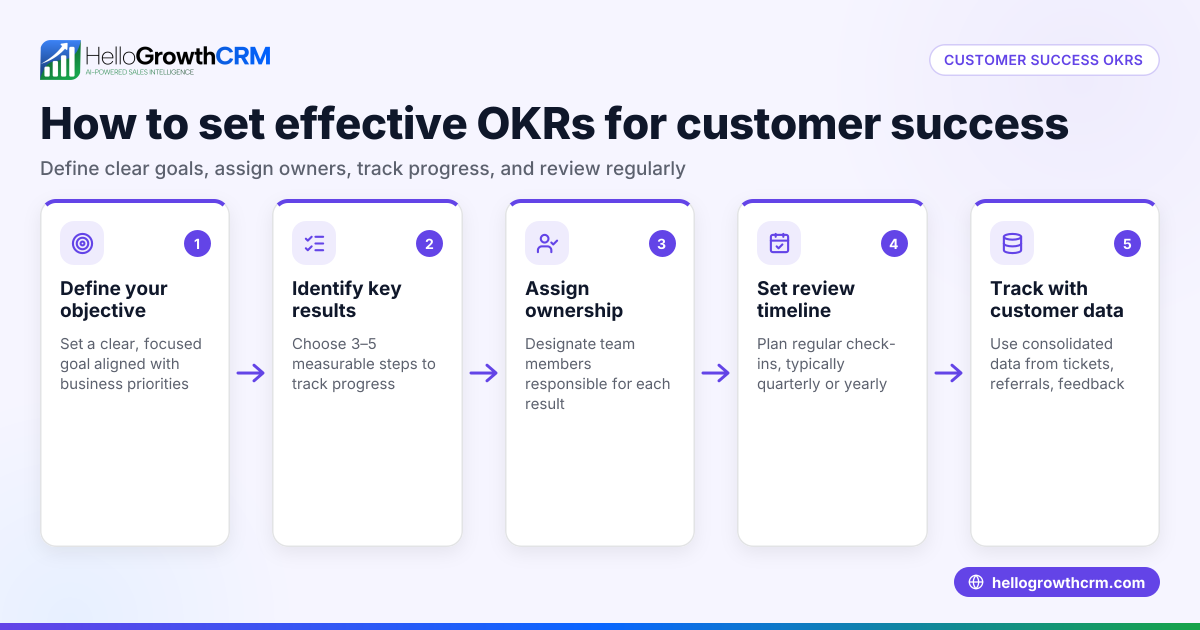
- Define your sales objective clearly. Decide on a specific goal such as "Increase monthly sales revenue" or "Improve lead conversion rate." The objective should be ambitious but achievable.
- Set measurable key results. Break down the objective into 3-5 quantifiable results. For example, "Generate qualified leads per month," "Close a set number of deals monthly," or "Reduce the average sales cycle duration."
- Assign ownership and timelines. Specify who is responsible for each key result and set a deadline, typically quarterly. This creates accountability.
- Track progress regularly. Use tools or meetings to update on each key result weekly or biweekly. Assess what’s working and what needs adjustment.
- Review and adjust OKRs quarterly. At the end of the period, measure actual results against targets. Celebrate wins, learn from misses, and set new OKRs for the next cycle.
- Integrate your OKRs with sales workflows. Make sure daily sales activities align with OKRs. For example, follow-up calls, pipeline management, and lead outreach should support your key results.
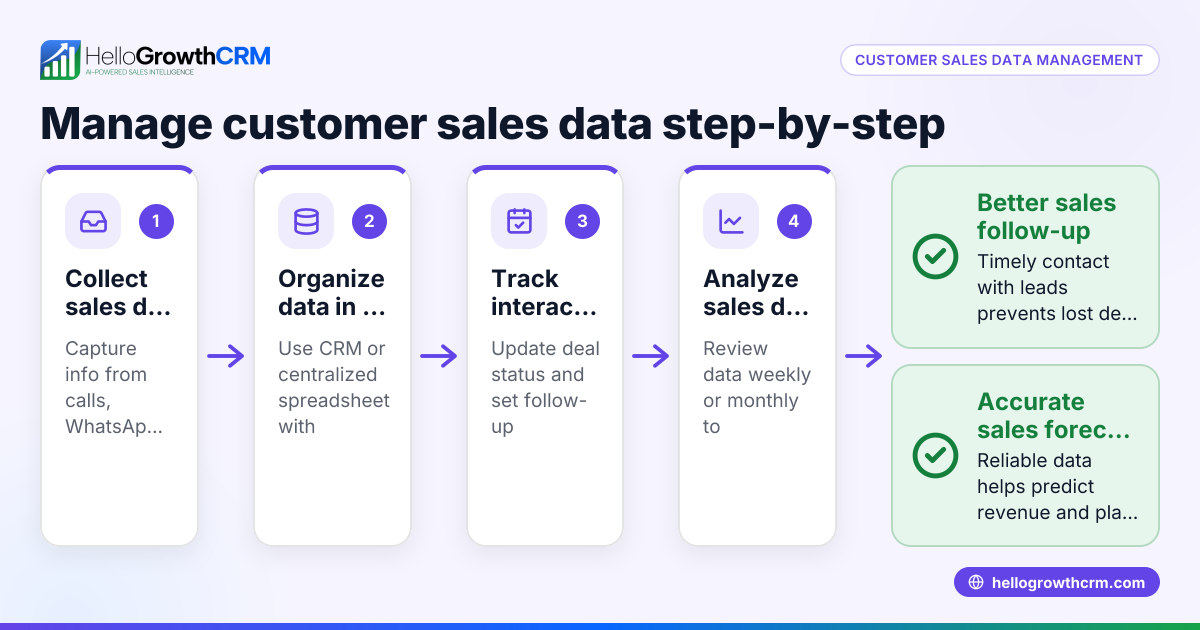
- Use CRM tools to support OKRs. Track deals, follow-ups, and lead statuses in one place to maintain focus and avoid lost opportunities.
Example (fictional figures)
A two-location dental practice in Columbus, Ohio wants to increase new patient appointments by 20% in Q3 2026.
Objective: Increase new patient appointments by 20% by 09/30/2026.
Key Results:
- Generate 300 new patient inquiries per month.
- Convert those inquiries into 120 appointments monthly.
- Reduce appointment no-show rate from 15% to 10%.
Calculations:
Current monthly appointments = 100
Target increase = 100 × 20% = 20
Target monthly appointments = 100 + 20 = 120
To get 120 appointments, they aim for 300 inquiries (assuming a conversion rate of 40%, which is a typical industry benchmark but not stated as a fact here) to reach the target appointments.
Monthly revenue per new patient appointment = $150
Current monthly revenue from new patients = 100 × $150 = $15,000
Target monthly revenue from new patients = 120 × $150 = $18,000
Increase in monthly revenue = $18,000 - $15,000 = $3,000
They will track inquiries and appointments weekly, adjusting marketing and follow-up calls to meet targets.
Common mistakes
- Setting vague objectives. Prevent this by making objectives specific and measurable, e.g., "Increase sales revenue by 10%" instead of "Increase sales."
- Too many key results. Limit to 3-5 key results per objective to maintain focus.
- Ignoring timelines. Always set deadlines to create urgency and accountability.
- Failing to track progress regularly. Schedule weekly or biweekly check-ins to stay on target.
- Not aligning daily sales activities with OKRs. Use CRM tools to link tasks and deals to your OKRs to avoid lost leads or forgotten follow-ups. See how pipeline management helps in HelloGrowthCRM.
- Overlooking field sales activity and territory management. If you have field reps, track their visits and commissions to ensure alignment with OKRs using territory and field operations features in HelloGrowthCRM.
Doing this in HelloGrowthCRM
HelloGrowthCRM helps manage sales OKRs by organizing deals in a pipeline where each opportunity is tracked from first contact through close. For example, a quotation sent last week appears as a deal at the 'quote sent' stage with a follow-up date, so it is not forgotten. For businesses with field sales, reps can log visits from their phones, and managers can see daily activity beats. If you don’t have a dedicated sales manager, Managed RevOps support is available to keep your follow-up queue active and clean every week. Learn more about these features to keep your sales team aligned and accountable.
Frequently asked questions
What are sales OKRs? Sales OKRs are specific objectives and measurable key results set for sales teams to focus efforts and track progress. They clarify what the team aims to achieve and how success is measured.
How often should I set or review sales OKRs? Most businesses set sales OKRs quarterly, with weekly or biweekly progress tracking. Quarterly reviews allow adjustment of goals based on performance and market changes.
Can sales OKRs work for small teams? Yes, sales OKRs are especially helpful for small businesses to create clear priorities and accountability. They prevent scattered efforts and lost leads.
How do I link daily sales activities to OKRs? Use a CRM to track deals, follow-ups, and communications. This ensures daily tasks contribute directly to your key results and objectives. Pipeline and task boards can help with this in HelloGrowthCRM.
What if I don’t have a sales manager? You can use Managed RevOps services to get expert help with lead follow-up, pipeline hygiene, and weekly KPI reporting, keeping your sales process on track. See Managed RevOps for details.
Key takeaways
- Sales OKRs define clear, measurable goals for your sales team.
- Set a few key results per objective with ownership and deadlines.
- Track progress regularly and adjust quarterly.
- Avoid vague goals, too many key results, and poor tracking.
- Align daily sales tasks with OKRs using CRM tools.
- Use pipeline and field operations features to support sales activity and accountability.
Start improving your sales focus and results by setting your first sales OKRs today. To manage your sales pipeline, follow-ups, and team activities effectively, consider trying HelloGrowthCRM. Start on the Free Forever plan (200 leads, no credit card).
Ready to put this into practice?
Set up your pipeline, WhatsApp follow-ups, and AI lead scoring in minutes — free, no credit card.
Try HelloGrowthCRM freeGet CRM tips in your inbox
Join thousands of sales professionals who get weekly insights on CRM strategy, AI automation, and pipeline optimization.

The HelloGrowthCRM team publishes guides on CRM strategy, AI sales tools, and revenue operations for small business sales teams.