HelloGrowthCRM software
Built for real small-business sales teams
HelloGrowthCRM helps reps qualify faster, follow up on time, and close more deals—with practical automation in one place.
- AI lead scoring and pipeline visibility
- Built-in dialer, WhatsApp, and email automation
- Sales forecasting and RevOps-ready reporting
Salesforce alternatives for mid market B2B teams that want simpler pipeline governance are CRM platforms built to give leaders cleaner stage control, better forecast accuracy, and easier rep adoption without heavy admin work, costly customization, or slow reporting. For growing revenue teams, the best alternative is not just a lower-cost CRM. It is a system that helps marketing, sales, and RevOps run one clear process, enforce deal hygiene, and make pipeline reviews faster and more reliable.
Key Takeaways
- Mid-market B2B teams often outgrow loose CRM habits before they outgrow their revenue goals.
- Simpler pipeline governance means clear stages, required fields, clean handoffs, and consistent forecasting.
- Many teams look for Salesforce alternatives when admin work, customization, and reporting complexity slow execution.
- HelloGrowthCRM is designed for teams that want structure without a long implementation cycle.
- The right CRM should support lead scoring, email automation, forecasting, and pipeline visibility in one workflow.
- A successful switch depends on process design, data cleanup, and rep adoption as much as software selection.
Why Mid-Market B2B Teams Start Looking for Alternatives
Mid-market B2B sales teams face a common problem. They need more control than spreadsheets and lightweight CRMs can offer. But they do not want a platform that takes months to configure and maintain.
This is where the search for salesforce alternatives for mid market b2b teams that want simpler pipeline governance usually starts. The issue is rarely only price. The bigger issue is operational drag.
Teams often struggle with:
- Too many custom fields and objects
- Inconsistent stage definitions
- Poor handoff between SDRs and AEs
- Forecast reports that depend on manual cleanup
- Low rep adoption because workflows feel heavy
- RevOps teams spending more time fixing data than improving process
For a mid-market B2B company, pipeline governance needs to be practical. Managers need to trust what they see in the CRM. Reps need to know what happens next. Marketing needs clear lead routing. Leadership needs confidence in forecasts.
That is why many teams compare platforms based on ease of execution, not feature volume. A CRM should support day-to-day selling. It should not become a separate admin project.
What Simpler Pipeline Governance Actually Means
Simpler pipeline governance does not mean less control. It means clearer control with less friction.
In practice, strong pipeline governance includes:
- Standard deal stages with clear entry and exit rules
- Required fields at the right moments
- Consistent next-step tracking
- Defined ownership across the funnel
- Forecast categories tied to real deal behavior
- Alerts for stalled or risky deals
A mid-market B2B software company gives a good example. Imagine a team with 25 sellers across inbound, outbound, and expansion motions. If each rep uses different close dates, different stage logic, and different qualification notes, the pipeline becomes hard to trust. Weekly forecast calls turn into data repair sessions.
A better setup uses automation and clear rules. For example, a deal cannot move to Proposal without budget, timeline, and decision process fields completed. A manager can then review pipeline quality instead of asking reps to fill in basics during the meeting.
HelloGrowthCRM is built around this kind of structure. Teams can align process, reporting, and automation through connected Features instead of relying on layers of custom work.
Signs Your Current CRM Is Too Complex for Your Team
Many teams do not realize the CRM is the problem until execution slows down. Watch for these signs:
- Reps update records late because the system feels tedious
- Managers keep separate spreadsheets for forecast calls
- Pipeline reviews focus on missing data, not deal strategy
- New hires need too much training to follow the process
- Simple changes need admin or consultant support
- Reporting is possible, but not fast enough for weekly decisions
Complexity creates hidden cost. You may still have the features you asked for. But if your team avoids using them, governance breaks down anyway.
What to Look for in a Salesforce Alternative
The best alternative for a mid-market B2B team should improve pipeline discipline while reducing manual effort. That means looking past broad claims and testing specific workflows.
1. Clear stage-based process control
You need a CRM that makes stage progression easy to govern. Look for:
- Required fields by stage
- Exit criteria tied to selling milestones
- Alerts for stalled deals
- Easy visibility into pipeline aging
This matters more than having endless customization. Governance works best when the process is visible and repeatable.
2. Better forecasting without manual patchwork
Forecasting should come from live deal behavior. It should not depend on heroic manager cleanup each Friday.
With built-in Sales Forecasting, teams can connect stage quality, close confidence, and pipeline movement in one place. That helps leaders spot risk early and coach reps on real signals.
3. Lead routing and qualification built into the workflow
Mid-market teams often lose speed between marketing and sales. An alternative CRM should help route, score, and prioritize leads automatically.
This is where AI Lead Scoring and an integrated AI CRM can help. Instead of sending every lead into the same queue, teams can focus reps on accounts with stronger fit and intent.
4. Automation that reduces admin load
Automation should support governance. It should not create more logic to maintain.
Useful examples include:
- Auto-creating follow-up tasks after a meeting
- Updating lifecycle stages from lead behavior
- Triggering alerts when close dates slip
- Moving inactive deals into review queues
- Sending nurture sequences through Email Automation
These workflows help enforce consistency without asking managers to monitor everything manually.
5. Fast implementation and easier adoption
Mid-market teams often do not have a large internal CRM admin function. They need a system that can go live quickly and stay manageable.
That is why many buyers also look at service support. With Managed RevOps, teams can set up pipeline rules, reporting, and handoffs without building everything from scratch.
How HelloGrowthCRM Fits This Need
HelloGrowthCRM is a strong fit for B2B teams that want tighter process control without a heavy platform burden. Its value is not just in replacing a CRM. It is in making pipeline execution easier to run.
A mid-market SaaS company might use HelloGrowthCRM like this:
- Marketing captures inbound demos and content leads
- AI scoring prioritizes accounts with the best fit
- SDRs work a structured qualification process
- Qualified deals move through stage rules with required fields
- Managers review forecast risk using live opportunity data
- Customer-facing teams track expansion opportunities in the same system
This creates one operating model. Teams are not bouncing between tools and spreadsheets to understand pipeline health.
Governance workflows that matter most
For most B2B teams, the most important governance workflows are simple:
- Lead-to-opportunity conversion rules
- Stage exit criteria
- Next-step enforcement
- Forecast rollups by team and segment
- Pipeline aging and stuck-deal alerts
- Rep activity tied to deal progression
HelloGrowthCRM supports these workflows through connected Integrations, reporting, and purpose-built Sales Tools. The result is less custom overhead and better day-to-day visibility.
Why this matters for RevOps leaders
RevOps leaders need a CRM that supports scale without turning every process change into a project. If adding one field breaks reports or stage logic, governance gets expensive.
HelloGrowthCRM gives RevOps teams a cleaner base to work from. The goal is to simplify control, not remove it. That is a better fit for companies that need discipline but do not want a highly complex operating model.
Comparing Approaches: Heavy Customization vs Guided Simplicity
When teams evaluate CRM options, they often compare two broad approaches.
Heavy customization model
This model offers maximum flexibility. It can work well for very large organizations with dedicated admin and development resources. But mid-market teams often run into tradeoffs:
- Longer setup times
- Higher consulting dependency
- More testing when processes change
- Slower report updates
- Lower rep adoption if screens feel cluttered
Guided simplicity model
This approach focuses on common B2B revenue workflows. It gives teams enough control to enforce process, but with fewer moving parts.
The benefits are often better for mid-market execution:
- Faster onboarding
- Cleaner pipeline data
- Easier training for reps and managers
- Quicker reporting cycles
- Less admin burden for RevOps
HelloGrowthCRM fits the guided simplicity model. Teams can still tailor the system to their process, but they do not need to overbuild governance just to get basic control.
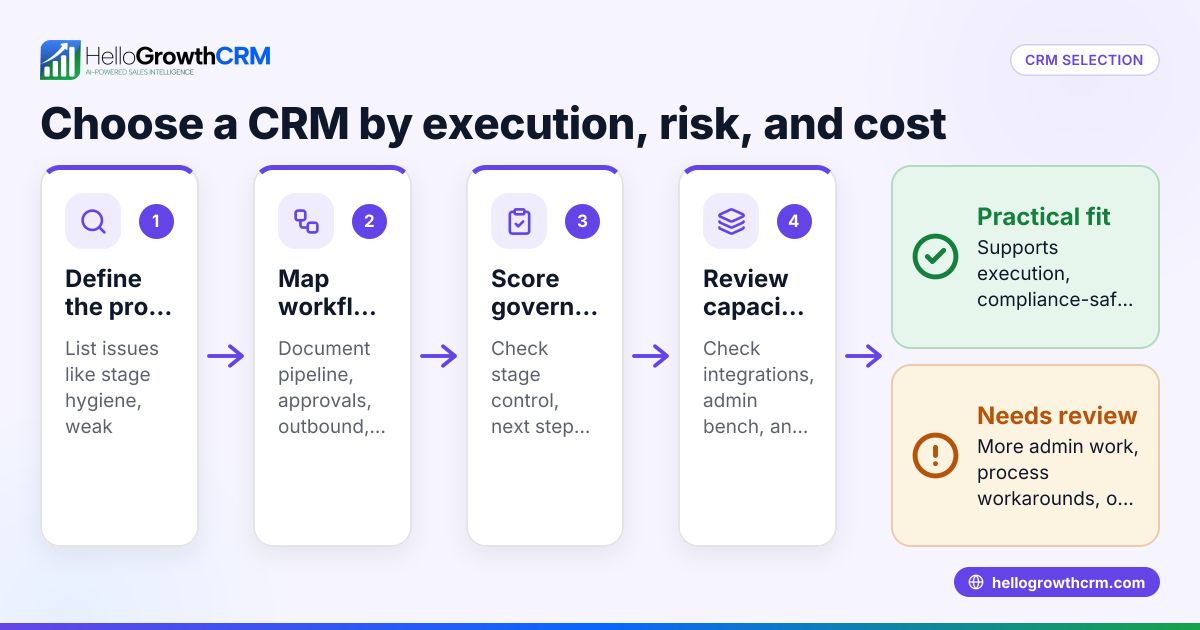
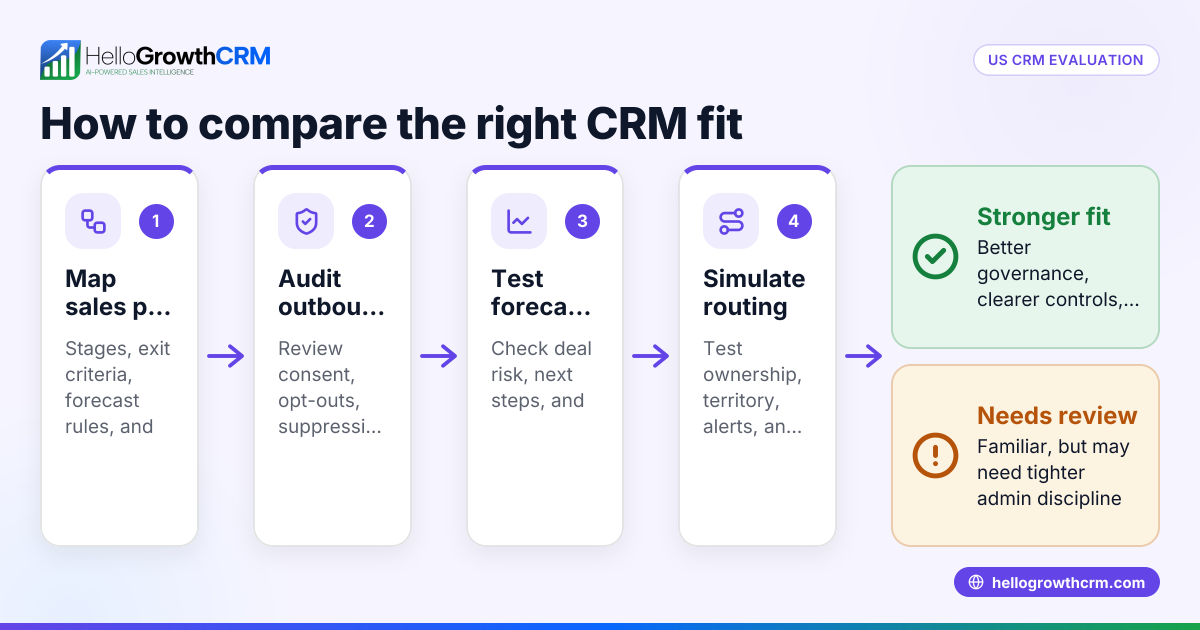
How to Choose Salesforce Alternatives for Mid-Market B2B Teams That Want Simpler Pipeline Governance: Step-by-Step
- Map your current pipeline problems
Start with the real issues. List where governance breaks today, such as skipped qualification, weak forecasting, or poor handoffs. - Define non-negotiable process rules
Decide which controls must exist in the new CRM. Common examples include required fields by stage, next-step tracking, and close-date discipline. - Audit your reporting needs
Identify the dashboards leaders use every week. Focus on pipeline coverage, stage conversion, aging, and forecast accuracy. - Review lead management workflows
Check how leads are scored, routed, and accepted by sales. A strong alternative should support this natively or through simple automation. - Test rep adoption in real scenarios
Ask sellers and managers to run sample workflows. Make sure creating, updating, and reviewing deals feels fast and clear. - Check implementation effort
Compare how much setup, migration, and admin support each option needs. Mid-market teams usually benefit from faster deployment and less custom maintenance. - Evaluate total operating cost
Include software, services, admin time, and reporting overhead. The cheapest license is not always the simplest system to run. - Choose a platform built for revenue execution
Select the CRM that improves governance while helping your team move faster. For many B2B teams, that means a platform like HelloGrowthCRM with connected Pricing, automation, and forecasting built for growth.
Common Migration Mistakes to Avoid
A CRM switch can improve pipeline governance fast. But only if the rollout is disciplined.
Mistake 1: Migrating bad process into a new system
A new CRM will not fix weak stage definitions. Clean up process before migration. Do not move confusion into a new platform.
Mistake 2: Keeping too many legacy fields
Field sprawl hurts adoption. If a field does not affect routing, reporting, or selling, remove it.
Mistake 3: Ignoring manager workflows
Managers are core users of pipeline governance. Build dashboards and inspection views for weekly reviews, not just rep data entry.
Mistake 4: Treating implementation as an IT project
This is a revenue process project. Sales, marketing, and RevOps should all help shape the design.
Mistake 5: Undertraining reps on deal hygiene
Good governance depends on habits. Reps need short, clear training tied to real examples and manager expectations.
The Best Fit Is the CRM Your Team Will Actually Run Well
Mid-market B2B teams need more than contact storage and activity logs. They need a system that makes the pipeline easier to trust. That means simple rules, clear ownership, better forecasting, and fewer admin headaches.
If your current setup makes pipeline reviews harder than they should be, it may be time to move to a CRM built for cleaner execution. HelloGrowthCRM helps teams create stronger governance through practical automation, structured workflows, and better visibility across the funnel. You can explore the platform through a Demo or start a Free Trial to see how a simpler revenue operating system can support your next stage of growth.
Frequently Asked Questions
Q: What does pipeline governance mean in a mid-market B2B CRM?
A: Pipeline governance means having clear rules for how opportunities are created, updated, advanced, and forecasted in the CRM. For mid-market B2B teams, it usually includes standard stages, required fields, ownership rules, and review dashboards. The goal is to make pipeline data trustworthy and easy to manage.
Q: Why do mid-market teams look for Salesforce alternatives?
A: Many mid-market teams look for alternatives when CRM admin work starts slowing sales execution. Common reasons include complex customization, low rep adoption, difficult reporting, and high maintenance overhead. Teams often want a system that gives structure without adding friction.
Q: What should B2B teams prioritize when comparing CRM alternatives?
A: They should prioritize stage governance, forecasting, lead routing, rep usability, and implementation effort. A good CRM should help teams run clean handoffs and pipeline reviews without needing constant manual cleanup. Ease of adoption matters as much as feature depth.
Q: Is HelloGrowthCRM a good fit for companies with RevOps needs?
A: Yes. HelloGrowthCRM is well suited for companies that want better pipeline structure, forecasting, and process consistency without a highly complex system. It also supports RevOps-led improvements through automation, reporting, and service support when needed.
Q: How long does it take to switch to a simpler CRM?
A: The timeline depends on data quality, process complexity, and integration needs. Many mid-market teams can move faster when they reduce unnecessary fields and focus on core workflows first. A simpler CRM usually shortens both setup and training time.
Q: Can a simpler CRM still support forecasting and automation?
A: Yes. Simpler does not mean limited. A strong platform should still support forecasting, lead scoring, task automation, email sequences, and dashboard reporting. The difference is that these tools should be easier to use and maintain.
Q: What is the biggest mistake teams make during CRM migration?
A: The biggest mistake is moving messy processes into a new system without fixing them first. If stage rules, ownership, and reporting logic stay unclear, the new CRM will inherit the same problems. The best migrations start with process cleanup before data import.
Frequently Asked Questions
Ready to put this into practice?
Set up your pipeline, WhatsApp follow-ups, and AI lead scoring in minutes — free, no credit card.
Try HelloGrowthCRM freeGet CRM tips in your inbox
Join thousands of sales professionals who get weekly insights on CRM strategy, AI automation, and pipeline optimization.

The HelloGrowthCRM team publishes guides on CRM strategy, AI sales tools, and revenue operations for small business sales teams.