HelloGrowthCRM software
Built for real small-business sales teams
HelloGrowthCRM helps reps qualify faster, follow up on time, and close more deals—with practical automation in one place.
- AI lead scoring and pipeline visibility
- Built-in dialer, WhatsApp, and email automation
- Sales forecasting and RevOps-ready reporting
Secondary sales tracking means monitoring the sales your distributors or retailers make to their own customers, beyond the initial sales you make to those distributors or retailers. This insight helps you understand product movement in the market, manage stock levels, and identify growth opportunities. This article covers why secondary sales tracking is important for UAE businesses, how to track it step-by-step, a worked example, common pitfalls, and how HelloGrowthCRM supports this process.
Why this comes up / what goes wrong
For small and mid-sized UAE businesses, especially those using distributors or resellers, secondary sales tracking is crucial but often overlooked. You may sell a product batch to a distributor and assume it reaches end customers smoothly. However, without tracking secondary sales, you can't verify if the product is selling well or stuck in inventory. This leads to inaccurate demand forecasting, missed revenue, and poor distributor management. Many businesses rely on manual reports, WhatsApp messages, or spreadsheets, which cause delays and errors. Without clear secondary sales data, you risk losing control over your market presence and fail to motivate your sales channel effectively.
Step-by-step
- Define your sales channels and secondary sales points
- Identify all distributors, retailers, or resellers who sell your products to end customers.
- Clarify what counts as secondary sales in your context (e.g., sales from distributor to retailer or retailer to consumer).
- Set up data collection methods
- Decide how secondary sales data will be reported (mobile app, WhatsApp messages, phone calls, or forms).
- Train your distributors or sales reps to submit sales details regularly.
- Implement tracking tools
- Use a CRM or sales management system that can capture and organise secondary sales data by channel and region.
- Ensure leads and deals are logged with owners and next steps to avoid missing follow-ups.
- Verify and validate sales data
- Cross-check reported secondary sales with inventory movement or payments to catch discrepancies.
- Follow up with field visits or calls to confirm data accuracy.
- Analyse and report
- Review secondary sales by product, territory, and time period.
- Use this data to forecast demand, plan production, and adjust marketing strategies.
- Motivate your sales channels
- Link commissions or incentives to verified secondary sales.
- Share performance reports with distributors and reps to encourage better results.
- Continuously improve
- Collect feedback from your sales network on the tracking process.
- Update tools and training to reduce errors and delays.
Example (fictional figures)
A car-rental company in Abu Dhabi sells AED 500,000 worth of vehicles to three local dealers on 01/03/2024. They want to track how many cars each dealer rents out to customers (secondary sales) in March.
- Dealer A reports 40 cars rented at AED 5,000 each: 40 × AED 5,000 = AED 200,000
- Dealer B reports 30 cars rented at AED 5,000 each: 30 × AED 5,000 = AED 150,000
- Dealer C reports 20 cars rented at AED 5,000 each: 20 × AED 5,000 = AED 100,000
Total secondary sales reported = AED 200,000 + AED 150,000 + AED 100,000 = AED 450,000
The company compares this to the AED 500,000 primary sales to see if vehicles are moving well. They notice Dealer C's lower secondary sales and plan a visit to support them.
Common mistakes
- Relying on manual or informal reports: Using WhatsApp texts or spreadsheets without structure leads to lost or late data. Prevent by using a CRM with lead and deal tracking to organise sales systematically.
- Not defining clear sales stages: Without clear stages (e.g., order received, delivered, sold), tracking is inconsistent. Use pipeline stages to monitor progress and plan follow-ups.
- Ignoring field feedback: Not verifying reported sales with field visits causes inaccurate data. Schedule regular check-ins and use field sales tools to log visits and activities.
- Failing to assign ownership: Without assigning lead or deal owners, follow-ups are missed. Always assign a responsible person for each lead or deal to ensure accountability.
- No incentives linked to secondary sales: Distributors may not prioritise secondary sales reporting without rewards. Link commissions to verified sales to motivate accuracy.
- Overcomplicating data collection: Complex forms or processes discourage timely reporting. Keep tools simple and mobile-friendly.
Doing this in HelloGrowthCRM
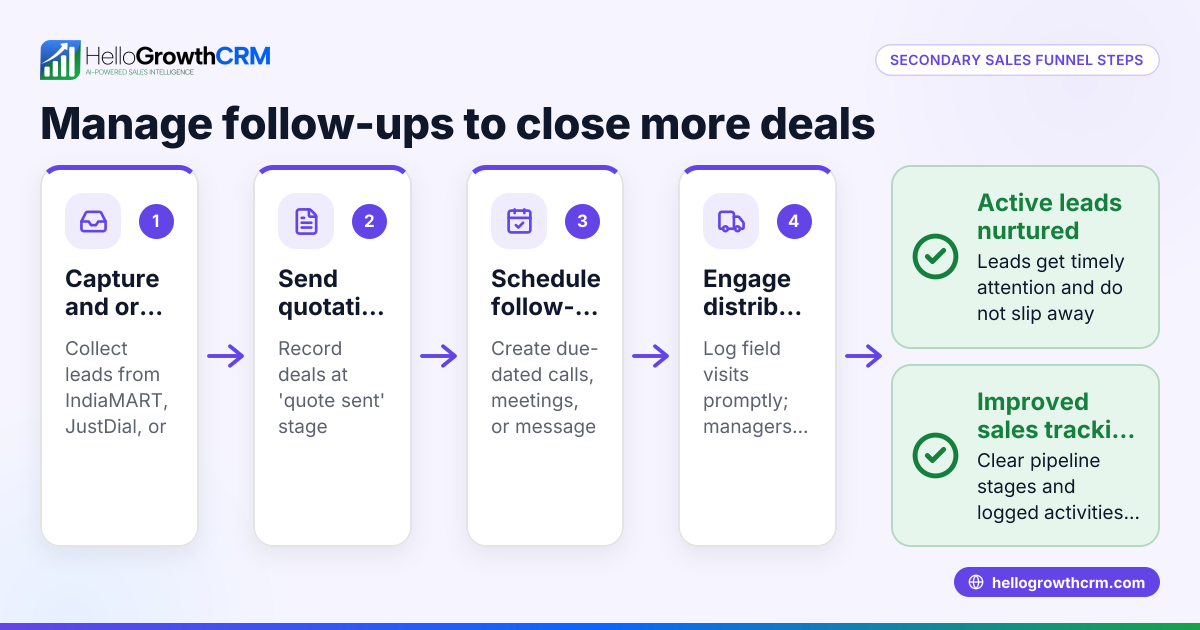
HelloGrowthCRM helps you track secondary sales by capturing every enquiry from forms, calls, or WhatsApp as a lead with an owner and next step, preventing leads from getting lost in notebooks. The Deals (pipeline) feature lets you track quotations and sales stages clearly, so a quotation sent last week appears as a deal at the 'quote sent' stage with a follow-up date, ensuring no opportunity is forgotten. For distributors with field reps, the Territories and field operations tools allow reps to log visits from their phones, and managers can see the day's activities and sales beats. This makes secondary sales tracking more organised and actionable. Learn more about HelloGrowthCRM for the United Arab Emirates, the WhatsApp and SMS CRM, and the built-in CRM dialer.
Frequently asked questions
What is the difference between primary and secondary sales tracking? Primary sales tracking monitors your direct sales to distributors or retailers. Secondary sales tracking monitors the sales those distributors or retailers make to their customers. Secondary sales data gives deeper insight into product movement and market demand.
How can I collect secondary sales data efficiently? Use digital tools like CRM systems that integrate with WhatsApp and mobile apps. Train your sales reps or distributors to log sales promptly. Automate reminders and follow-ups to ensure data is submitted on time.
Why is secondary sales tracking important for small businesses? It helps you understand if your products are selling at the consumer level, manage inventory better, forecast demand accurately, and motivate your sales channel with incentives linked to actual sales.
Can HelloGrowthCRM help with secondary sales tracking? Yes. It captures leads from WhatsApp, calls, and forms, tracks deals in a pipeline with stages and follow-ups, and supports field sales operations with visit logs and territory management, making secondary sales tracking easier.
How often should I review secondary sales data? Regularly, at least monthly or weekly depending on your sales cycle. Frequent reviews help identify trends, address issues quickly, and adjust your sales strategy effectively.
Key takeaways
- Secondary sales tracking monitors sales beyond your direct customers to understand true product movement.
- Define clear sales channels and use structured data collection methods to get accurate secondary sales data.
- Use CRM pipelines and assign owners to leads and deals to avoid missed follow-ups.
- Verify data with field visits and link incentives to motivate your sales network.
- HelloGrowthCRM offers lead capture, deal tracking, and field operations tools to support secondary sales tracking.
Start tracking your secondary sales effectively today. Start on the Free Forever plan (200 leads, no credit card) and organise your sales pipeline with HelloGrowthCRM.
Ready to put this into practice?
Set up your pipeline, WhatsApp follow-ups, and AI lead scoring in minutes — free, no credit card.
Try HelloGrowthCRM freeGet CRM tips in your inbox
Join thousands of sales professionals who get weekly insights on CRM strategy, AI automation, and pipeline optimization.

The HelloGrowthCRM team publishes guides on CRM strategy, AI sales tools, and revenue operations for small business sales teams.