HelloGrowthCRM software
Built for real small-business sales teams
HelloGrowthCRM helps reps qualify faster, follow up on time, and close more deals—with practical automation in one place.
- AI lead scoring and pipeline visibility
- Built-in dialer, WhatsApp, and email automation
- Sales forecasting and RevOps-ready reporting
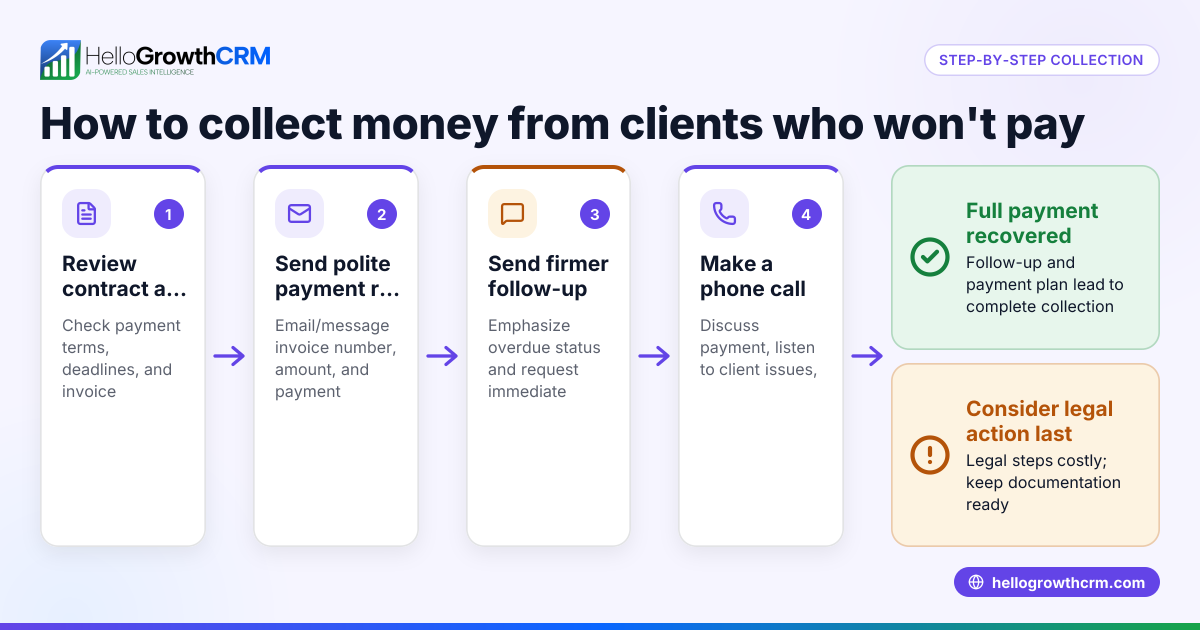
When a client refuses to pay, your first action should be to check your contract and invoice to verify payment terms and deadlines. Then, reach out to the client quickly to find out why payment is delayed. Keep detailed records of all communications. If informal reminders don’t work, send formal payment reminders and try to negotiate a solution. If the client still refuses to pay, consider mediation or legal action. This article covers why these situations arise, a clear step-by-step process to handle them, a practical example with calculations, common mistakes to avoid, and answers to frequent questions.
Why this comes up / what goes wrong
Small-business owners in the US often encounter clients who refuse to pay due to several reasons. These include misunderstandings about the work scope, dissatisfaction with the product or service, financial difficulties on the client’s part, or disputes over contract terms. For example, a client might claim the work was incomplete or not as agreed. Sometimes, clients delay payment because of cash flow problems or internal approval delays. Without clear agreements and documentation, these issues can escalate, causing serious cash flow problems for your business. Understanding why this happens helps you respond effectively and protect your business.
Step-by-step
- Review your contract and invoice: Confirm the payment terms, due dates, and any clauses about disputes, late fees, or penalties. Make sure the invoice matches what was agreed.
- Contact the client promptly: Reach out politely by phone, email, or message to ask why payment hasn’t been made. Sometimes a simple reminder resolves the issue.
- Document all communications: Save emails, texts, call notes, and messages. This documentation can be important if you need to escalate.
- Send a formal payment reminder: If informal contact fails, send a written reminder stating the amount due, original due date, and any consequences of continued non-payment.
- Negotiate if there is a dispute: Discuss the client’s concerns openly. You might agree on a payment plan or partial payment to resolve the issue amicably.
- Consider mediation or arbitration: If negotiation stalls, a neutral third party can help resolve the dispute without resorting to court.
- Send a final demand letter: This letter should state that if payment is not received by a specific deadline, you will pursue legal action.
- Seek legal advice or take legal action: Consult a lawyer to understand your options. Small claims court is often suitable for smaller amounts.
- Review and improve your payment process: After resolving the issue, update contracts, invoicing, and follow-up procedures to reduce future risks.
Using tools like a built-in CRM dialer helps maintain timely and documented communication. A WhatsApp and SMS CRM can automate reminders and follow-ups, increasing efficiency.
Example (fictional figures)
A plumbing company in Austin, Texas, completed a $5,000 job on 03/01/2026. Payment was due in 30 days, so by 03/31/2026.
- On 04/05/2026, the client has not paid.
- Step 1: Review contract — payment due in 30 days.
- Step 2: Contact client on 04/06/2026; client claims dissatisfaction.
- Step 3: Document all communication.
- Step 4: Send formal payment reminder on 04/10/2026.
- Step 5: Negotiate partial payment of $3,000.
- Step 6: Client agrees to pay $3,000 by 04/20/2026.
- Step 7: Receive $3,000 on 04/20/2026.
- Step 8: Decide whether to write off remaining $2,000 or pursue legal action.
Calculation:
$3,000 + $2,000 = $5,000
This approach balances maintaining client relations with protecting your cash flow.
Common mistakes
- Ignoring the problem: Delaying contact allows issues to worsen. Prevent by acting promptly.
- Not documenting communications: Without records, proving your case is harder. Always keep written evidence.
- Failing to review contracts: Overlooking contract terms can cause misunderstandings. Always verify terms before escalating.
- Skipping negotiation: Going straight to legal action can harm relationships and increase costs. Attempt negotiation first.
- Relying only on informal communication: Phone calls or texts alone can lead to miscommunication. Use formal written reminders too.
- Not improving processes after resolution: Repeating mistakes invites future problems. Update your systems based on lessons learned.
See how HelloGrowthCRM for the United States can help organize client communications and payment tracking.
Frequently asked questions
What if the client claims the work was incomplete? Ask for specific feedback and review your contract and deliverables carefully. Offer to fix any legitimate issues promptly and document all agreements to avoid future disputes.
Can I charge late fees or interest? Check your contract for late payment terms. If present, you may apply fees as specified; otherwise, seek client agreement or legal advice.
When should I involve a lawyer? Seek legal advice if communication and negotiation fail, especially if the unpaid amount is significant or the client is unresponsive.
Is small claims court a good option? Small claims court is a cost-effective venue for pursuing unpaid debts below state limits. It suits many small-business payment disputes.
How can CRM software help with payment issues? CRM tools track client communications, automate reminders, and keep payment records organized, improving follow-up efficiency and documentation.
Key takeaways
- Review your contract and invoice carefully before taking action.
- Contact the client promptly and keep detailed records of all communication.
- Use formal payment reminders and negotiate before escalating.
- Consider mediation or legal action if payment is still withheld.
- Avoid common mistakes such as ignoring the problem or poor documentation.
- Improve your payment and communication processes after resolution.
Start managing client relationships and payments more effectively. Start on the Free Forever plan (200 leads, no credit card).
Ready to put this into practice?
Set up your pipeline, WhatsApp follow-ups, and AI lead scoring in minutes — free, no credit card.
Try HelloGrowthCRM freeGet CRM tips in your inbox
Join thousands of sales professionals who get weekly insights on CRM strategy, AI automation, and pipeline optimization.

The HelloGrowthCRM team publishes guides on CRM strategy, AI sales tools, and revenue operations for small business sales teams.