Skip to content
Wati vs AiSensy

Wati vs AiSensy: Which WhatsApp Platform Fits How Your Team Sells

Short answer: Wati leans toward shared inbox conversations, AiSensy toward broadcast campaigns. Both sit on the official WhatsApp Business API and are widely used in India. Below: pricing layers, chatbots, support, trial checks and who should pick which.

Last updated:

Free Forever • No Credit Card Required

Comparison of Wati and AiSensy across shared inbox handling, broadcast campaigns, automation and setup effort

Quick answer

Is HelloGrowthCRM right for Wati vs AiSensy?

Yes. HelloGrowthCRM gives Wati vs AiSensy a single system to capture every lead, automate follow-up across phone, WhatsApp, and email, prioritise leads with AI scoring, and forecast revenue — with calling and messaging built in instead of sold as add-ons. It's built for the problems these teams actually hit — like enquiries arrive on WhatsApp and land in one person's personal chat, so the business owns none of the history — rather than generic sales busywork.
  • Both platforms sit on top of the official WhatsApp Business API, so the first thing they share is a formal number, template approvals and a verified business profile
  • Wati is generally chosen by teams that think in conversations: a shared inbox, agents replying, and automation supporting a human who is already in the chat
  • AiSensy is generally chosen by teams that think in campaigns: audience lists, broadcast sends and follow-up journeys aimed at a large contact base

See pricingBook a demo

HelloGrowthCRM

Capture. Follow up. Close.

From Enquiry to Customer in One CRMEvery lead captured, followed up and tracked — so nothing goes cold.The path a lead takes inside HelloGrowthCRM, from first enquiry to a repeat customer.
  1. Step 1

    Capture

    Web forms, WhatsApp, calls and ads land in one inbox

  2. Step 2

    Qualify

    AI lead scoring flags who is ready to talk

  3. Step 3

    Assign

    Routed to the right rep automatically

  4. Step 4

    Follow up

    Reminders, sequences and WhatsApp nudges

  5. Step 5

    Track the deal

    Stages, value and next step in the pipeline

  6. Step 6

    Win & retain

    Renewals and repeat business stay on the radar

Every call, message and email is logged on the contact — the history travels with the lead.

One contact record, one pipeline, one clear next step.

01

Who each tool is really for

Wati

Wati is generally chosen by teams whose day is made of individual conversations. A shared inbox, several agents, assignment and internal notes are the centre of the product, with automation supporting the human rather than replacing them. It suits businesses where a customer message deserves a considered reply within minutes.

AiSensy

AiSensy is generally chosen by teams whose day is made of campaigns. Building audiences, sending template broadcasts and following up at scale is the centre of the product. It suits businesses with a sizeable contact base and a marketing calendar, where the volume of outbound messages is the thing that drives revenue.

02

How they differ structurally

Deployment model and the API reality

Both are solution providers sitting on the official WhatsApp Business API, so both involve business verification, a formal number and template approvals. That layer is largely the same wherever you go. What differs is the software wrapped around it, and how it behaves when things go wrong.

Target team and breadth versus depth

Support and inside sales teams tend to feel at home in a conversation-led product. Marketing teams and D2C operations tend to feel at home in a campaign-led one. Depth in one direction usually means less depth in the other, so buy for the work you actually do daily rather than for the demo that impressed the room.

Implementation effort and channel coverage

Expect a few days rather than weeks, with waiting time attached to verification and template approval. Neither product covers phone calls, deal pipelines or forecasting, so decide separately where those will live. Check current features on the vendor's site, since this category changes quickly.

03

Wati vs AiSensy at a glance

Qualitative tendencies to confirm during a trial, not scores.

DimensionWatiAiSensy
Centre of the productShared inbox and agent repliesBroadcasts and audience campaigns
Typical buyerSupport or inside sales leadMarketing or growth lead
Daily rhythmAnswering individual conversationsPlanning and sending to lists
Automation emphasisAssisting a human in the chatDriving journeys after a send
Underlying platformOfficial WhatsApp Business APIOfficial WhatsApp Business API
CRM depthLight, conversation focusedLight, campaign focused
Common companion toolA CRM for pipeline and callsA CRM for pipeline and calls
Best fit signalReplies matter more than sendsSends drive most of your revenue
04

What to compare before you choose

Searchers comparing Wati and AiSensy usually want a verdict. A fair verdict depends on five things you can check in an afternoon, and vendor pages will not give you an unbiased answer on any of them.

Pricing

Cost has two layers: the platform subscription, and the per-message charges that come through the WhatsApp API. Plan prices and message markups change often, so ask each vendor for a written quote at your monthly message volume and number of agents. Also ask whether message credits are pre-purchased and whether extra agents or contacts cost more.

Chatbots and automation

Build one flow you already run by hand, such as a lead qualification or order status reply, in each trial. Note how many steps it takes, what you can customise, and how the handover to a human agent works.

Marketing features

If you run broadcasts, check segmentation, scheduling, click-to-WhatsApp ad support and how replies are routed after a send. If you mostly reply, check assignment, notes and transfer instead.

Support and onboarding

Vendor comparison pages claim better support for themselves, so test it: raise a real question during the trial and note the channel, the reply time and whether onboarding help is included.

Free trial

Trial length and limits differ and change over time. Confirm the current terms on each vendor site, and use the trial to run the full scenario, including template approval, which can take a day or more.


05

Which to pick when

  • If most of your day is answering individual enquiries, choose the conversation-led platform and test agent assignment properly.
  • If most of your revenue follows planned campaigns to a large list, choose the broadcast-led platform and test reply handling.
  • If you need both equally, decide which failure hurts more: a slow reply or a weak campaign.
  • If deals, calls and follow-ups also need tracking, plan for a CRM alongside either choice rather than hoping the messaging tool covers it.
  • If you might switch providers later, settle number release and history export before signing anything.
06

Where HelloGrowthCRM fits

Short and clearly labelled, because this page is about the two platforms above. HelloGrowthCRM is a CRM rather than a WhatsApp platform: pipeline, built-in dialer, WhatsApp inbox, email and SMS sequences and AI lead scoring in one system, from ₹899 per user per month with a free plan available. Teams look at it when they want conversations, calls and deals in one place instead of two systems. For heavy broadcast marketing programmes, a dedicated campaign platform above may still suit better.

Challenges we solve

Common CRM problems in this industry — and how HelloGrowthCRM solves each one

Every team in this space loses revenue to the same recurring gaps. Each card below states one problem and the specific HelloGrowthCRM capability that closes it.

  • Problem: Enquiries arrive on WhatsApp and land in one person's personal chat, so the business owns none of the history.

    How HelloGrowthCRM solves it: Both platforms solve this by moving conversations onto a business number with a shared inbox. Verify agent assignment and history retention during the trial.

    HelloGrowthCRM capability: Business number, shared history

  • Problem: Broadcasts get sent, replies flood in, and nobody has decided who answers them.

    How HelloGrowthCRM solves it: Test the reply path immediately after a campaign in each trial. Sending is the easy half; handling the response is where teams actually struggle.

    HelloGrowthCRM capability: Plan the reply path

  • Problem: The WhatsApp tool holds conversations while deals, calls and follow-ups live somewhere else entirely.

    How HelloGrowthCRM solves it: Decide early whether you need a messaging platform beside a CRM or a CRM with messaging inside it, then shortlist accordingly.

    HelloGrowthCRM capability: Decide the system of record

  • Problem: Switching later feels impossible because the number, templates and history sit with the provider.

    How HelloGrowthCRM solves it: Ask about number release, template migration and history export before you sign, and record the answers. This is easier to establish before money changes hands.

    HelloGrowthCRM capability: Check the exit path

What you get

Why teams choose HelloGrowthCRM

AI-powered CRM with the features you need to close more deals.

  • Both platforms sit on top of the official WhatsApp Business API, so the first thing they share is a formal number, template approvals and a verified business profile
  • Wati is generally chosen by teams that think in conversations: a shared inbox, agents replying, and automation supporting a human who is already in the chat
  • AiSensy is generally chosen by teams that think in campaigns: audience lists, broadcast sends and follow-up journeys aimed at a large contact base
  • Ask both providers how a new WhatsApp number is provisioned and, crucially, how it is released if you leave, because number portability is where switching cost hides
  • Template message approval is a shared reality of the WhatsApp API, so test how each platform handles rejections and re-submissions rather than assuming it is painless
  • Agent workflows deserve testing if several people reply: check assignment, internal notes, transfer and what a supervisor can see at a glance
  • Campaign workflows deserve testing if you send at scale: check list building, segmentation, scheduling and how reply handling works after a broadcast lands
  • Messaging charges levied through the WhatsApp API are separate from the software subscription, so confirm current details with each provider before comparing costs
  • Chatbot builders vary in approach, and the honest test is building one flow you already run manually rather than admiring a demo tree
  • Check what happens to your conversation history if you leave, including export formats and whether media attachments are included
  • Neither platform is a full CRM, so plan how deals, follow-up tasks and phone calls will be tracked alongside the WhatsApp conversation
  • Check current features on each vendor site, since capabilities in this category change quickly and any comparison page ages faster than the products do
Watch it work

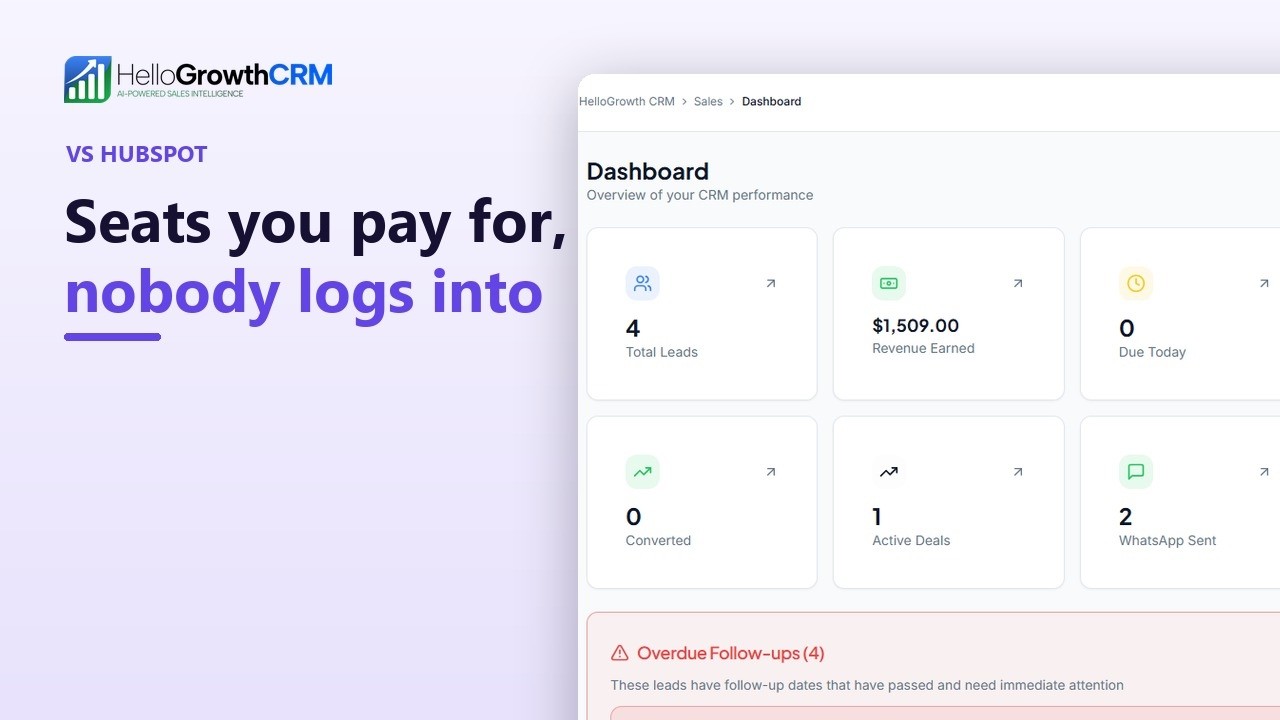
HelloGrowthCRM vs HubSpot — Honest Comparison for Small Business 2026

HelloGrowthCRM vs HubSpot — Honest Comparison for Small Business 2026
Comparing WhatsApp tools often turns into a CRM decision. This is how HelloGrowthCRM compares with HubSpot.

Key takeaways from this video

  • A side-by-side look at pricing, features, AI capabilities and ease of use.
  • A feature comparison covering AI, the dialer, WhatsApp and task boards.
  • Where HubSpot comes out ahead, and where HelloGrowthCRM does.
  • Who should choose which, depending on how the team sells.

HelloGrowthCRM by the numbers

$12
per user/month list price — USD 100/user/year, billed annually on annual billing, ₹899/user/mo in India
$0
free forever starter plan — no credit card required
14-day
trial included on paid plans
500+
teams worldwide run their pipeline on HelloGrowthCRM

Frequently Asked Questions

Common questions about using HelloGrowthCRM in your industry.

Both are WhatsApp Business API platforms used widely by Indian businesses, and both cover messaging, automation and team access. The difference is emphasis. One is more often described in terms of a shared team inbox and conversation handling, the other in terms of broadcast campaigns and audience engagement. Most buyers should decide by asking which activity they will do every day: replying to individuals, or sending to many.

If several people must reply from one business number, if you want automation, or if you intend to send template messages at scale, then yes, the official API is the appropriate route and both of these platforms sit on it. A single person handling a modest number of chats can often continue with the standard business app. The API brings structure, approvals and a formal number, which is the point.

There are usually two layers: the software subscription charged by the platform, and messaging charges that arise through the WhatsApp API itself. We do not publish either provider's figures here because they change. Ask each vendor to explain both layers in writing for your expected volume, and confirm what happens if volumes rise sharply during a campaign month.

Usually, though the process depends on how that number is currently registered and whether it is already tied to another provider. Ask each platform to describe the migration steps and the expected downtime before you commit. Just as importantly, ask how the number is released if you leave later. Providers that answer both questions clearly are telling you something useful about how they operate.

Generally not, and it is worth being clear about that early. They manage conversations well. They are not designed to hold a sales pipeline, call history, deal values, forecasts and follow-up tasks in the way a CRM does. Many Indian teams end up running a messaging platform beside a CRM, which works, or choosing a CRM with WhatsApp built in, which reduces the number of systems.

For a small team, allow a few days. Business verification, number provisioning and template approvals are the steps that introduce waiting, and they are largely outside the platform's control. What you can control is preparation: have your business documents ready, draft your template messages in advance, and decide who will handle replies before the number goes live.

It depends on your agents, contacts and message volume, and both vendors change plans often, so any figure on a third-party page may be out of date. Ask each for a written quote covering the subscription and the WhatsApp message charges at your expected volume, then compare the total, not the headline plan price.

AiSensy is generally associated with broadcast campaigns and audience lists, and Wati with shared inbox and agent conversations. Both can do some of each, so test the activity you will do most often in a trial.

Run one real scenario end to end in each platform. Send a template message to a small list, have two team members reply from the shared inbox, transfer a conversation between them, and then find that conversation again a week later. Add one automation you already run manually. That exercise reveals more than any feature list, and it takes an afternoon.

Ready to grow?

Join small businesses that close more deals with HelloGrowthCRM.

Free Forever • No Credit Card Required

Take the next step

Free Forever • No Credit Card Required

Prefer email? Write to sales@hellogrowthcrm.com