HelloGrowthCRM software
Built for real small-business sales teams
HelloGrowthCRM helps reps qualify faster, follow up on time, and close more deals—with practical automation in one place.
- AI lead scoring and pipeline visibility
- Built-in dialer, WhatsApp, and email automation
- Sales forecasting and RevOps-ready reporting
Adding interest to unpaid invoices means charging a fee on overdue amounts to encourage timely payment and recover costs from delayed funds. To do this correctly, set clear terms in your contracts or invoices, calculate interest based on the overdue period, and communicate it clearly to your customer. This article covers why interest is added, a step-by-step process, a worked example, common mistakes, and how HelloGrowthCRM can assist with managing invoices and payments.
Why this comes up / what goes wrong
Small-business owners in Canada often face late payments that disrupt cash flow and business operations. When invoices remain unpaid past their due date, it can delay paying suppliers, staff, or investing in growth opportunities. Adding interest to unpaid invoices encourages customers to pay on time and helps recover some of the cost caused by the delay. Without clear interest terms, customers may not feel urgency to settle balances, and disagreements can arise. Businesses should ensure interest charges comply with any legal requirements or contract terms to avoid conflicts.
Step-by-step
- Set Clear Terms Beforehand: Include an interest clause in your contract or on your invoice. Specify the interest rate, how it is calculated (e.g., monthly or annually), and when it applies (e.g., after a 30-day grace period).
- Calculate the Interest Rate: Choose a reasonable interest rate. Ensure it complies with applicable laws and industry standards.
- Track Overdue Invoices: Monitor invoices past their due date. Record when the payment became overdue to calculate interest accurately.
- Calculate Interest Owed: Multiply the overdue amount by the interest rate and the fraction of the period overdue. For example, if charging 2% monthly interest, and the invoice is 15 days overdue, calculate half a month’s interest.
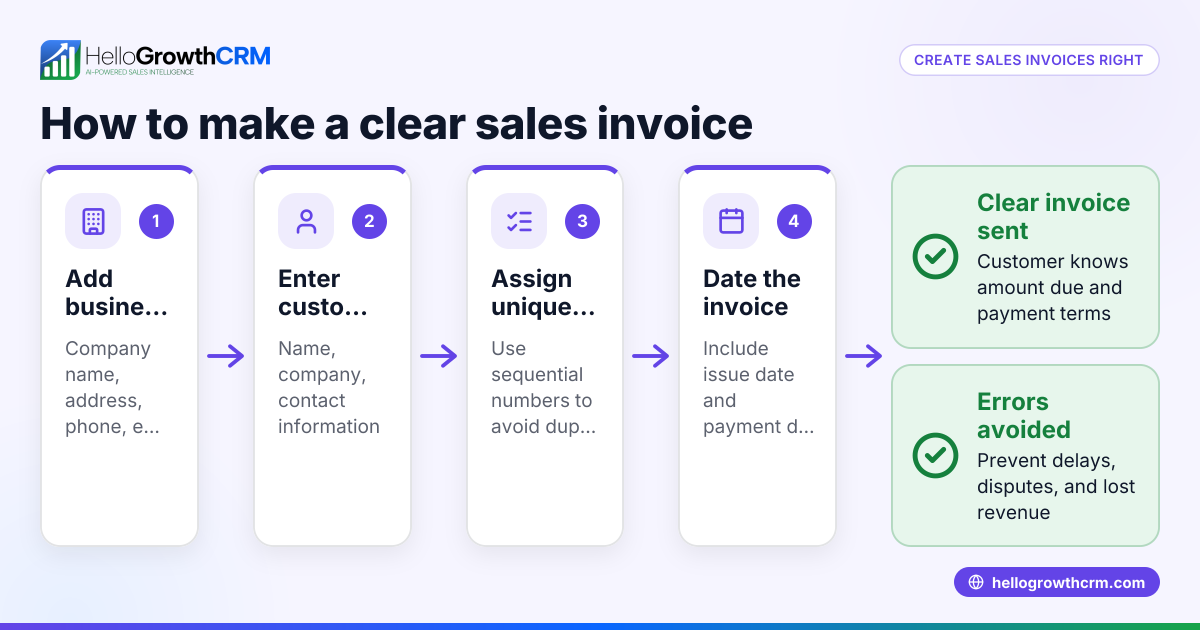
- Notify the Customer: Send a polite reminder including the original invoice, the overdue amount, the interest charged, and the new total payable.
- Add Interest to the Invoice or Statement: Issue an updated invoice or statement showing the interest added. This keeps records clear and transparent.
- Follow Up and Record Payments: Continue following up on payments. When payment is received, record it against the invoice and interest charged.
- Review and Adjust Terms if Needed: If late payments are frequent, consider revising your payment terms or interest policy to better protect your cash flow.
For managing quotes, invoices, and payments efficiently, consider tools with features like a built-in CRM dialer and WhatsApp and SMS CRM for automated reminders.
Example (fictional figures)
An HVAC company in Surrey, British Columbia, issued an invoice of C$5,000 on 2026-03-01 with payment terms of 30 days and a 2% monthly interest on overdue amounts.
- Invoice due date = 2026-03-31
- Payment received on 2026-04-15
- Days overdue = 15 days
Calculate interest:
Monthly interest rate = 2% Fraction of month overdue = 15 / 30 = 0.5 Interest = C$5,000 × 2% × 0.5 Interest = C$5,000 × 0.02 × 0.5 = C$50
Total amount due = C$5,000 + C$50 = C$5,050
The company sends a statement showing the original invoice amount, interest charged of C$50, and total due of C$5,050.
Common mistakes
- Not including interest terms in contracts or invoices: Prevent by always adding clear interest clauses before work begins.
- Charging interest without notifying customers: Prevent by sending reminders and updated statements showing interest.
- Applying interest incorrectly or to paid invoices: Prevent by carefully tracking payment dates and amounts.
- Using an unreasonably high interest rate: Avoid this by following legal limits and industry norms.
- Failing to document communications about interest charges: Prevent by keeping records of all reminders and statements.
- Not automating follow-ups leading to inconsistent application: Prevent by using CRM tools to track invoices and send reminders, such as those with a built-in CRM dialer.
Doing this in HelloGrowthCRM
HelloGrowthCRM helps you manage quotes, proposals, invoices, and payments all in one place. From the deal record, you can build, send, and track commercial documents including invoices and proposals. The status of the quotation or invoice (sent, viewed, accepted) is visible on the same screen as your follow-up task, helping you stay on top of overdue payments. This integration supports clear communication and timely follow-up to reduce unpaid invoices. Learn more at HelloGrowthCRM for Canada.
Frequently asked questions
Can I add interest to any unpaid invoice? You can add interest only if your contract or invoice terms specify it. Without prior agreement, charging interest may lead to disputes. Always include clear interest terms upfront.
What interest rate can I charge on overdue invoices? Interest rates should be reasonable and comply with applicable laws. Consult a legal expert for your jurisdiction.
How do I calculate interest for partial months overdue? Calculate the fraction of the month overdue and multiply by the monthly interest rate and overdue amount as a general approach.
Should I notify customers before adding interest? Yes. It is best practice to send reminders and inform customers about interest charges clearly to maintain good relationships.
Can CRM tools help automate invoice follow-up? Yes. CRM tools with features like a built-in CRM dialer and WhatsApp and SMS CRM can send quotes and invoices, track their status, and manage follow-up tasks to reduce unpaid invoices.
Key takeaways
- Always include clear interest terms in contracts or invoices before work begins.
- Calculate interest based on the overdue amount, rate, and time overdue.
- Notify customers promptly with updated invoices or statements showing interest charges.
- Avoid common mistakes like charging without terms or poor record-keeping.
- Use CRM tools with integrated invoice and follow-up features to manage payments efficiently.
Start managing your invoices better today. Start on the Free Forever plan (200 leads, no credit card).
Ready to put this into practice?
Set up your pipeline, WhatsApp follow-ups, and AI lead scoring in minutes — free, no credit card.
Try HelloGrowthCRM freeGet CRM tips in your inbox
Join thousands of sales professionals who get weekly insights on CRM strategy, AI automation, and pipeline optimization.

The HelloGrowthCRM team publishes guides on CRM strategy, AI sales tools, and revenue operations for small business sales teams.