HelloGrowthCRM software
Built for real small-business sales teams
HelloGrowthCRM helps reps qualify faster, follow up on time, and close more deals—with practical automation in one place.
- AI lead scoring and pipeline visibility
- Built-in dialer, WhatsApp, and email automation
- Sales forecasting and RevOps-ready reporting
The best restaurant CRM system in Singapore is one that helps you manage leads, customer interactions, and sales pipelines efficiently while integrating with popular communication channels like WhatsApp and SMS. Choosing the right CRM depends on your restaurant’s size, team workflow, and the communication tools your customers use. This article explains why restaurant owners search for the best CRM, guides you through the selection process, highlights common mistakes, and includes a fictional example of a Singapore restaurant business.
Why this comes up / what goes wrong
Restaurant owners and accountants in Singapore often struggle with managing customer relationships across multiple platforms such as WhatsApp, email, and spreadsheets. This leads to slow follow-ups, missed leads, and lost sales opportunities. Many restaurants, cafes, and cloud kitchens want a CRM system that their team will actually use, one that fits their workflow and supports messaging channels popular in Singapore. The search for the best restaurant CRM system in Singapore arises because generic CRMs may not handle WhatsApp conversations or SMS sequences well, or may be too complex or expensive for smaller teams.
Step-by-step
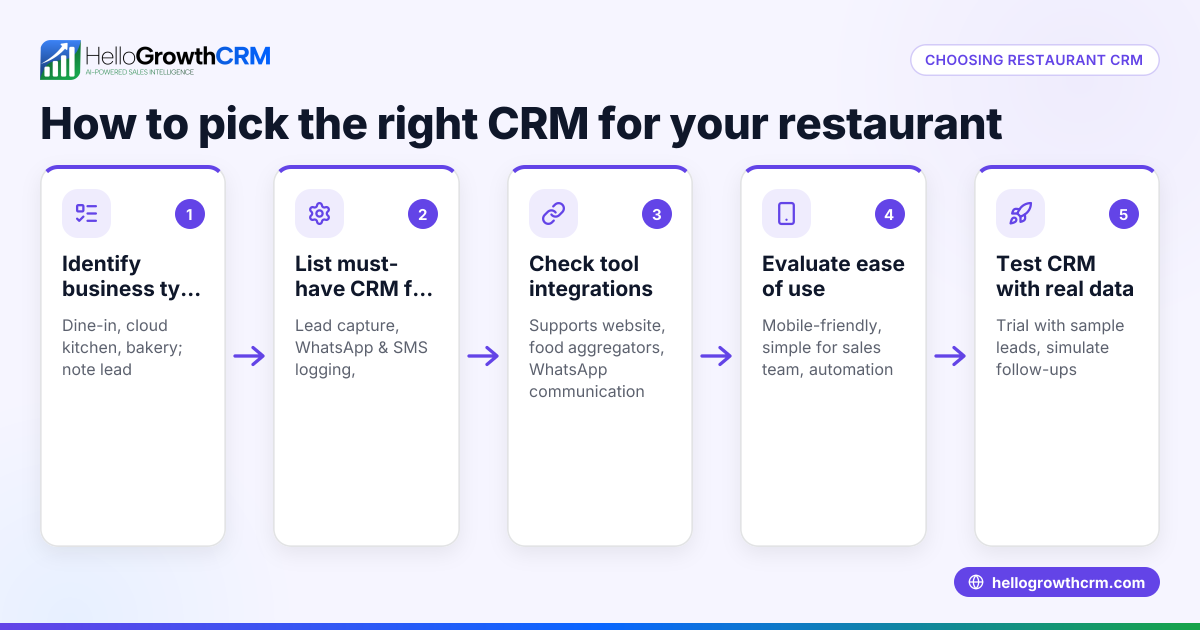
- Identify your restaurant’s CRM needs: List what your team requires, such as lead capture, WhatsApp messaging, SMS follow-ups, pipeline management, or sales reporting.
- Check channel support: Ensure the CRM supports WhatsApp and SMS natively, as many Singapore customers prefer these channels for communication.
- Evaluate ease of use: The CRM should be user-friendly so your team will adopt it quickly without extensive training.
- Look for AI assistance: Some CRMs offer AI agents that draft follow-up messages after calls, saving time on manual typing.
- Consider pricing and plans: Start with a free or low-cost plan that suits your team size; check if there are limits on leads or messaging.
- Test integrations: Confirm the CRM integrates with your website forms or booking systems to capture leads automatically.
- Assess pipeline and task management: The CRM should provide clear boards or views to track leads and follow-ups.
- Review reporting and forecasting features: Good reporting helps you understand sales trends and forecast revenue.
- Ask for a trial or demo: Use a trial period to see how well the CRM fits your restaurant’s workflow.
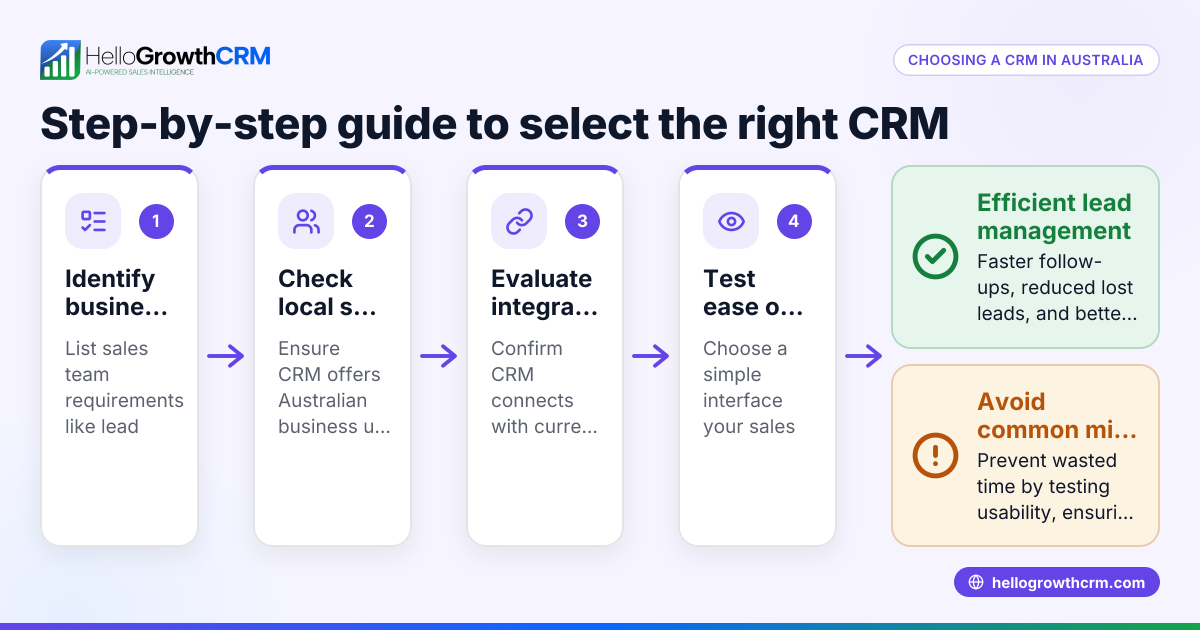
- Check local support and compliance: Prefer a CRM that understands Singapore’s business environment and data privacy requirements.
For more on industry-specific solutions, see Restaurants, cafes and cloud kitchens.
Example (fictional figures)
A cloud kitchen in Novena, Singapore, called "TasteHub," wants to improve its lead follow-up and customer engagement. They receive about 150 new leads monthly from their website and WhatsApp inquiries.
- Leads per month = 150
- Average order value = S$50
- Conversion rate without CRM = 10%
- Expected conversion rate with CRM = 20%
Current monthly revenue = 150 × 10% × S$50 = 15 × S$50 = S$750
Expected monthly revenue with CRM = 150 × 20% × S$50 = 30 × S$50 = S$1,500
Revenue increase = S$1,500 - S$750 = S$750
By adopting a CRM with WhatsApp and SMS sequences and AI-assisted follow-ups, TasteHub doubles its conversion rate and increases monthly revenue by S$750.
Common mistakes
- Ignoring channel preferences: Choosing a CRM without WhatsApp or SMS support leads to poor customer engagement. Prevent this by confirming channel support early.
- Overcomplicating workflows: Selecting a CRM with too many unnecessary features can overwhelm staff. Choose one that matches your team size and processes.
- Neglecting user adoption: Failing to train or involve your team results in low CRM usage. Prevent this by choosing user-friendly software and providing training.
- Not testing integrations: Missing out on automatic lead capture means manual data entry errors. Always test CRM integrations with your booking or web forms.
- Ignoring local business needs: Using a CRM that does not comply with Singapore’s data privacy or lacks local support can cause issues. Choose a CRM designed for Singapore businesses, such as HelloGrowthCRM.
See more about WhatsApp and SMS CRM at WhatsApp and SMS CRM.
Doing this in HelloGrowthCRM
HelloGrowthCRM supports WhatsApp and SMS messaging workflows that log conversations on lead records, allowing follow-ups to be sent as messages directly. Its AI agents (currently in Beta on the Growth plan) draft follow-up messages after calls, so sales reps only review and send them. For small teams, the Free Forever plan allows managing a pipeline with up to two users at no cost until advanced calling or WhatsApp automation is needed. HelloGrowthCRM is designed with Singapore businesses in mind. Learn more at HelloGrowthCRM for Singapore.
Frequently asked questions
What features should a restaurant CRM system in Singapore have? A restaurant CRM should support WhatsApp and SMS communication, lead capture from web forms, pipeline and task boards for sales tracking, and ideally AI features for follow-up automation. Integration with booking and ordering systems is also useful.
Can I use WhatsApp for customer follow-ups in a CRM? Yes, many Singapore restaurants prefer WhatsApp for customer communication. A CRM like HelloGrowthCRM logs WhatsApp conversations on lead records and allows sending follow-ups as WhatsApp messages.
Is there a free CRM suitable for small restaurant teams? Yes, HelloGrowthCRM offers a Free Forever plan for up to two users, managing up to 200 leads with a full Kanban pipeline and task management, ideal for small teams starting out.
How do AI agents help in a restaurant CRM? AI agents can draft follow-up messages after calls, reducing manual work for sales reps. This helps ensure timely follow-ups and better lead conversion.
How do I know if a CRM fits my restaurant’s workflow? Test the CRM with your team during a trial or demo. Check if it supports your communication channels, integrates with your systems, and is easy for your staff to use.
Key takeaways
- Choose a CRM that supports WhatsApp and SMS, popular channels in Singapore.
- Ensure the CRM fits your restaurant’s size and workflow with easy-to-use features.
- Use AI agents to automate follow-ups and save time.
- Test integrations to capture leads automatically and avoid manual errors.
- Start with a free or low-cost plan suitable for your team.
- Consider local support and compliance for Singapore businesses.
Start managing your restaurant leads better today. Start on the Free Forever plan (200 leads, no credit card).
Ready to put this into practice?
Set up your pipeline, WhatsApp follow-ups, and AI lead scoring in minutes — free, no credit card.
Try HelloGrowthCRM freeGet CRM tips in your inbox
Join thousands of sales professionals who get weekly insights on CRM strategy, AI automation, and pipeline optimization.

The HelloGrowthCRM team publishes guides on CRM strategy, AI sales tools, and revenue operations for small business sales teams.