HelloGrowthCRM software
Built for real small-business sales teams
HelloGrowthCRM helps reps qualify faster, follow up on time, and close more deals—with practical automation in one place.
- AI lead scoring and pipeline visibility
- Built-in dialer, WhatsApp, and email automation
- Sales forecasting and RevOps-ready reporting
A call listening session is a meeting where sales managers or supervisors review sales calls made by their team members. The goal is to assess how well sales reps communicate, identify strengths and weaknesses, and provide feedback to improve sales results. These sessions can involve listening to recorded calls or live calls and discussing them with the team.
Why this comes up / what goes wrong
Small-business owners often face challenges in maintaining consistent sales quality and customer engagement. When sales calls are managed through text messages, emails, or spreadsheets without a centralized system, it becomes difficult to monitor how leads are handled. Sales reps may miss follow-ups, use ineffective messaging, or fail to address customer objections properly. Without reviewing calls directly, managers lack insight into the actual conversations, making coaching and training less effective. This can result in lost leads, slow responses, and uneven customer experiences that hurt business growth.
Step-by-step
- Schedule the session: Choose a regular time for your call listening sessions, such as weekly or monthly, ensuring sales reps and managers can attend.
- Select calls to review: Pick a representative sample of calls from recent days, including successful calls, lost leads, and average conversations to get a balanced view.
- Prepare evaluation criteria: Define clear points to listen for, such as tone of voice, clarity of information, objection handling, product knowledge, and adherence to scripts or sales processes.
- Listen actively: Play recorded calls or listen live, taking detailed notes on what worked well and areas needing improvement.
- Discuss with the team: Share your observations openly with sales reps. Encourage them to self-assess and suggest ways to improve.
- Document action items: Write down specific coaching points or training tasks based on the session’s findings.
- Follow up: Track improvements in subsequent calls and adjust coaching as necessary.
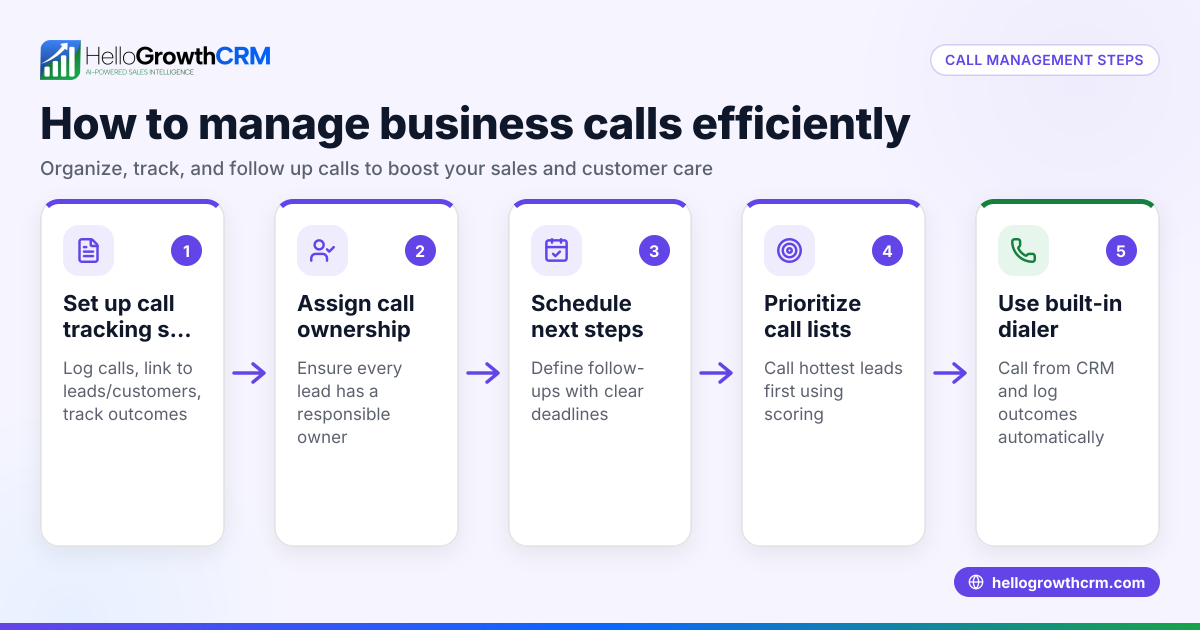
- Use CRM tools: Utilize a CRM with a built-in dialer to log call outcomes and keep full call histories tied to each lead. This makes it easier to select calls for review and track progress over time. See how the built-in CRM dialer helps with this.
Example (fictional figures)
Phoenix Home Realty, a residential real estate team in Phoenix, Arizona, holds a call listening session on 06/15/2026. They review 10 calls from the previous week.
- Total calls reviewed: 10
- Calls converted to appointments: 3
- Calls lost due to objections: 4
- Calls needing script improvement: 3
They identify that reps are not handling price objections well, causing lost leads. They schedule a training costing $1,200 to improve objection handling skills.
Cost of training: $1,200
Expected increase in appointments: 20% (from 3 to 3.6 calls)
Additional appointments: 0.6 × $5,000 average commission = $3,000
Return on training investment = $3,000 - $1,200 = $1,800
This example shows how call listening sessions help identify specific issues and justify targeted training investments.
Common mistakes
- Not setting clear goals: Without defined evaluation criteria, feedback becomes vague and unhelpful. Prevent this by preparing clear points to assess before the session.
- Reviewing too many calls at once: Trying to listen to too many calls can overwhelm the team and dilute focus. Limit the number to a manageable sample to maintain quality discussion.
- Ignoring positive calls: Focusing only on mistakes demotivates reps. Highlight what reps do well to encourage good practices.
- Failing to document feedback: Without recording action items, coaching lacks follow-through. Always write down specific points and assign responsibility.
- Skipping follow-up: Improvements require tracking over time. Schedule follow-up sessions to review progress and adjust coaching.
- Not using CRM tools: Managing calls outside a CRM makes tracking outcomes and histories harder. Use tools like HelloGrowthCRM’s built-in dialer to log calls and outcomes, simplifying call reviews and coaching. See the built-in CRM dialer for details.
Doing this in HelloGrowthCRM
HelloGrowthCRM offers a built-in dialer that lets reps work through a call list directly inside the CRM. Each call outcome is logged on the lead, keeping a full call history tied to contact and deal records. This centralized call logging helps managers select calls for listening sessions and track improvements over time. For US businesses managing sales via WhatsApp, SMS, and email, HelloGrowthCRM’s combined CRM and dialer streamline follow-up and coaching. Learn more about HelloGrowthCRM for the United States and its WhatsApp and SMS CRM features.
Frequently asked questions
What is the main purpose of a call listening session? A call listening session is designed to evaluate sales calls to improve communication, identify training needs, and increase sales effectiveness. It allows managers to provide targeted feedback based on real conversations.
Do I need recorded calls for a call listening session? Recordings help but are not always necessary. Live call listening works too. If your CRM or dialer logs call outcomes and histories, that data supports your review.
How often should I hold call listening sessions? Weekly or monthly sessions are common. The best frequency depends on your call volume and team size.
Can call listening sessions improve customer experience? Yes, by identifying communication gaps and coaching reps, sessions ensure consistent and clear customer interactions.
How does a CRM with a built-in dialer support call listening sessions? It logs every call outcome and keeps full call histories tied to leads, making it easier to select and review calls during sessions. See the built-in CRM dialer.
Key takeaways
- A call listening session reviews sales calls to improve agent performance and sales results.
- Small businesses use these sessions to identify coaching needs and maintain consistent customer communication.
- Run sessions regularly with clear criteria, focused call samples, and documented feedback.
- Avoid mistakes like unclear goals, no follow-up, or ignoring positive calls.
- Using a CRM with a built-in dialer helps log calls and outcomes, simplifying call reviews and coaching.
Start improving your sales calls today. Start on the Free Forever plan (200 leads, no credit card).
Ready to put this into practice?
Set up your pipeline, WhatsApp follow-ups, and AI lead scoring in minutes — free, no credit card.
Try HelloGrowthCRM freeGet CRM tips in your inbox
Join thousands of sales professionals who get weekly insights on CRM strategy, AI automation, and pipeline optimization.

The HelloGrowthCRM team publishes guides on CRM strategy, AI sales tools, and revenue operations for small business sales teams.