HelloGrowthCRM software
Built for real small-business sales teams
HelloGrowthCRM helps reps qualify faster, follow up on time, and close more deals—with practical automation in one place.
- AI lead scoring and pipeline visibility
- Built-in dialer, WhatsApp, and email automation
- Sales forecasting and RevOps-ready reporting
In the UAE, a manufacturing business should choose a CRM that can cope with WhatsApp enquiries, Arabic and English records, deposits and staged billing, field visits across emirates, and the fact that tax, privacy and licensing rules can change depending on whether the entity is mainland, free zone, DIFC or ADGM.
That matters because manufacturers here rarely sell through one clean channel. A factory in Sharjah may get distributor enquiries by phone, repeat orders by WhatsApp, RFQs from exhibitions at Dubai World Trade Centre, and service requests from installers who expect a reply after normal office hours during Ramadan. If those contacts land in separate inboxes and spreadsheets, the sales problem looks like a lead problem when it is really a process problem.
A good CRM for UAE manufacturing is less about a flashy demo and more about whether the system can hold the commercial record you actually need: who asked, which legal entity is selling, what documents were sent, what money was received, who visited site, and what consent you have for future follow-up.
WhatsApp enquiries and trade-show leads need one intake path
Manufacturing teams in the UAE often treat inbound business as if it all starts with a formal RFQ. In practice, it may start on Instagram, Dubizzle, Google Business Profile, a trade show badge scan, a referral from a contractor, or a WhatsApp message saying only “need quote today”. If your CRM only feels comfortable with polished web leads, staff will keep using side channels.
That is a local issue, not a generic software preference. In the UAE, WhatsApp is often the channel clients actually reply on, even when the formal quotation later moves to email. A manufacturer selling equipment to fit-out contractors in Al Quoz or industrial buyers in Mussafah may find that email-only follow-up gets ignored while a short WhatsApp confirmation gets the drawing approved.
The CRM should therefore capture leads from multiple sources into one queue, tag source clearly, and create a pipeline record immediately. If you want to explore that setup, the most relevant product layer is lead capture and qualification, because the first operational win is getting every enquiry into one governed record rather than letting hot leads sit inside personal phones.
For UAE teams, source fields should not stop at “website” and “referral”. They should reflect how you actually win work: exhibitions, dealer referral, Google Business Profile, WhatsApp inbound, repeat customer reorder, property platform lead, or installer partner. That gives management something useful to review each month without inventing a separate reporting spreadsheet.
VAT treatment of deposits changes what your deal record must capture
Many manufacturers in the UAE take advances for made-to-order goods, tooling, imported components or production slots. That is where CRM design starts to affect tax hygiene. VAT is administered by the Federal Tax Authority, and the FTA publishes guidance on registration, tax invoices and the treatment of advances. The practical point for a CRM buyer is simple: receipt of payment can matter when the payment arrives, not only when goods leave the premises.
If your team records only a final invoice date, you can lose sight of an earlier commercial event that accounting needs to review. This becomes more important where the business uses progress billing, retains deposits against future supply, or runs both mainland and free-zone entities. Free-zone and mainland treatment is not something to gloss over with a generic vendor answer; the same group can have different tax consequences depending on entity, activity and place of supply, so your finance lead should verify the current FTA position and the relevant UAE tax law before freezing the workflow.
The arithmetic below is illustrative; the figures are made up to show the shape of the decision. A Ras Al Khaimah manufacturer agrees a custom fabrication order for AED 240,000. The buyer pays an advance of AED 60,000 to reserve materials, a second instalment of AED 100,000 after drawings are approved, and the balance on delivery. If sales logs the opportunity only as “AED 240,000 closing next month”, finance misses two earlier money events that may need document issuance and review under FTA guidance. A better CRM record shows the deal amount, the expected instalment schedule, the payment actually received, and which commercial document was sent at each point. This example leaves out freight, customs treatment, credit notes, and any entity-specific tax analysis.
If you send quotations and proposals from the CRM, the value is not convenience alone. It is that the commercial paper, the deal stage and the payments received stay tied together, giving finance a cleaner handoff when it checks the current FTA rules and the applicable law.
Arabic names, RTL text and export quality are not cosmetic issues
UAE manufacturing sales rarely operate in one language. A contact may speak English on a call, send a delivery location in Arabic, and ask for a colleague’s number in Hindi or Urdu. Public-facing pages and messages need Arabic to render right-to-left properly, not just inside an admin screen. If your CRM mishandles Arabic-script company names or contact names, the damage shows up later in quotations, dispatch coordination and exports to other systems.
This is one of the easiest tests to run before you buy. Load real records with Arabic company names, Arabic addresses and mixed-script contact data. Export them. Re-import them. Then inspect the quotation output and message preview. If a sales manager has to keep an unofficial Excel sheet “because the Arabic breaks”, the CRM has already failed.
For manufacturers selling through dealers or project channels, this matters even more because one wrong character can turn site information into delivery confusion. It also interacts with compliance: if you collect Emirates ID details for a legitimate purpose, that purpose should be clear and limited. Emirates ID is a standard identifier in the UAE, but that does not mean sales staff should collect it casually. The UAE Personal Data Protection Law sits under the UAE Data Office framework, while DIFC and ADGM have their own data protection regulators for entities in those jurisdictions. So the CRM should let you decide which personal fields are truly necessary rather than encouraging staff to gather everything “just in case”.
Consent, promotional messaging and service updates should not share the same flag
Manufacturers often send three very different kinds of messages: a quotation follow-up, a dispatch or installation update, and general marketing. In the UAE, that distinction matters. Marketing traffic to UAE numbers sits under the regulatory framework overseen by the TDRA, which distinguishes promotional messages from service communications. Platform rules for business messaging also change, so any claim by a vendor about template approval or channel cost is something you should verify at the time you buy.
A CRM should therefore store communication basis with more care than a simple “opted in” checkbox. The sales team needs to know whether a number can receive a quote reminder, a delivery notice, a campaign about a new product line, or none of the above. If that sounds administrative, think about the real-world consequence: teams stop messaging from the CRM and revert to personal devices whenever the rules feel unclear.
This is where a UAE manufacturing buyer should ask to see the actual record design, not the marketing slides. One short checklist is enough:
- Can the contact record distinguish service communication from promotional messaging?
- Can you store source of enquiry, consent context and preferred channel?
- Can Arabic and English message content both be reviewed before sending?
- Can one account hold multiple buyer contacts with different permissions?
- Can the history show exactly what was sent and by whom?
If WhatsApp is central to your pipeline, review the WhatsApp and SMS workflows with your own records, not with a generic sample dataset. The goal is to keep compliant, visible communication inside the shared system so handoffs do not depend on who owns the phone.
Cheques, bank transfers and staged collections belong inside the opportunity
UAE manufacturing collections are rarely card-first. Bank transfer is common, credit card can appear for smaller orders, cash still exists in some sectors, Apple Pay and Google Pay show up in certain retail-adjacent cases, and post-dated cheques remain in use in parts of the market. That mix changes what “deal closed” should mean in your CRM.
If a salesperson marks a job won when the customer says yes, operations may start work before the agreed cheque date, before the transfer arrives, or before a deposit is cleared internally. For a manufacturer with imported inputs or custom production, that is not a minor workflow issue; it can create unnecessary purchasing risk.
The CRM should let you tie quotations, proposals, invoices and payments received back to the same deal record so commercial status and collection status are not confused. That does not turn the CRM into your accounting system, and no software choice removes the need for finance review. It does mean the sales pipeline reflects local payment reality. A stage such as “verbal yes” is different from “deposit received” or “PDC collected”, and the system should preserve that distinction.
If you use multiple tools today, inspect how data will move through integrations before rollout. UAE businesses often discover too late that the issue is not creating an invoice but reconciling the human story around the payment: who promised what, for which entity, against which quote revision.
Field visits from Jebel Ali to Sharjah need a single activity history
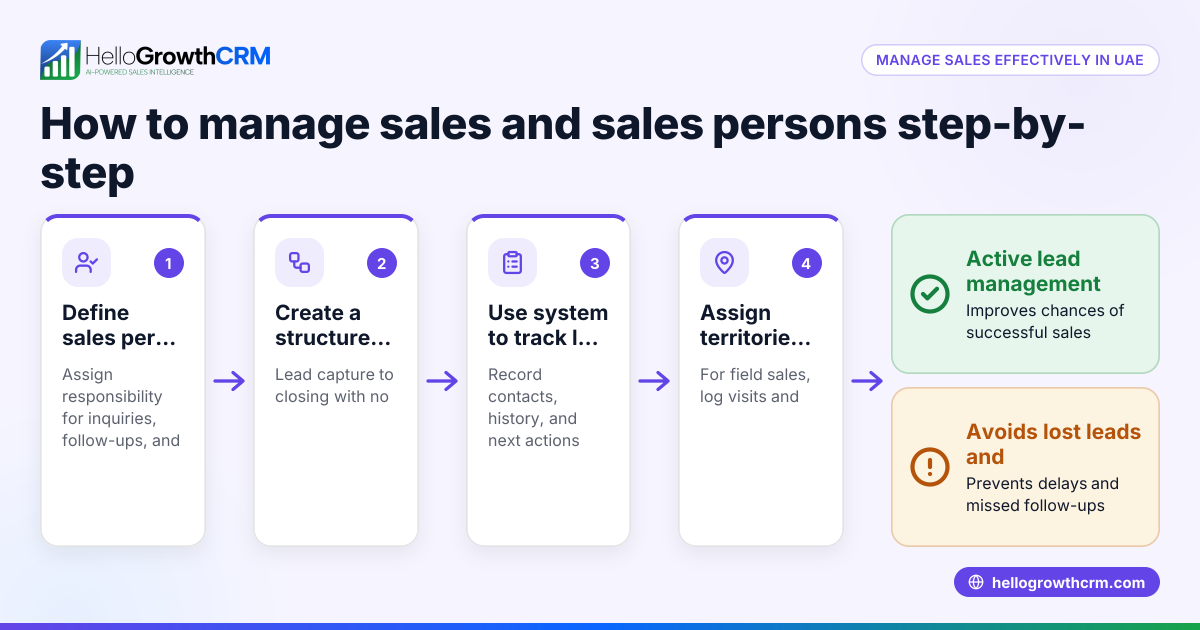
Manufacturing sales in the UAE often includes plant visits, distributor meetings, sample drop-offs, on-site measurements and after-sales checks across more than one emirate. The geography is not huge, but the operational spread is real. A rep may spend the morning in Jebel Ali Industrial Area, then head to Sharjah or Ajman, while an internal estimator waits on dimensions before issuing the revised quotation.
Without a shared activity history, field work becomes anecdotal. Notes stay in chat threads, and nobody can tell whether the delay is with the customer, the sales rep, technical review or production planning. A CRM for this market should make visits, calls, tasks, notes and handoffs visible on the same account and deal record.
This matters around calendar patterns too. The UAE working week is not a simple assumption, and public-sector and private-sector routines are not identical. During Ramadan, reduced working hours apply and many customers are easier to reach later in the day. Several holidays follow the Hijri calendar and are confirmed close to the time, so rigid annual automation can miss reality. Your CRM should support tasking and scheduling that reflects how buyers actually answer.
That is where activities and task boards become more than admin features. They are the place where site findings, promised callbacks, estimator actions and distributor follow-ups stay attached to the same commercial record instead of getting lost between departments.
Licensing structure affects who is allowed to sell what, and from which entity
UAE manufacturers often operate through more than one legal vehicle: a mainland trading entity, a free-zone production entity, or a group structure with sales staff sitting in one emirate and fulfilment in another. Multi-emirate operations also face different licensing authorities depending on where the entity is established. In the same tower, two businesses can face different rule sets because one sits in a free zone and the other does not.
That means your CRM should capture the selling entity, trade licence context and operating location at account or deal level where relevant. Otherwise staff may quote from the wrong company, send the wrong bank details, or promise a service from an entity not set up for that activity. For some firms, especially those working around DIFC or ADGM clients, the data-protection regime attached to the entity matters as much as the commercial workflow.
This is not about stuffing the CRM with legal jargon. It is about practical controls. When a lead is qualified, the system should help route it to the correct business unit, territory or entity so the quotation, tax review and customer communication start in the right place. If your team covers installers, project sales and distributor accounts across emirates, evaluate whether territories and field operations match the way your sales ownership actually works.
Test with your own records, then decide whether to start simple or with managed rollout
The safest way to choose a CRM for a UAE manufacturing business is to test your own records inside it. Use a current quotation, a mixed Arabic-English contact list, a deal with a deposit, a field visit note, and a buyer who prefers WhatsApp to email. That will tell you more than any polished demo.
Many firms should begin with a narrower scope than they expect: inbound lead capture, one pipeline, activity logging, and document tracking. That is enough to expose whether the system fits your local process. Teams that are short on admin discipline may also want help cleaning pipeline stages, routing leads and enforcing follow-up. If that is your situation, review managed RevOps support alongside the software itself so rollout does not depend on an already overstretched sales manager.
For smaller teams or a pilot division, the free CRM option can be a sensible way to test live records without forcing a full migration on day one.
The right CRM for UAE manufacturing is the one that reflects how business is actually sold here: through mixed channels, mixed languages, mixed payment methods and entity-specific rules. Choose for that reality, and the system has a chance of becoming the operating record instead of another abandoned app.
Ready to put this into practice?
Set up your pipeline, WhatsApp follow-ups, and AI lead scoring in minutes — free, no credit card.
Try HelloGrowthCRM freeGet CRM tips in your inbox
Join thousands of sales professionals who get weekly insights on CRM strategy, AI automation, and pipeline optimization.

The HelloGrowthCRM team publishes guides on CRM strategy, AI sales tools, and revenue operations for small business sales teams.