HelloGrowthCRM software
Built for real small-business sales teams
HelloGrowthCRM helps reps qualify faster, follow up on time, and close more deals—with practical automation in one place.
- AI lead scoring and pipeline visibility
- Built-in dialer, WhatsApp, and email automation
- Sales forecasting and RevOps-ready reporting
A CRM for electrical distributors helps you capture every counter inquiry, track contractor follow-ups, manage quote pipelines, and predict reorders before revenue slips. For U.S. B2B distributors, the right setup matters because sales happen across branches, outside reps, phones, email, and repeat buying patterns that are easy to lose in spreadsheets.
Key takeaways
- The best CRM for electrical distributors tracks branch counter leads, contractor accounts, quotes, jobs, and repeat orders in one place.
- Electrical distribution sales teams need workflows for phone calls, email, outside sales, and account-based follow-up.
- A useful CRM should connect sales activity to quote stages, reorder timing, and realistic pipeline forecasts.
- U.S. distributors should also support common business needs like QuickBooks, Stripe, ERP handoffs, and buyer expectations around SOC 2.
- An ai crm can help small and mid-sized distributors prioritize leads, flag stale quotes, and improve rep follow-up without adding admin work.
Why CRM for electrical distributors is different
Electrical distribution is not a simple one-call-close sales process. Your team may sell to contractors, facilities teams, OEMs, panel builders, commercial property groups, and industrial buyers. Some deals start at the counter. Others begin with a phone call, an email request, or a field rep visit.
That creates several problems fast.
A branch employee may talk with a contractor in person and promise to follow up on pricing. An outside rep may quote a project in Houston and wait weeks for an update. A customer in Chicago may reorder breakers, conduit, fittings, or controls every 30 to 90 days, but no one notices when the buying pattern drops.
A CRM for electrical distributors should solve those gaps. It should not just store contacts. It should help your team run the daily sales motion with less guesswork.
That means the CRM needs to do four jobs well:
- Capture leads from every channel.
- Route and track follow-up by rep, branch, or territory.
- Manage quotes and project pipelines.
- Surface reorder signals and forecast future revenue.
If your current system cannot do those jobs, your team is likely relying on memory, inboxes, and spreadsheets. That usually leads to missed follow-ups, stale quotes, and weak forecasting.
What should a CRM for electrical distributors actually track?
It should track the account, every contact, every quote, every branch interaction, and the next action. It should also show reorder timing, open opportunities, and rep activity in one place so managers can see what is moving and what is stuck.
In practice, electrical distributors need more than standard contact records. They need account context that reflects how buying works in the field.
Core records you should track
Start with account-level information. This includes the contractor or business name, branch relationships, service locations, billing details, and assigned rep. Then track each buyer, estimator, project manager, purchasing contact, and field supervisor separately.
Next, track sales objects tied to revenue:
- Counter inquiries
- New account requests
- Quote requests
- Project opportunities
- Repeat order opportunities
- Open follow-up tasks
- Calls, emails, and meeting notes
For each opportunity, your team should be able to answer basic questions fast:
- Who requested the quote?
- What products or categories are involved?
- Is it stock, special order, or project-based?
- What is the expected close date?
- What branch or rep owns it?
- What happened last?
- What should happen next?
Without that structure, quote follow-up gets inconsistent. One rep updates notes. Another keeps everything in email. A branch manager cannot tell which large opportunities are active versus dead.
Counter leads matter more than many distributors think
Counter traffic is often treated like a transaction channel, not a lead source. That is a mistake. Many future house accounts and contractor relationships start with small in-person purchases and pricing conversations.
Your CRM should let inside staff log quick counter leads in seconds. That record does not need ten required fields. It needs enough detail for a rep to follow up properly.
A useful counter lead record often includes:
- Company name
- Contact name
- Phone number
- Email address
- Product need
- Job or site reference
- Branch location
- Follow-up owner
- Next follow-up date
If this data stays on paper or in a rep’s notebook, your team loses visibility. A good system turns counter activity into pipeline, not forgotten conversations.
How do you track contractor follow-ups without slowing reps down?
Use short workflows with clear next steps. Reps should log calls, quote updates, and promised follow-up dates quickly. Managers need automatic reminders for stale quotes and inactive accounts so follow-up happens on time.
Speed matters here. If follow-up feels heavy, reps skip it. The CRM should help them work, not create extra admin.
Build a follow-up process around real electrical sales behavior
Contractor follow-up is rarely one straight line. Buyers may ask for pricing, disappear for a week, then return with revised quantities. A foreman may need material fast for a jobsite. An estimator may compare several distributors before making a decision.
That means your follow-up system should be practical.
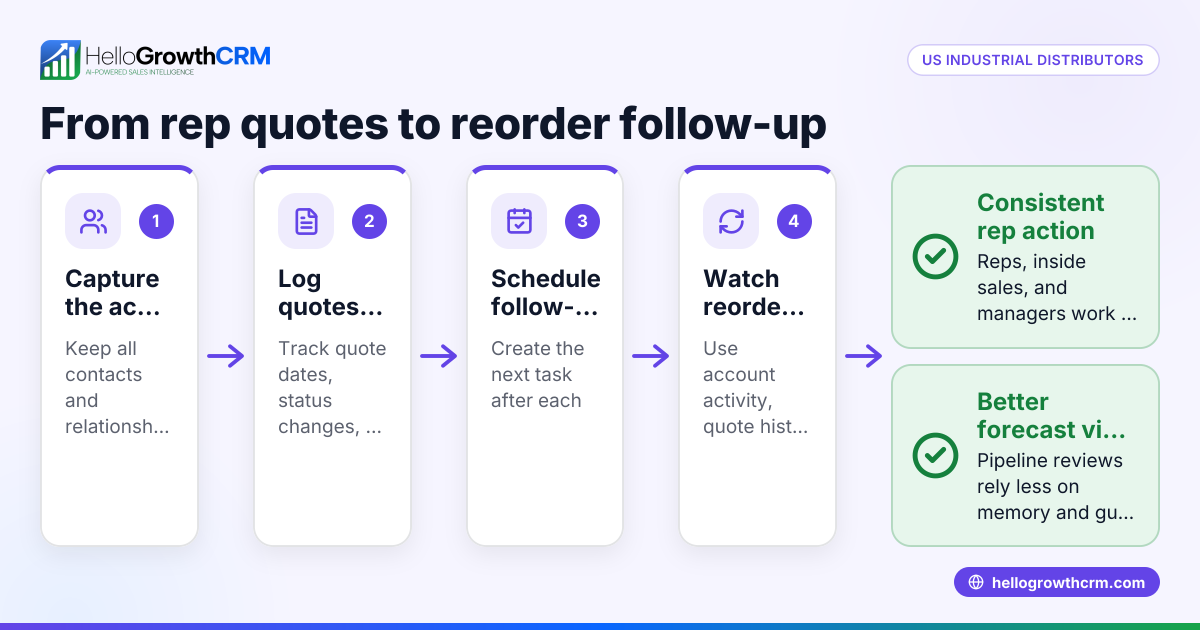
A good starting workflow looks like this:
- Capture the inquiry immediately.
- Assign it to the right branch, territory, or account owner.
- Set one next step with a due date.
- Log each contact attempt.
- Update the quote or opportunity stage.
- Trigger reminders if nothing happens after a set period.
This is where automation helps. With email automation, your team can standardize routine quote follow-ups and keep messaging consistent without writing every message from scratch.
Prioritize by account value, urgency, and buying pattern
Not every follow-up deserves the same effort. A one-time parts request is different from a contractor quoting a school renovation in Detroit or a facilities buyer with monthly reorder potential.
A better CRM helps reps sort work by likely value. That can include:
- Open quote amount
- Account tier
- Product urgency
- Recent activity
- Historical reorder timing
- Time since last response
This is where AI lead scoring can help. Instead of making reps guess, the system can highlight which leads or accounts deserve attention first.
How should quote pipelines work for electrical distributors?
A quote pipeline should show where each opportunity stands, who owns it, what it is worth, and the next committed action. The best pipelines are simple enough for reps to maintain and detailed enough for managers to forecast with confidence.
Quote management is often where distributor revenue gets stuck. Quotes pile up. Follow-up becomes uneven. Managers only hear about big deals in meetings, not in real time.
Use clear stages that match your sales motion
Many distributors make the mistake of using generic pipeline stages. That causes confusion because the stages do not match how electrical sales actually progress.
A more useful quote pipeline might include stages like:
- New inquiry
- Qualifying need
- Pricing in progress
- Quote sent
- Follow-up due
- Revised quote requested
- Verbal approval
- Won
- Lost
- Dormant
These stages should be visible to inside sales, outside reps, and branch leaders. Everyone should know what each stage means. If the pipeline definitions are loose, reporting becomes unreliable.
Track project business separately from repeat business
Project quotes and recurring account orders are not the same. A contractor bidding a hospital job behaves differently from a maintenance buyer reordering standard inventory every month.
Your CRM should separate those motions. That way your team can forecast new project revenue without mixing it with predictable reorder business.
Useful fields for quote records include:
- Expected revenue
- Product category
- Branch
- Rep
- Job name
- Bid date
- Decision date
- Competitor notes
- Margin estimate
- Last activity date
When those fields are updated regularly, leadership gets a clearer view of what is likely to close and what needs attention.
For teams that need better visibility, sales forecasting can help turn pipeline updates into more realistic branch and rep forecasts.
Can a CRM help forecast reorders for electrical accounts?
Yes. A CRM can flag accounts that usually reorder on a pattern, show when an expected order is late, and help reps act before revenue drops. That is especially useful for house accounts, maintenance buyers, and contractors with steady purchasing cycles.
This is one of the biggest missed opportunities in electrical distribution. Many repeat orders are treated as automatic until they stop. By then, the buyer may already be ordering elsewhere.
Look for reorder signals, not just open deals
Not every future sale starts as a new opportunity. Many start as buying behavior. If a customer usually places an order every 45 days and now it has been 70, that matters.
A strong CRM should help your team spot signals like:
- Time since last order or quote
- Drop in account activity
- Shrinking average order size
- Repeat requests for the same product families
- Seasonal buying cycles
- Branch-specific reorder patterns
This is where an AI CRM becomes useful. It can identify patterns across your accounts and show reps which customers may need attention before they go quiet for good.
Tie sales data to your finance and operations stack
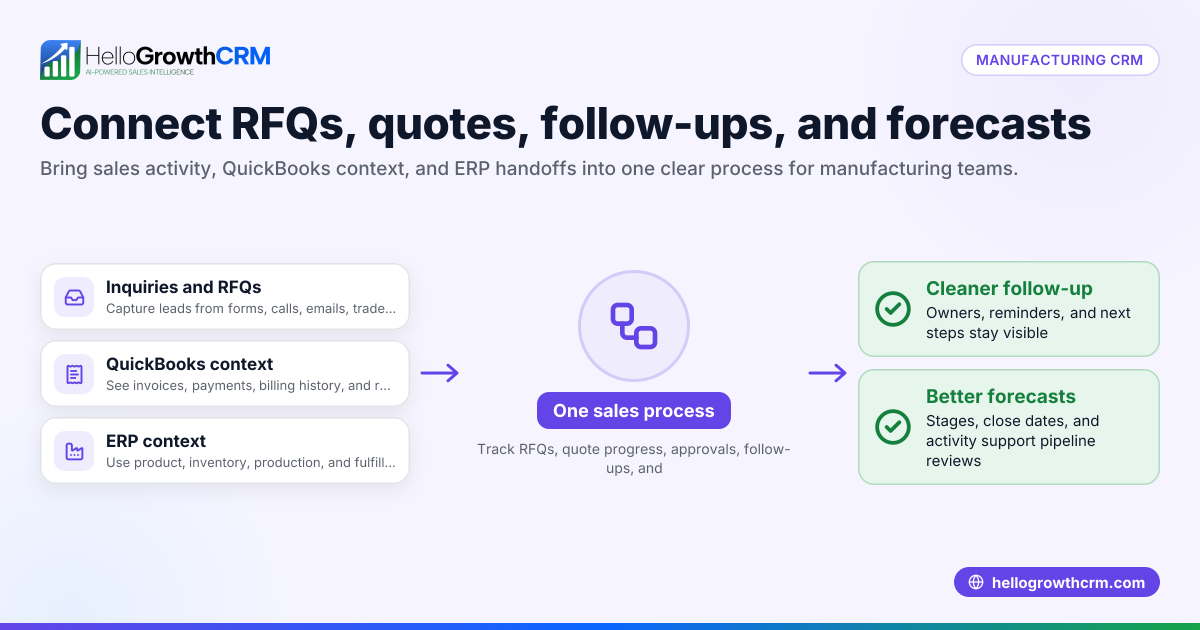
Most distributors already have data in accounting or ERP tools. The CRM should not replace those systems. It should work alongside them so sales can act on useful information.
For many U.S. businesses, common finance and payment tools include QuickBooks and Stripe. In distribution, ERP systems often remain the source for inventory, purchasing, and order processing. Your CRM should connect where it makes sense through integrations, while keeping sales teams focused on account growth and follow-up.
What features matter most in a CRM for electrical distributors?
The most important features are lead capture, account ownership, quote pipeline tracking, reminders, communication logging, and reorder visibility. If a CRM does those well, your team will use it. Fancy extras do not matter if reps cannot update deals quickly.
Once the basics are covered, look for features that reduce manual work.
The must-have feature list
A practical CRM for electrical distributors should include:
- Fast lead capture for counter, phone, and email inquiries
- Account and contact management
- Territory or branch assignment
- Quote and opportunity pipelines
- Task reminders and follow-up automation
- Email and call logging
- Activity dashboards
- Reorder alerts or account health views
- Forecast reporting
- Permission controls by branch or team
Those are the features that affect daily execution.
The adoption test is simple
Ask one question before buying any CRM: will branch staff and reps actually use it every day?
If the answer is no, the feature list does not matter. The system has to be quick enough for busy teams. It should support how they already sell by phone, email, and in-person visits.
This is one reason many growing distributors look for both software and process support. Tools alone do not fix bad pipeline hygiene. Managed RevOps can help teams define stages, ownership rules, dashboards, and follow-up standards so the CRM becomes part of operations, not another abandoned project.
How to choose the right CRM for your distribution business
The right CRM fits your sales process, branch structure, and team habits. It should be easy to adopt, flexible enough for quotes and reorders, and strong on reporting so leadership can trust the pipeline.
Choosing well starts with your actual workflow, not a generic software checklist.
1. Map how leads enter the business
List every source of demand:
- Counter walk-ins
- Inbound phone calls
- Email quote requests
- Website forms
- Outside rep prospecting
- Existing account reorder activity
Then decide who should own each lead type and how quickly follow-up should happen.
2. Define your pipeline stages clearly
Do not buy a CRM until your quote and project stages are agreed internally. If branch leaders and reps define stages differently, the system will fail.
Create written stage definitions. Keep them simple. Tie each stage to one next action.
3. Decide what managers need to see weekly
Your dashboard should answer practical questions:
- Which quotes are aging?
- Which reps have overdue follow-ups?
- Which branches have the strongest pipeline?
- Which accounts may be at risk of churn?
- What revenue is likely this month and this quarter?
If the CRM cannot answer those questions simply, it will not help leadership much.
4. Check communications and compliance basics
Most U.S. distributors still rely heavily on email and phone. Your CRM should support those channels well. If you run outbound email or calling, your process should also respect laws like CAN-SPAM and TCPA where applicable. The tool should make responsible outreach easier, not sloppier.
5. Consider buyer trust and data expectations
Larger B2B buyers may ask security questions during onboarding. SOC 2 expectations are common in many U.S. business relationships, especially when customer data and workflows are involved. If software security matters to your customers or internal IT team, include that in your review process.
6. Choose a system your team can grow into
A small distributor may start with one branch and a few reps. But growth changes requirements fast. You may add outside sales coverage, more branches, or tighter forecasting needs.
Review the product’s features and make sure it can support where you are headed, not just where you are today.
Common implementation mistakes electrical distributors should avoid
The biggest mistakes are overcomplicating data entry, skipping process design, and failing to assign ownership. Most CRM issues come from bad setup and weak habits, not from the software itself.
Mistake 1: Making reps enter too much
If every lead requires too many fields, data quality will drop. Start with the minimum information needed to act. Add more only when it improves decision-making.
Mistake 2: Treating all opportunities the same
Counter leads, project quotes, and repeat account management should not all follow one workflow. Different sales motions need different fields, reminders, and reports.
Mistake 3: Ignoring branch-level visibility
Electrical distribution often runs by branch, territory, or account ownership. If reporting only works at the company level, managers will miss local issues.
Mistake 4: Not enforcing next steps
A pipeline without next actions is just a list. Every active quote should have an owner, a due date, and a clear follow-up task.
Mistake 5: Failing to review adoption weekly
Early adoption determines long-term value. Managers should review usage, overdue follow-ups, stale opportunities, and data quality every week during rollout.
A practical CRM setup for a growing U.S. electrical distributor
For most small and mid-sized distributors, the best setup is simple. Capture every inquiry. Assign ownership fast. Use a quote pipeline with clean stages. Track reorder timing. Review dashboards weekly.
That sounds basic, but it creates discipline.
When reps can see their next priorities, branch managers can coach from facts, and leaders can forecast from actual activity, the CRM starts producing value. The goal is not more software. The goal is fewer missed opportunities and more predictable revenue.
Ready to put this into practice?
Set up your pipeline, WhatsApp follow-ups, and AI lead scoring in minutes — free, no credit card.
Try HelloGrowthCRM freeGet CRM tips in your inbox
Join thousands of sales professionals who get weekly insights on CRM strategy, AI automation, and pipeline optimization.

The HelloGrowthCRM team publishes guides on CRM strategy, AI sales tools, and revenue operations for small business sales teams.