HelloGrowthCRM software
Built for real small-business sales teams
HelloGrowthCRM helps reps qualify faster, follow up on time, and close more deals—with practical automation in one place.
- AI lead scoring and pipeline visibility
- Built-in dialer, WhatsApp, and email automation
- Sales forecasting and RevOps-ready reporting
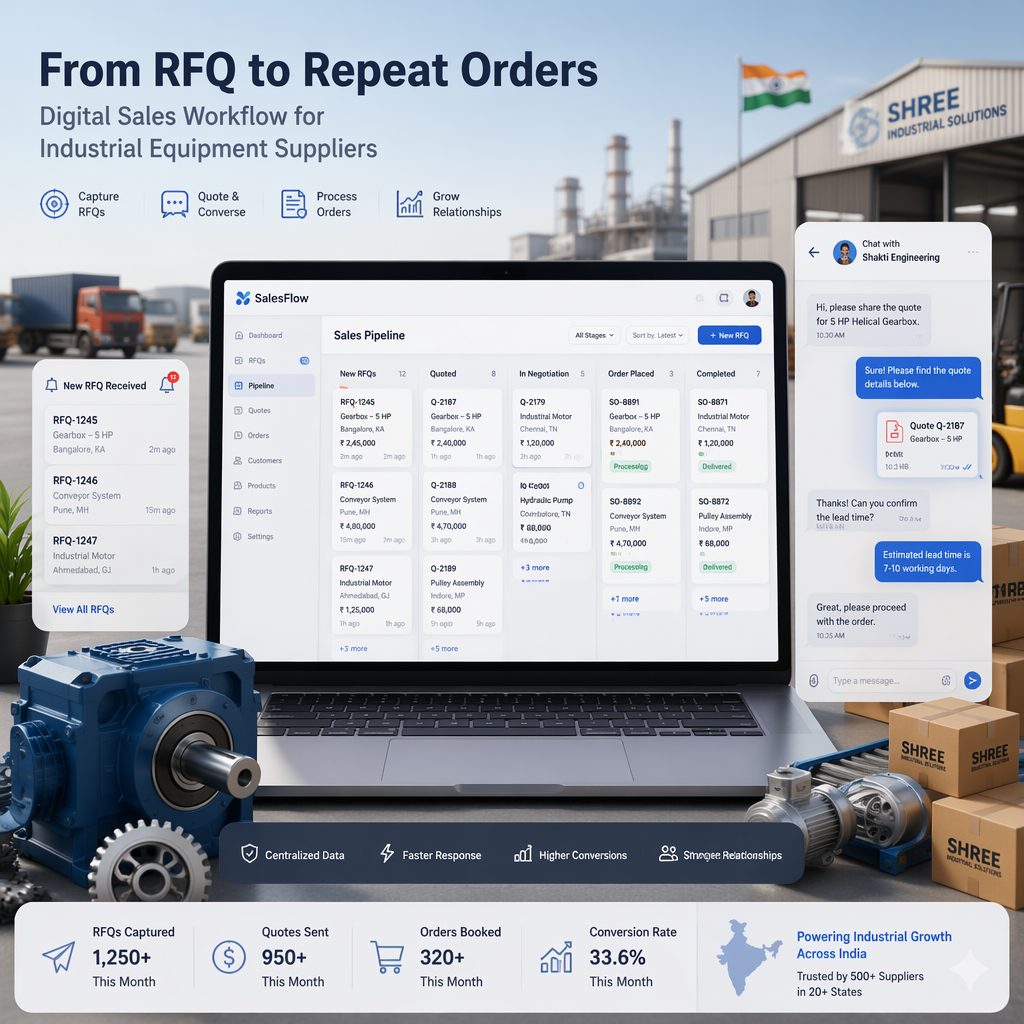
A CRM for industrial distributors helps your sales team manage quote activity, follow-ups, repeat orders, and pipeline visibility in one place. For US distributors, the right system should fit long sales cycles, multiple contacts per account, rep-driven pricing, and reorder patterns that drive predictable revenue.
Key takeaways
- The best crm for industrial distributors tracks quotes, calls, emails, and reorder timing by account.
- US distributors need a CRM that supports outside reps, inside sales, and operations in one workflow.
- Follow-up discipline matters as much as lead generation in industrial sales.
- Reorder forecasting works best when your CRM captures quote history, order cadence, and rep notes.
- An ai crm can help sales teams prioritize accounts, score opportunities, and keep pipelines current.
- Adoption improves when the CRM matches how distributors actually sell, not how software vendors think they sell.
Why industrial distributors in the United States need a different kind of CRM
Industrial distribution sales are rarely simple. A rep may quote a Chicago manufacturer, wait three weeks for plant approval, revise pricing, and then follow up with both purchasing and maintenance. Another account in Houston may place small orders every month, but only after a phone call from an outside rep who knows the buyer well.
That is why generic contact management tools often fail. Industrial distributors need structure around quotes, customer relationships, reorder timing, and field rep activity. They also need a system the team will actually update.
In many US distributors, key sales information still lives in inboxes, spreadsheets, notebooks, and ERP records. The quote may sit in one tool. The customer call notes may sit in a rep's phone. The reorder history may live in the ERP. When these records stay disconnected, teams miss follow-ups, lose visibility, and make weak forecasts.
A good CRM brings those activities together. It gives sales leaders one place to see who was quoted, who needs a call, which deals are slowing down, and which accounts are likely to reorder.
What should a crm for industrial distributors actually do?
It should help reps move real deals forward without adding busywork. For most US industrial distributors, that means five core jobs.
1. Capture and organize every account
Distributors usually sell into accounts with several stakeholders. You may deal with a buyer, a plant manager, a maintenance lead, and an owner. Your CRM should keep all of those contacts tied to one account.
That matters when staff changes happen. If one buyer leaves, your team should still see the full relationship history.
2. Track quotes and revisions
Quotes are often the center of the sales process. Your CRM should log quote dates, values, products, expected close timing, and status changes. It should also show when a quote was revised and why.
That history helps managers coach reps. It also helps reps avoid restarting the same conversation every time a customer asks for an update.
3. Drive follow-ups automatically
In distribution, many deals are not lost because of price. They are lost because nobody followed up at the right time. A CRM should create reminders, tasks, and sequences after a quote is sent.
That can include email, phone call, or even WhatsApp when appropriate for the customer relationship. The goal is simple. No quote should go quiet without a next step.
4. Support reorder forecasting
Many distributor accounts buy on a cycle. Some reorder every 30 days. Others buy around shutdowns, seasonal maintenance, or project schedules. A useful CRM should help your team spot those patterns.
That is where sales forecasting becomes practical. Instead of guessing from memory, your team can review account activity and likely reorder windows.
5. Show the real pipeline
Industrial sales leaders need more than top-line pipeline value. They need to know which quotes are active, which reps are behind on follow-up, and which accounts may reorder soon. The CRM should make that visible without requiring hours of manual reporting.
How do industrial distributors use a CRM day to day?
A CRM for industrial distributors should fit the daily rhythm of quoting, calling, checking stock, and nudging buyers. It should make routine tasks faster, not heavier.
In practice, a typical workflow looks like this:
- A lead comes in from a website form, phone call, trade show list, or rep referral.
- The sales team assigns the account to the right territory or rep.
- The rep logs the opportunity and any product need.
- A quote is created and attached to the account.
- The CRM schedules follow-ups based on quote date and expected decision timing.
- The rep logs calls, emails, and customer feedback.
- If the customer buys, the account moves into a reorder or account management motion.
- The system watches for inactivity or likely reorder timing and prompts the next action.
This matters because distributor sales are often won through consistency. Your best reps may already do this instinctively. The problem is scale. New reps, inside sales teams, and managers need a repeatable process.
That is also where email automation can help. It gives teams a structured way to send timely follow-ups without relying on every rep to remember every date.
Why do rep quotes and follow-ups fall through the cracks?
Quotes and follow-ups fall through the cracks when the process depends on personal memory, inbox folders, or spreadsheets. The fix is a CRM that gives every quote an owner, next step, and due date.
Most industrial distributors do not have a lead problem. They have a process problem. Reps are juggling customer visits, product questions, internal coordination, and quote revisions. When the day gets busy, follow-up becomes uneven.
A few common breakdowns show up again and again:
Quote activity is not centralized
If quote records stay in separate files or email chains, managers cannot see which opportunities are active. Reps also lose context when customers come back after a delay.
No next step is assigned
A quote with no task is a quote that drifts. Every quote should trigger the next action automatically. That could be a call in two days, a pricing check in five days, or a reorder review next month.
Reps own relationships, but not the system
Many distributor businesses rely on rep knowledge. That can work until a rep is out sick, leaves the company, or gets overloaded. A CRM protects the business by turning personal knowledge into team knowledge.
Forecasts are based on optimism
Without disciplined follow-up data, pipeline reviews become guesswork. Deals sit in the same stage for weeks. Managers cannot tell whether a quote is alive, delayed, or dead.
What does reorder forecasting look like in a distributor CRM?
Reorder forecasting means using account history, quote activity, and buying patterns to predict when a customer is likely to buy again. It helps reps prioritize the right accounts before demand goes cold.
For US industrial distributors, reorder forecasting is not just a reporting feature. It is a revenue habit. A strong account base often creates repeat business, but only if someone stays ahead of timing.
Start with account-level buying rhythm
Look at what the customer bought, how often, and under what conditions. Some accounts reorder consumables every month. Others buy after maintenance cycles, capital projects, or budget approvals.
Your CRM should let the rep record context along with dates. That gives future forecasts more value than a simple list of past transactions.
Use quote history, not just closed orders
Many reorder signals show up before the order does. A customer may request updated pricing, ask for an alternate item, or reopen an old quote. Those signals matter.
That is where AI lead scoring can help in a distribution environment. It can help surface which accounts or deals deserve attention based on recent activity and patterns, not just rep intuition.
Give reps a reorder queue
A useful CRM should produce a practical work list. Which accounts are nearing reorder timing? Which customers have gone quiet past their usual cadence? Which reps need to call before the month ends?
When reorder forecasting becomes part of the daily workflow, it drives pipeline quality and account retention at the same time.
How should a CRM fit with ERP and finance systems?
A distributor CRM should sit alongside your ERP and finance stack, not try to replace them. The CRM should manage sales activity, while the ERP remains the source for orders, inventory, and fulfillment.
Many industrial distributors already rely on an ERP for product, pricing, and order records. They may also use QuickBooks or Stripe in parts of the finance workflow. That is normal. The problem is not having separate systems. The problem is when the sales team cannot connect customer conversations to the rest of the business.
A CRM should help bridge that gap by giving reps and managers better visibility before and after the order. That includes:
- quote status
- communication history
- next follow-up date
- contact roles
- account notes
- expected reorder timing
- pipeline health
This is where integrations matter. You want customer-facing teams to work in one place while keeping operational systems intact.
What features matter most for outside reps and inside sales?
Outside reps and inside sales need a CRM that keeps account history, tasks, and communication in one place. It should make handoffs easy and show exactly what happened with each quote or reorder opportunity.
Industrial distribution often depends on teamwork. The outside rep owns the relationship. The inside rep handles quoting and follow-up. Operations may answer product questions. Leadership wants a clear forecast. If each group works from different records, the customer feels the disconnect.
For outside reps
Outside reps need mobile access, fast note entry, call logging, and clear account history before every visit. They should be able to see open quotes, pending tasks, and recent communication from the road.
For inside sales
Inside reps need queue-based work. They should be able to filter by open quotes, overdue follow-ups, recent inbound leads, and likely reorders. Speed matters here.
For managers
Managers need visibility without chasing updates. They should be able to review rep activity, quote aging, stage movement, and forecast quality from a single dashboard.
An AI CRM can help here because it reduces manual cleanup and surfaces what needs attention. That matters in a business where reps are often busy selling, not updating software.
Common mistakes when choosing a CRM for industrial distributors
Many distributors buy a CRM based on a demo that looks polished but does not match their sales reality. The result is poor adoption and weak data.
Here are the biggest mistakes to avoid.
Choosing for marketing, not field sales
Some systems are strong at top-of-funnel campaigns but weak at quote management and account follow-up. If your revenue depends on repeat orders and rep relationships, that mismatch shows up fast.
Ignoring quote workflow
If quote records are an afterthought, your sales process will stay fragmented. For distributors, quote workflow should be central.
Making reps do too much admin
If the CRM takes too many clicks to update, reps will stop using it. Simplicity matters more than a long feature list.
Forgetting handoffs
The customer experience often breaks at the handoff between rep, inside sales, and operations. Your CRM should support that transition clearly.
Buying software without process support
A tool alone does not fix messy sales operations. Some teams also need help with setup, pipeline design, follow-up rules, and reporting. That is why some distributors look for managed RevOps support along with the platform.
How to choose the right CRM for your distribution team
Start with your actual sales motion. Then map the CRM to that process.
Here is a practical selection process for a US industrial distributor.
1. Document the current workflow
List how a lead becomes a quote, how a quote gets followed up, and how an account turns into repeat business. Keep it simple but honest.
2. Identify failure points
Find where deals stall. That may be quote follow-up, territory assignment, account ownership, or poor visibility into reorder timing.
3. Define must-have workflows
Do not start with features. Start with workflows. For example:
- assign inbound leads by territory
- log quote revisions
- create automatic follow-up tasks
- flag likely reorder accounts
- report on quote aging by rep
4. Involve the people who will use it
Include outside reps, inside sales, and managers in the evaluation. If the system does not fit their day, adoption will be weak.
5. Check setup and support
A CRM should not become another stalled software project. Look closely at onboarding, configuration help, and reporting support. You can review features and compare them to your sales process before making a decision.
6. Run a real pilot
Test with live accounts, active quotes, and follow-up tasks. A CRM should prove itself in real selling conditions, not just in a clean demo.
When is it time to replace your current CRM?
It is time to replace your CRM when reps avoid it, quote follow-ups are inconsistent, and forecasts cannot be trusted. If your team still runs key sales activity from inboxes and spreadsheets, the CRM is not doing its job.
Other warning signs include:
- reps keep personal notes outside the system
- quote status is hard to find
- managers ask for updates manually every week
- repeat order opportunities are missed
- the pipeline looks full, but close rates stay weak
- onboarding a new rep takes too long
If that sounds familiar, the issue may not be effort. It may be fit. Industrial distributors need a CRM designed around account continuity, quote flow, and reorder visibility.
If you want to see how HelloGrowthCRM supports distributor sales teams, you can explore the free trial or book a demo.
Frequently asked questions
What is the best crm for industrial distributors?
The best crm for industrial distributors is one that handles accounts, quotes, follow-ups, and reorder visibility in a simple workflow. It should support both outside reps and inside sales without adding too much admin work.
Can a CRM help with repeat orders?
Yes. A CRM can track buying cadence, quote activity, and account notes to help reps spot likely reorder timing. That helps teams prioritize the right accounts before the customer goes quiet.
Do industrial distributors need both a CRM and an ERP?
Usually, yes. The CRM manages sales relationships, quote follow-up, and pipeline activity. The ERP remains the system for orders, inventory, and fulfillment.
How can AI help a distributor sales team?
AI can help prioritize accounts, flag stale quotes, and surface likely next actions. In practice, that means less manual sorting and better focus for reps and managers.
Frequently Asked Questions
Ready to put this into practice?
Set up your pipeline, WhatsApp follow-ups, and AI lead scoring in minutes — free, no credit card.
Try HelloGrowthCRM freeGet CRM tips in your inbox
Join thousands of sales professionals who get weekly insights on CRM strategy, AI automation, and pipeline optimization.

The HelloGrowthCRM team publishes guides on CRM strategy, AI sales tools, and revenue operations for small business sales teams.