HelloGrowthCRM software
Built for real small-business sales teams
HelloGrowthCRM helps reps qualify faster, follow up on time, and close more deals—with practical automation in one place.
- AI lead scoring and pipeline visibility
- Built-in dialer, WhatsApp, and email automation
- Sales forecasting and RevOps-ready reporting
A CRM for U.S. IT staffing firms is a recruiting and revenue system that tracks job reqs, candidate redeployment, client rate cards, interviews, placements, outreach consent, and post-placement follow-up in one workflow, helping American staffing teams replace scattered spreadsheets, generic CRMs, and disconnected ATS-style processes with a single operating layer.
Key Takeaways
- U.S. IT staffing firms need more than basic contact management. They need req intake, submittal tracking, redeployment workflows, and client-specific rate controls.
- HelloGrowthCRM fits mid-market staffing teams that want structure similar to Salesforce or HubSpot without heavy admin overhead.
- TCPA-safe and CAN-SPAM-aware outreach matters for recruiters using calls, SMS, email, and WhatsApp across New York, Chicago, Austin, and other U.S. markets.
- Rate cards, margins, interview coordination, and placement follow-up should live in the same CRM record to improve forecast accuracy.
- SOC 2 expectations, finance integrations like Stripe and QuickBooks, and clear permission controls are now table stakes for U.S. buyers.
- HelloGrowthCRM’s AI CRM, AI Lead Scoring, and AI Pipeline Management help staffing teams prioritize both candidates and client opportunities.
Why do U.S. IT staffing firms need a specialized CRM?
U.S. IT staffing firms need a specialized CRM because generic systems rarely handle req intake, candidate redeployment, rate-card enforcement, interview scheduling, and compliant recruiter outreach in one place. A staffing-specific CRM helps teams move faster, protect margins, and keep client and candidate records accurate across every placement stage.
Most mid-market staffing firms start with a mix of spreadsheets, inbox folders, and a CRM built for standard SaaS sales. That breaks down fast.
IT staffing workflows are different because one account can contain:
- Multiple open reqs
- Different billing rates by role and geography
- Candidate ownership rules
- Bench and redeployment opportunities
- Client-specific interview loops
- Placement and post-placement check-ins
A recruiter in Chicago may be sourcing Java engineers. An account manager in New York may be negotiating a client’s VMS-submitted contract rate. A delivery lead in Austin may be trying to redeploy a consultant whose project ends in 21 days. Those motions need one source of truth.
HelloGrowthCRM helps connect these workflows with configurable records, Smart Inbox, Meeting Scheduler, and Sales Task Boards. Instead of forcing staffing teams into a pure pipeline model, it supports the operational reality of reqs, candidates, hiring managers, and redeployment windows.
The core records staffing teams actually need
In practice, most U.S. IT staffing firms need these linked records:
- Client account
- Hiring manager contact
- Job req
- Candidate
- Submission
- Interview
- Placement
- Rate card
- Redeployment opportunity
When I have audited staffing pipelines like this, the biggest issue is not lead volume. It is record fragmentation. Teams cannot answer simple questions like:
- Which consultants are becoming available in 30 days?
- Which clients allow a higher bill rate for cloud engineers in San Francisco?
- Which reqs are stalled at interview stage?
- Which candidates opted into SMS?
That is where a purpose-built setup inside Features matters.
How does HelloGrowthCRM support the full IT staffing workflow?
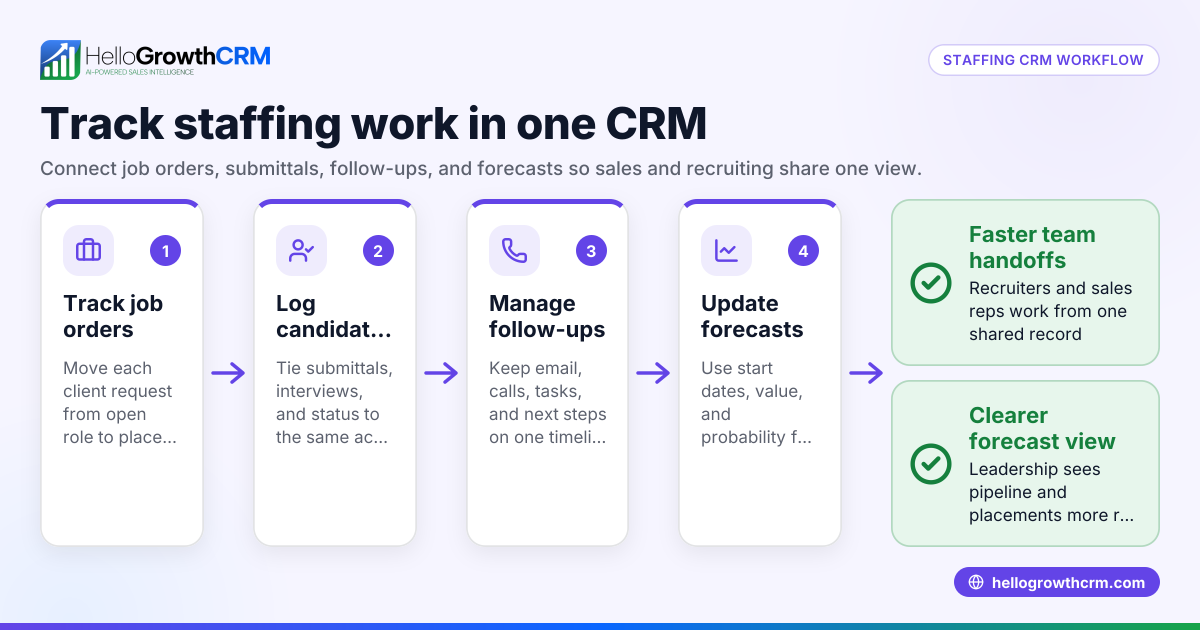
HelloGrowthCRM supports the full IT staffing workflow by connecting client development, req intake, sourcing, candidate redeployment, interview coordination, placement tracking, and follow-up inside one CRM. That gives RevOps, recruiting, and account teams a shared system for pipeline visibility, margin control, and compliant outreach.
A good staffing workflow starts before sourcing. It starts with clean req intake.
Req intake and qualification
Each new req should capture:
- Role title and skill stack
- Location and work model
- Contract, contract-to-hire, or direct-hire type
- Bill rate ceiling
- Pay rate range
- Start date
- Submission deadline
- Required documents
- Interview steps
- Hiring manager and approver
Using AI Deal Insights, account managers can spot missing fields before a req goes live. That reduces the common handoff problem where recruiters start sourcing without margin, timing, or compliance details.
Candidate redeployment and bench management
Candidate redeployment is one of the clearest revenue wins in staffing. Instead of treating each placement as a closed record, keep every placed consultant active with an availability date, current client, skill tags, and target next role.
In one rollout we did with a 12-person sales team and 18 recruiters, redeployment became the fastest source of warm starts once we added a 45-day availability trigger and a dedicated task queue. Recruiters stopped searching cold first. They started with proven consultants already known to the firm.
HelloGrowthCRM supports this with Customer Health Score for active placements, task automation through Email Automation, and prioritization with AI Lead Scoring. Even though “lead scoring” sounds sales-specific, the logic works well for ranking redeployable talent by recency, skill fit, client history, and availability.
Interview coordination and placement follow-up
Interview speed matters in staffing. Slow response times kill submittals.
Use Meeting Scheduler and Google Meet or Microsoft Teams integrations to manage:
- Recruiter screens
- Technical evaluations
- Client interviews
- Offer reviews
- Start-date confirmations
After placement, the workflow should continue with:
- Day 1 check-in
- End-of-week feedback
- 30-day retention review
- Contract renewal reminder
- Redeployment alert
This is where AI Pipeline Management helps. It keeps placements from disappearing into a “closed won” black hole.
What should a staffing CRM track for client rate cards and margins?
A staffing CRM should track client rate cards and margins by role, location, engagement type, supplier terms, and expiration date so recruiters and account managers do not submit talent at unapproved pricing. That protects gross margin, speeds approvals, and reduces rate confusion across branches and account teams.
Rate-card tracking is not optional for U.S. IT staffing firms. It is how you avoid leaking margin.
Minimum fields for rate-card control
For each client, track:
- Role category
- Skill family
- City or market
- Bill rate minimum and maximum
- Target pay rate
- Markup percentage
- Overtime terms
- Vendor or MSP rules
- Expiration date
- Approval owner
A cloud architect in San Francisco may have a very different range than a desktop support contractor in Austin. One national client may allow $145 per hour bill rate for one skill set and cap another at $82.
If that information lives in email threads, recruiters will guess. Guessing destroys profitability.
Why rate cards belong in the CRM, not just finance
Finance systems matter, but they are not where recruiters work. Rate cards need to be visible in the same screen as the req and candidate submission.
HelloGrowthCRM can connect upstream work to downstream billing through Revenue Attribution and integrations like QuickBooks and Stripe. For staffing firms that bill retainers, placement fees, or project-based services, that alignment helps RevOps tie pipeline activity to cash collection.
In one staffing deployment, we set alerts when a proposed pay rate pushed markup below target. That saved account managers from approving “urgent” submissions that looked good on fill rate but underperformed on gross margin.
How do staffing firms keep outreach TCPA-safe and CAN-SPAM-aware?
Staffing firms keep outreach TCPA-safe and CAN-SPAM-aware by capturing consent, honoring opt-outs fast, segmenting communication channels, and logging every touchpoint. The goal is not legal perfection through the CRM alone, but a repeatable operating process that reduces risk for calls, text messages, and recruiting emails.
This area needs care. I am not giving legal advice. U.S. staffing leaders should confirm their process with counsel, especially for high-volume outbound.
The FTC’s CAN-SPAM guidance explains core commercial email requirements, including clear identification, opt-out handling, and prompt suppression. The FCC’s TCPA resources outline restrictions around calls and texts, which matter when recruiters use SMS or dialers.
Practical compliance controls inside the CRM
Your CRM should capture:
- Email opt-in status
- SMS consent status
- Call permission notes
- Source of consent
- Timestamp of consent
- Opt-out date
- Channel suppression rules
HelloGrowthCRM supports channel-level execution through WhatsApp & SMS CRM, CRM Dialer, and Smart Inbox. That lets teams separate channels instead of blasting the same list everywhere.
Operational guardrails for U.S. recruiters
For American staffing teams, set simple guardrails:
- Do not send SMS without clear consent logic
- Do not call suppressed contacts from alternate numbers
- Process email opt-outs immediately
- Keep templates role-relevant and truthful
- Log recruiter notes for disputes
- Review outbound sequences for TCPA and CAN-SPAM alignment
This also matters for vendor trust. Mid-market buyers often expect security and process maturity before they share candidate data. The NIST Cybersecurity Framework is a useful reference point for access controls, governance, and incident planning, even if your CRM evaluation is not a formal security audit.
How does HelloGrowthCRM compare with Salesforce and HubSpot for IT staffing?
HelloGrowthCRM compares well with Salesforce and HubSpot for IT staffing when firms want staffing-specific workflow control, lower admin burden, and faster time to value. Salesforce offers deep customization, and HubSpot offers ease of use, but both often need extra configuration to support redeployment, rate cards, and recruiter outreach governance.
To be clear, HelloGrowthCRM is our product. This comparison is meant to help buyers frame trade-offs honestly.
| Criteria | HelloGrowthCRM | Salesforce | HubSpot |
|---|---|---|---|
| Fit for IT staffing workflow | Strong for reqs, redeployment, rate logic, outreach workflows | Highly customizable but usually admin-heavy | Easy to start, but staffing-specific models often need workarounds |
| Admin overhead | Moderate | High for most mid-market staffing firms | Low to moderate |
| AI assistance | Built into AI CRM, AI Sales Copilot, and pipeline tools | Strong ecosystem, often more setup | Strong marketing and sales AI features |
| Recruiter outreach channels | Native support for email, dialer, SMS, and WhatsApp workflows | Possible with add-ons and integrations | Good email support, more setup for staffing channel governance |
| Rate-card visibility | Easy to model in CRM workflow | Custom object and process design needed | Usually requires custom properties and process discipline |
| Best fit | U.S. staffing firms wanting speed and operational alignment | Large enterprises with dedicated admins | Teams prioritizing simplicity over staffing depth |
When Salesforce may still be the right fit
Salesforce can be the right choice if:
- You already have a large admin team
- You need extensive enterprise customization
- Your parent company runs on Salesforce already
When HubSpot may still be the right fit
HubSpot can be a fit if:
- Your motion is lighter on redeployment complexity
- Marketing automation is the main buying driver
- You have fewer recruiters and simpler pricing models
For many mid-market firms, though, HelloGrowthCRM hits the middle ground: enough structure for staffing operations without a year-long CRM rebuild. Buyers can review Pricing or request a Demo based on their process complexity.
How to set up a CRM for U.S. IT staffing firms: Step-by-Step
Setting up a CRM for U.S. IT staffing firms means mapping your real recruiting and account workflow into records, stages, permissions, and automations before importing data. The fastest deployments start with reqs, candidates, rate cards, and outreach consent, then layer reporting and AI prioritization after core process hygiene is in place.
- Define your core objects
Set up accounts, contacts, job reqs, candidates, submissions, interviews, placements, and rate cards. Keep names simple and stage definitions consistent. - Map your recruiting stages
Use stages such as intake, sourcing, screened, submitted, interview, offer, placed, and redeployment. Track stage-velocity in days so RevOps can spot bottlenecks. - Build rate-card fields
Add bill rate, pay rate, markup, geography, client terms, and expiration date. Require approval when submissions fall below target margin. - Capture consent and suppression rules
Create fields for SMS consent, email opt-out, call restrictions, and communication source. Sync these with Email Automation and calling workflows. - Connect interview and inbox tools
Integrate Gmail, calendar tools, and Calendly if needed. This reduces manual scheduling and keeps communication history visible. - Create redeployment alerts
Trigger tasks at 45, 30, and 14 days before assignment end dates. Route high-value consultants to recruiters based on skills and client history. - Set finance integrations
Connect QuickBooks and Stripe where relevant for placement fees, invoicing visibility, or cash tracking. - Launch dashboards for RevOps and branch leaders
Start with submittal-to-interview ratio, interview-to-offer ratio, fill rate, gross margin, redeployment rate, and stage aging. Use Sales Forecasting to improve branch planning.
A practical rollout sequence
For teams under 50 reps, this usually works best in three phases:
- Phase 1: records, stages, permissions, and imports
- Phase 2: automations, templates, and consent governance
- Phase 3: AI prioritization, forecasting, and attribution
Above 50 reps, expect more work on role-based permissions, branch logic, and integration governance. That is where Managed RevOps can help reduce rollout risk.
What security and integration requirements matter most for U.S. staffing buyers?
Security and integration requirements matter most for U.S. staffing buyers because candidate data, client contracts, and outreach records are sensitive operational assets. Mid-market firms should look for role-based access, auditability, finance integrations, and security maturity that aligns with SOC 2 expectations and practical U.S. compliance needs.
SOC 2 is often part of the buying conversation, especially when staffing firms serve enterprise clients in banking, healthcare, or public companies. Buyers may also ask how data access is segmented for recruiters, account managers, finance, and leadership.
What to check during evaluation
Review these items during a CRM evaluation:
- Role-based permissions
- Audit trails for edits and outreach
- Data export controls
- Integration reliability
- API access
- Branch or region segmentation
- Vendor security documentation
- Backup and incident processes
If your team already depends on Microsoft or Google productivity stacks, integration depth matters. HelloGrowthCRM supports common workflows through All Integrations, including Slack, Gmail, and finance tools used by many U.S. staffing firms.
A measurable operations benefit also comes from centralization. Nucleus Research has reported that CRM pays back $8.71 for every dollar spent according to its CRM ROI analysis, a widely cited benchmark for CRM value realization https://nucleusresearch.com/research/single/crm-returns-8-71-for-every-dollar-spent/.
For staffing teams, that ROI usually shows up in faster fills, better redeployment, cleaner margin control, and fewer dropped handoffs between sales and recruiting.
If your firm is evaluating alternatives to Salesforce or HubSpot, HelloGrowthCRM is built to match how American IT staffing teams actually work. You can explore Features, start a Free Trial, or book a Demo to see req intake, rate-card tracking, candidate redeployment, and TCPA-aware outreach in one system for U.S. recruiting teams.
About the author
Jordan Hale is a Sales Operations Lead at HelloGrowthCRM with 11 years of experience in B2B SaaS and revenue operations. He has led CRM redesigns for staffing, services, and SaaS teams across the United States, including a multi-branch rollout that unified candidate redeployment, margin controls, and recruiter outreach for a 30-plus-user IT staffing firm. His work focuses on pipeline design, forecasting, and operational compliance for mid-market revenue teams.
Frequently Asked Questions
Q: What is the best CRM for U.S. IT staffing firms?
Ready to put this into practice?
Set up your pipeline, WhatsApp follow-ups, and AI lead scoring in minutes — free, no credit card.
Try HelloGrowthCRM freeGet CRM tips in your inbox
Join thousands of sales professionals who get weekly insights on CRM strategy, AI automation, and pipeline optimization.

The HelloGrowthCRM team publishes guides on CRM strategy, AI sales tools, and revenue operations for small business sales teams.