HelloGrowthCRM software
Built for real small-business sales teams
HelloGrowthCRM helps reps qualify faster, follow up on time, and close more deals—with practical automation in one place.
- AI lead scoring and pipeline visibility
- Built-in dialer, WhatsApp, and email automation
- Sales forecasting and RevOps-ready reporting
A CRM strategy framework is a structured plan that defines how your small business captures, manages, and nurtures leads and customers using CRM software. It clarifies your sales process, communication channels, and follow-up workflows. This article covers why you need a CRM strategy, step-by-step guidance to create one, common pitfalls, a realistic example, and how HelloGrowthCRM supports your strategy.
Why this comes up / what goes wrong
Many US small-business owners run sales using a mix of text messages, emails, and spreadsheets. Without a clear CRM strategy framework, leads slip through the cracks due to slow or inconsistent follow-up. Teams waste time juggling disconnected tools and lose visibility on deal progress. When evaluating CRM software or services, owners want to ensure the system fits their sales process, supports their communication channels, and helps the team actually use it daily.
Step-by-step
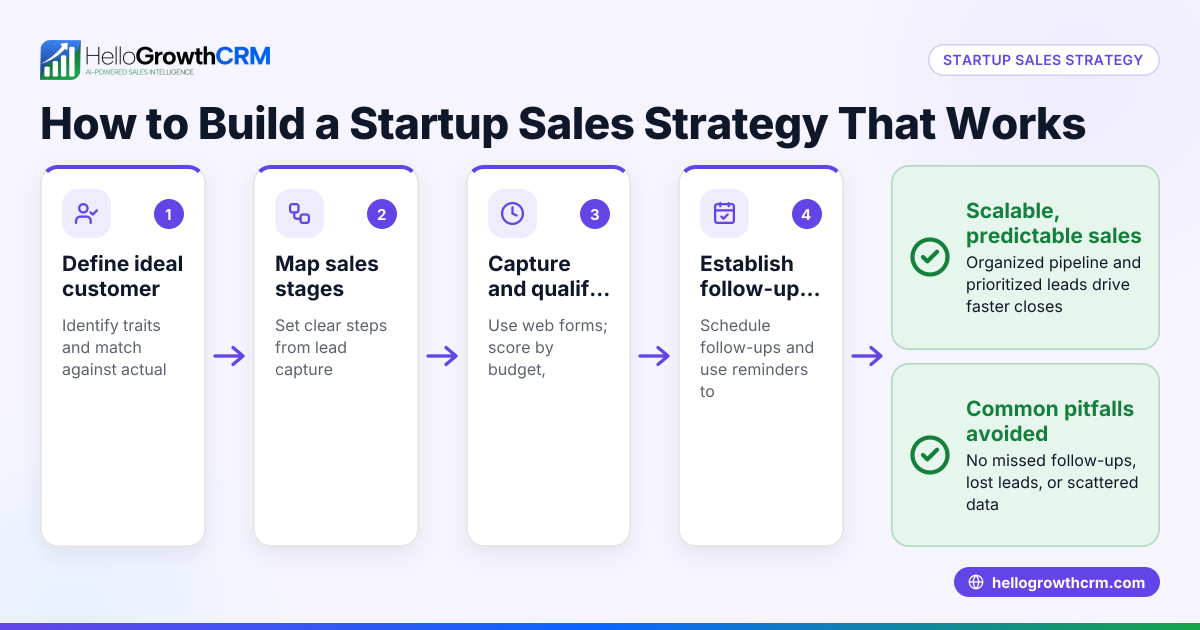
- Map Your Sales Process: Define each stage from lead capture to closing. Check if your process includes lead qualification, follow-up reminders, and deal tracking.
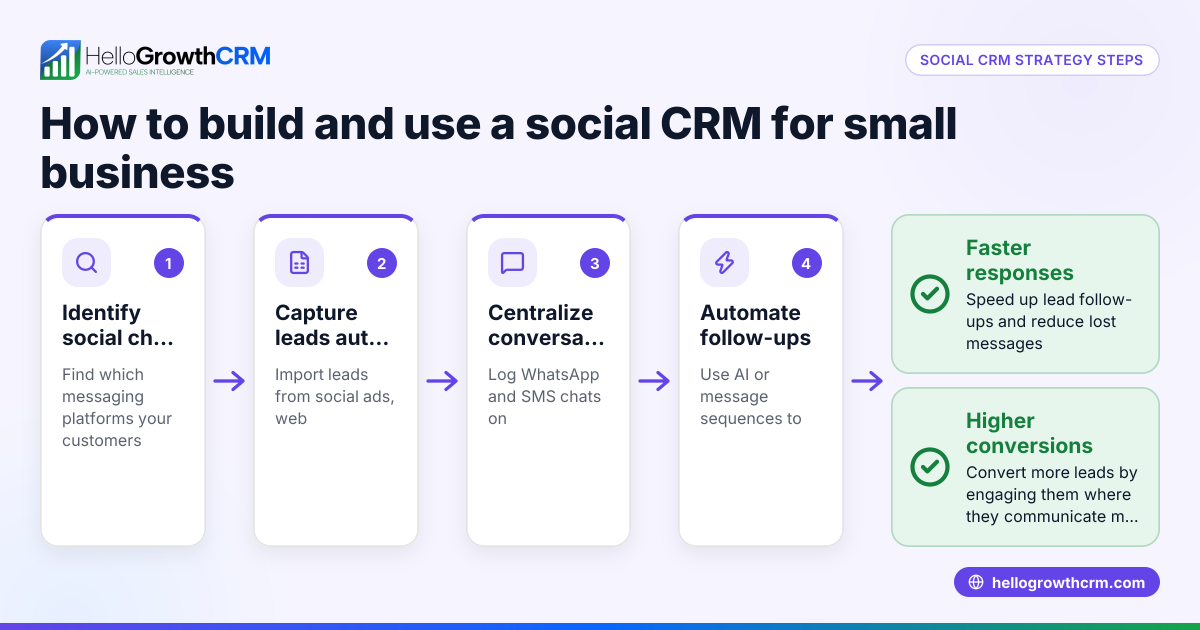
- Identify Communication Channels: Determine where your leads respond best—email, SMS, WhatsApp, or calls. Check if the CRM supports these channels and logs conversations.
- Set Follow-Up Workflows: Decide how and when to follow up with leads. Check for automation options to reduce manual tasks.
- Assign Roles and Responsibilities: Clarify who manages leads at each stage and who handles follow-ups. Check if the CRM allows task assignments and notifications.
- Establish Metrics and Reporting: Choose key performance indicators like lead response time, conversion rates, and sales forecasts. Check if the CRM offers easy reporting.
- Test and Adjust Your Framework: Pilot your CRM strategy with a small team, gather feedback, and refine steps and tools.
Example (fictional figures)
A residential real-estate team in Phoenix, Arizona, wants to improve lead follow-up. They receive about 100 new leads monthly.
- They map their sales stages: New Lead → Contacted → Showing Scheduled → Offer Made → Closed.
- They find most leads respond on WhatsApp and SMS.
- They set a follow-up schedule: initial message within 1 hour, second message after 2 days, call after 5 days if no reply.
- They assign the inside sales rep to handle new leads and the team lead to manage offers.
- They track metrics: lead response time, number of showings, and closed deals.
In January 2026, they had 100 leads.
Initial contact within 1 hour: 80 leads
Follow-up message after 2 days: 50 leads
Calls after 5 days: 20 leads
Closed deals: 10
They calculate their conversion rate:
Closed deals ÷ total leads = 10 ÷ 100 = 0.10 or 10%
They aim to improve follow-up to increase conversions.
Common mistakes
- Skipping sales process mapping: Prevent by documenting each step before choosing CRM features.
- Ignoring communication preferences: Prevent by surveying leads on preferred channels and ensuring CRM supports them, such as WhatsApp or SMS WhatsApp and SMS CRM.
- Overcomplicating workflows: Prevent by keeping follow-up steps simple and automating repetitive tasks.
- Failing to assign clear responsibilities: Prevent by defining roles and using CRM task boards for accountability.
- Neglecting metrics: Prevent by setting measurable goals and using CRM reporting tools.
- Choosing CRM without team buy-in: Prevent by involving users early and selecting user-friendly software.
Doing this in HelloGrowthCRM
HelloGrowthCRM supports your CRM strategy framework with WhatsApp and SMS messaging that logs conversations on the lead record, so your team can engage leads where they respond best. Its AI agents (currently in Beta) draft follow-up messages after calls, letting reps review and send efficiently. For small teams, the Free Forever plan lets two users manage their pipeline at no cost until they need calling or WhatsApp automation. Learn more about WhatsApp and SMS CRM and the built-in CRM dialer. Explore HelloGrowthCRM for your US business at HelloGrowthCRM for the United States.
Frequently asked questions
What is a CRM strategy framework? A CRM strategy framework is a structured approach to managing customer relationships, defining how leads are captured, followed up, and converted using CRM tools. It aligns sales processes, communication channels, and team roles.
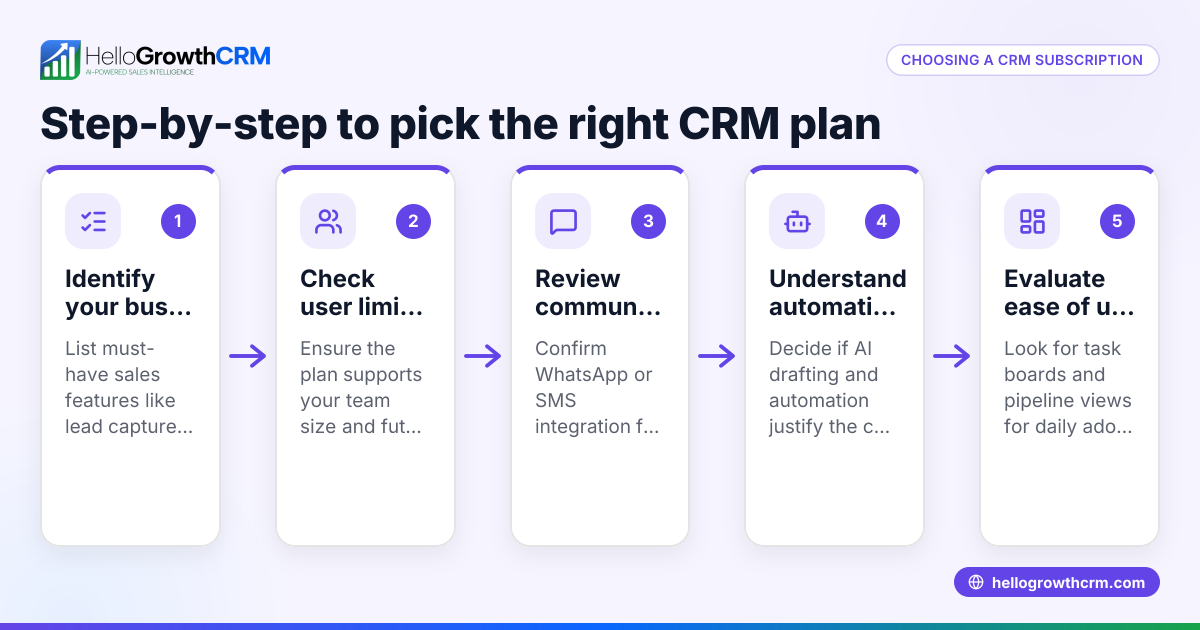
How do I choose the right CRM for my small business? Identify your sales process and preferred communication channels first. Then check if the CRM supports those channels (like WhatsApp and SMS), offers automation, and fits your team size and budget. Trial the software to ensure usability.
Can I automate follow-ups with CRM? Yes, many CRMs offer automation to schedule and send follow-ups. HelloGrowthCRM’s AI agents draft follow-up messages after calls to save time, though this feature is in Beta and requires a Growth plan or higher.
Is there a free CRM option to start with? HelloGrowthCRM offers a Free Forever plan for two users with 200 leads, a Kanban pipeline, and task management, allowing small teams to manage their sales pipeline without cost until advanced features are needed.
Why is team adoption important in a CRM strategy? Without team buy-in, CRM tools remain unused or underused, causing data gaps and lost leads. Involving users in planning and choosing user-friendly software improves adoption and results.
Key takeaways
- Define your sales stages and map your process clearly.
- Use communication channels your leads prefer, like WhatsApp and SMS.
- Automate follow-ups to ensure timely responses and reduce manual work.
- Assign clear roles and responsibilities within your team.
- Track key metrics and adjust your strategy based on data.
- Choose CRM software that your team will actually use and that fits your process.
Start your CRM journey with HelloGrowthCRM’s Free Forever plan, managing up to 200 leads with no credit card required. Visit Start on the Free Forever plan (200 leads, no credit card) to get started today.
Ready to put this into practice?
Set up your pipeline, WhatsApp follow-ups, and AI lead scoring in minutes — free, no credit card.
Try HelloGrowthCRM freeGet CRM tips in your inbox
Join thousands of sales professionals who get weekly insights on CRM strategy, AI automation, and pipeline optimization.

The HelloGrowthCRM team publishes guides on CRM strategy, AI sales tools, and revenue operations for small business sales teams.