HelloGrowthCRM software
Built for real small-business sales teams
HelloGrowthCRM helps reps qualify faster, follow up on time, and close more deals—with practical automation in one place.
- AI lead scoring and pipeline visibility
- Built-in dialer, WhatsApp, and email automation
- Sales forecasting and RevOps-ready reporting
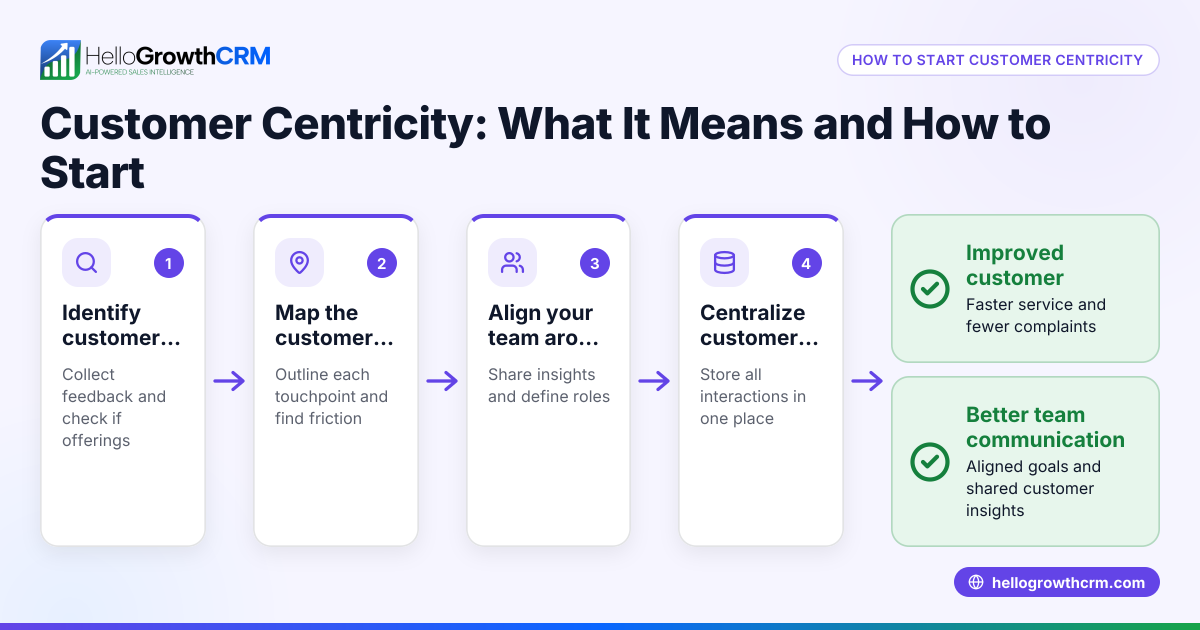
Customer centricity means organising your business so that every action revolves around your customers’ needs and expectations. Examples include sending personalised messages, responding rapidly to questions, and keeping after-sales service requests linked to the original customer record. This article covers why small businesses struggle with customer centricity, practical steps to become more customer-focused, a realistic example of a UK kitchen-fitting company, common mistakes to avoid, and how HelloGrowthCRM helps manage customer relationships effectively.
Why this comes up / what goes wrong
Small business owners often want to improve how they serve customers but face challenges. These include slow follow-up on leads, juggling communication across WhatsApp, email, and spreadsheets, and losing track of service requests after a sale. Such issues cause missed sales opportunities and unhappy customers because the business does not reply quickly or personally enough. Without a clear system, efforts to be customer-centric are inconsistent, inefficient, or too time-consuming.
Step-by-step
- Map the Customer Journey: Identify every point where customers interact with your business, from first contact to after-sales support. Check that you have clear processes for each stage.
- Collect Customer Data Efficiently: Use web forms or integrations to capture leads and customer details in one place. Check for duplicate or missing information.
- Personalise Communication: Tailor messages based on customer preferences or previous interactions. Check that your message templates are relevant and updated.
- Respond Quickly and Track Interactions: Ensure all enquiries, especially on WhatsApp and email, receive prompt replies. Regularly check response times and follow-up tasks.
- Manage After-Sales Service on the Same Record: Keep support tickets and service requests linked to the original customer record to avoid losing information. Check that all follow-ups are recorded.
- Encourage Referrals and Provide Self-Service: Set up a referral programme and maintain a knowledge base customers can access themselves. Check that referral tracking works and resources are current.
Following these steps creates a consistent, customer-focused experience that builds trust and loyalty. For more on managing customer engagement, see the customer health score features.
Example (fictional figures)
A kitchen-fitting company in Leeds, "Leeds Kitchens Ltd", wants to improve customer centricity.
- They receive 500 new leads yearly via their website form.
- Their goal is to increase timely responses to enquiries and track all service requests on the same customer record.
Calculations:
Leads per year = 500 Current timely responses = 300 (assumed for calculation purposes) Target timely responses = 450 (assumed for calculation purposes) Increase in timely responses = 450 - 300 = 150
Assuming each timely response converts to a sale worth £2,000:
Additional sales = 150 × £2,000 = £300,000
By using a CRM to manage leads and after-sales tickets, Leeds Kitchens Ltd expects to boost sales by £300,000 annually through better customer centricity.
Common mistakes
- Ignoring the customer journey: Prevent this by mapping all customer touchpoints clearly.
- Using disconnected tools for communication and data: Prevent by centralising all customer data and conversations, for example with WhatsApp and SMS CRM solutions like those described at WhatsApp and SMS CRM.
- Slow follow-up on leads and service requests: Prevent by setting reminders and tracking tasks diligently.
- No system for referrals or self-service knowledge sharing: Prevent by implementing a referral programme and maintaining an accessible knowledge base.
- Losing post-sale service information: Prevent by keeping all tickets and service requests linked to the original customer record.
Doing this in HelloGrowthCRM
HelloGrowthCRM supports customer centricity with a branded self-service customer portal, referral programme tracking, support tickets, and a knowledge base. After the sale, service requests stay linked on the same customer record as the deal, ensuring no information is lost. These features help small businesses manage customer relationships efficiently and maintain consistent communication. Learn more about HelloGrowthCRM for the United Kingdom at HelloGrowthCRM for the United Kingdom.
Frequently asked questions
What is customer centricity? Customer centricity means putting the customer’s needs and preferences at the centre of your business decisions, communication, and service. It involves understanding the customer journey and responding quickly and personally.
How do I start being more customer-centric? Begin by mapping your customer journey and organising your data in one place. Use personalised communication and track all interactions and service requests on a single customer record.
Why is customer centricity important for small businesses? It helps build trust, improves customer retention, and increases sales by ensuring customers feel valued and supported throughout their experience.
Can I manage WhatsApp messages in a CRM? Yes, some CRMs support WhatsApp and SMS messaging integrated directly into customer records, making follow-up easier and more organised.
How do referrals fit into customer centricity? Referral programmes reward loyal customers for recommending your business, creating a positive cycle of trust and new leads.
Key takeaways
- Customer centricity means prioritising customer needs at every interaction.
- Map the customer journey and centralise data to avoid lost leads.
- Personalised, timely communication improves sales and loyalty.
- Keep after-sales service requests linked to the original customer record.
- Use referral programmes and knowledge bases to support customers.
- HelloGrowthCRM offers tools like customer portals, tickets, and referral tracking to help.
Start improving your customer centricity today. Start on the Free Forever plan (200 leads, no credit card) and see how it can help your UK business manage leads, communication, and service all in one place.
Ready to put this into practice?
Set up your pipeline, WhatsApp follow-ups, and AI lead scoring in minutes — free, no credit card.
Try HelloGrowthCRM freeGet CRM tips in your inbox
Join thousands of sales professionals who get weekly insights on CRM strategy, AI automation, and pipeline optimization.

The HelloGrowthCRM team publishes guides on CRM strategy, AI sales tools, and revenue operations for small business sales teams.