HelloGrowthCRM software
Built for real small-business sales teams
HelloGrowthCRM helps reps qualify faster, follow up on time, and close more deals—with practical automation in one place.
- AI lead scoring and pipeline visibility
- Built-in dialer, WhatsApp, and email automation
- Sales forecasting and RevOps-ready reporting
Customer objections are concerns or hesitations that potential customers voice during the sales process. These objections may involve price, product features, timing, or doubts about your business. Handling objections well can turn hesitant prospects into buyers. This article covers why objections come up, a step-by-step method to respond, a realistic example, common mistakes, and how HelloGrowthCRM supports customer management after the sale.
Why this comes up / what goes wrong
Small-business owners often face customer objections because buyers want reassurance before committing. For example, a landscaping contractor in Charlotte might hear prospects say the price is too high or they want to wait until spring. Objections arise when prospects feel uncertain about value, timing, or trust. Without a clear process to address these concerns, businesses lose leads and revenue. Slow follow-up or scattered communication across texts, emails, and spreadsheets can worsen the problem. Inconsistent tracking of objections means sales teams may miss opportunities to resolve issues and close deals.
Step-by-step
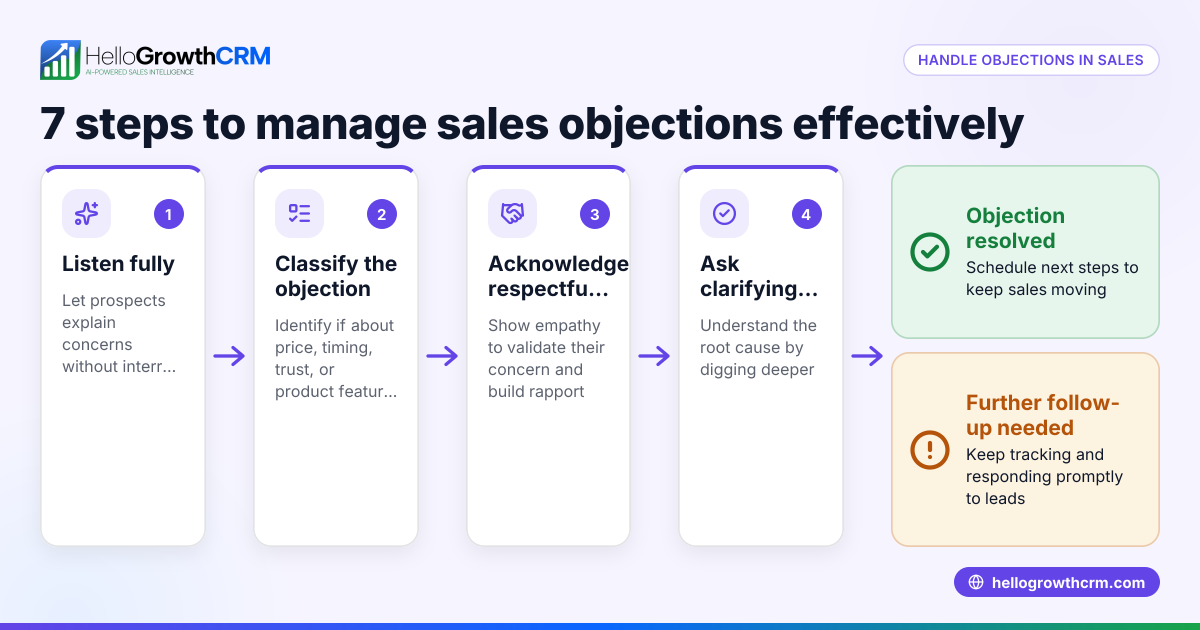
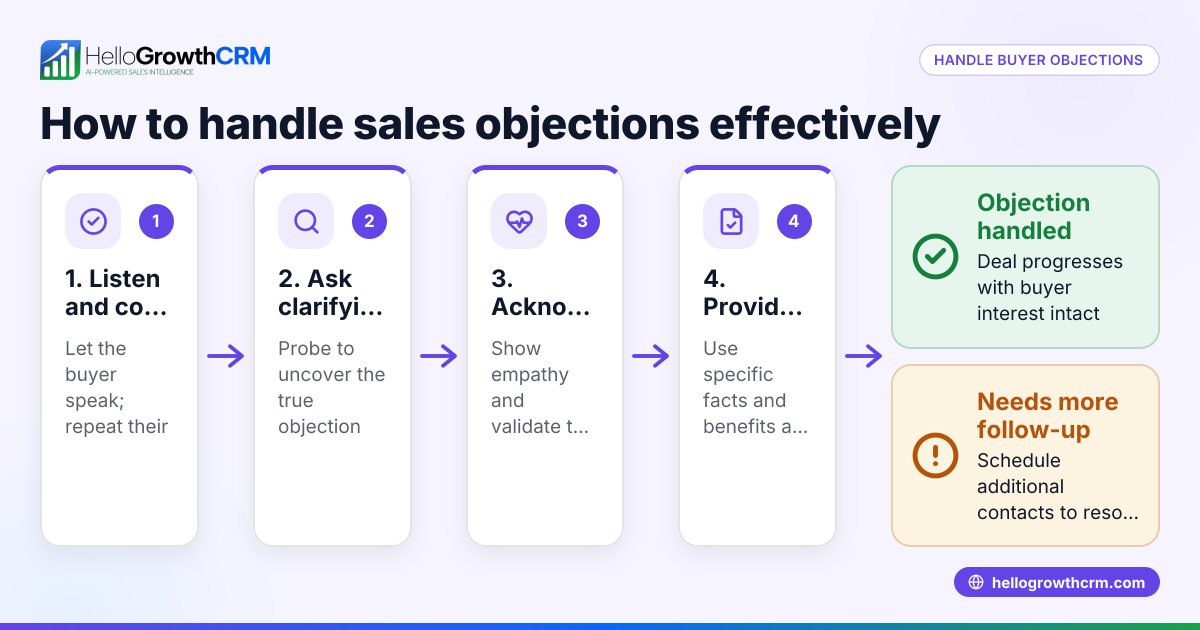
- Listen carefully to the objection. Understand exactly what the customer’s concern is without interrupting. This builds trust and shows respect.
- Acknowledge the concern. Show empathy by recognizing their hesitation as valid. For example, say "I understand that budget is a concern for you."
- Ask clarifying questions. Find out more details to address the root cause. Ask, "Can you tell me more about what you’re looking for or what worries you?"
- Provide clear, honest information. Explain how your product or service solves their problem or justifies the price. Avoid jargon and be transparent.
- Offer social proof or examples. Share testimonials, case studies, or referrals to build trust and demonstrate value.
- Check for additional concerns. Ask if they have other questions or objections to ensure all issues are addressed.
- Confirm agreement or next steps. If they are ready, move forward; if not, schedule a follow-up call or send additional information.
Use tools like a CRM with a customer health score to track objections and follow-ups efficiently. See customer health score for more on tracking customer engagement.
Example (fictional figures)
A landscaping contractor in Charlotte, North Carolina, quotes a client $5,000 on 04/15/2026 for a garden redesign. The client objects, saying it’s too expensive and wants to think about it.
Step 1: Listen to the objection — price too high. Step 2: Acknowledge — "I understand budget is important to you." Step 3: Ask — "What budget did you have in mind for this project?" Step 4: Provide info — "Our quote includes premium materials that last longer and reduce maintenance costs. This saves money over time." Step 5: Offer proof — "Here’s a referral from a client who was happy with the value and durability of our work." Step 6: Check for more concerns — "Do you have any other questions or concerns about the project?" Step 7: Confirm next steps — "Would you like me to send a revised proposal with options or schedule a call next week to discuss?"
If the client says their budget is $4,000, the contractor can offer a revised proposal:
Original quote: $5,000 Client budget: $4,000 Difference: $5,000 - $4,000 = $1,000
The contractor adjusts materials and labor to reduce costs by $1,000, offering a new quote of $4,000.
This approach keeps the conversation open and focused on the client’s needs, increasing the chance of closing the sale.
Common mistakes
- Ignoring objections or rushing to close. Prevent by listening fully and addressing concerns before moving forward.
- Being defensive or dismissive. Prevent by acknowledging objections respectfully and empathizing.
- Not following up after an objection. Prevent by scheduling clear next steps and maintaining contact.
- Using inconsistent communication channels. Prevent by centralizing customer info in one place like a WhatsApp and SMS CRM. Learn more at WhatsApp and SMS CRM.
- Failing to track objections and responses. Prevent by using a CRM to log objections and outcomes, so the team can review and improve.
Doing this in HelloGrowthCRM
HelloGrowthCRM helps small and mid-sized businesses manage customer objections and post-sale service requests efficiently. After the sale, service tickets and support requests stay linked to the same customer record as the deal, ensuring your team has full context. The branded self-service customer portal lets customers submit tickets or access the knowledge base, reducing back-and-forth and improving satisfaction. Referral tracking helps turn happy customers into new leads. For more details, see HelloGrowthCRM for the United States.
Frequently asked questions
What are the most common types of customer objections? Common objections include price concerns, doubts about product fit, timing issues, or lack of trust. Understanding these helps tailor your responses to address specific concerns.
How can I prepare to handle objections before they come up? Prepare by knowing your product’s value, gathering testimonials, and practicing responses to common objections. Using a CRM to track objection patterns helps identify frequent issues and improve your approach. See customer health score for tracking customer engagement.
Is it okay to push a customer after an objection? Pushing too hard can backfire and damage trust. Instead, acknowledge concerns, provide information, and offer options for next steps or follow-up calls. Respect the customer’s pace.
How do I keep track of objections and responses? Use a CRM that logs customer interactions and objections so your sales team can follow up consistently. HelloGrowthCRM supports this with linked customer records and ticket tracking.
Can customer objections be a sign of a bigger problem? Yes, recurring objections may indicate pricing issues, unclear messaging, or product gaps. Reviewing objection data helps improve your offering and sales approach.
Key takeaways
- Customer objections are signals of hesitation that need clear, empathetic responses.
- A step-by-step approach includes listening, acknowledging, clarifying, informing, and confirming.
- Avoid common mistakes like ignoring objections or inconsistent communication.
- Use a CRM like HelloGrowthCRM to track objections and manage customer service efficiently.
- After the sale, keep service requests linked to the same customer record for better follow-up.
Start handling customer objections with confidence and keep your sales moving forward. Start on the Free Forever plan (200 leads, no credit card).
Ready to put this into practice?
Set up your pipeline, WhatsApp follow-ups, and AI lead scoring in minutes — free, no credit card.
Try HelloGrowthCRM freeGet CRM tips in your inbox
Join thousands of sales professionals who get weekly insights on CRM strategy, AI automation, and pipeline optimization.

The HelloGrowthCRM team publishes guides on CRM strategy, AI sales tools, and revenue operations for small business sales teams.