HelloGrowthCRM software
Built for real small-business sales teams
HelloGrowthCRM helps reps qualify faster, follow up on time, and close more deals—with practical automation in one place.
- AI lead scoring and pipeline visibility
- Built-in dialer, WhatsApp, and email automation
- Sales forecasting and RevOps-ready reporting
Customer success analytics is the practice of tracking and analyzing customer data to understand how well your business meets customer needs and where improvements can boost loyalty and revenue. It involves measuring customer health, engagement, support interactions, and renewal likelihood.
Why this comes up / what goes wrong
Small business owners often struggle with keeping customers happy and preventing churn because they lack clear data on customer health. They may notice lost sales or support issues but don’t have a reliable way to track signals like satisfaction, usage, or service requests. Without analytics, it’s hard to prioritize which customers need attention or which products and services drive success. This leads to missed upsell opportunities and wasted time on reactive support.
Step-by-step
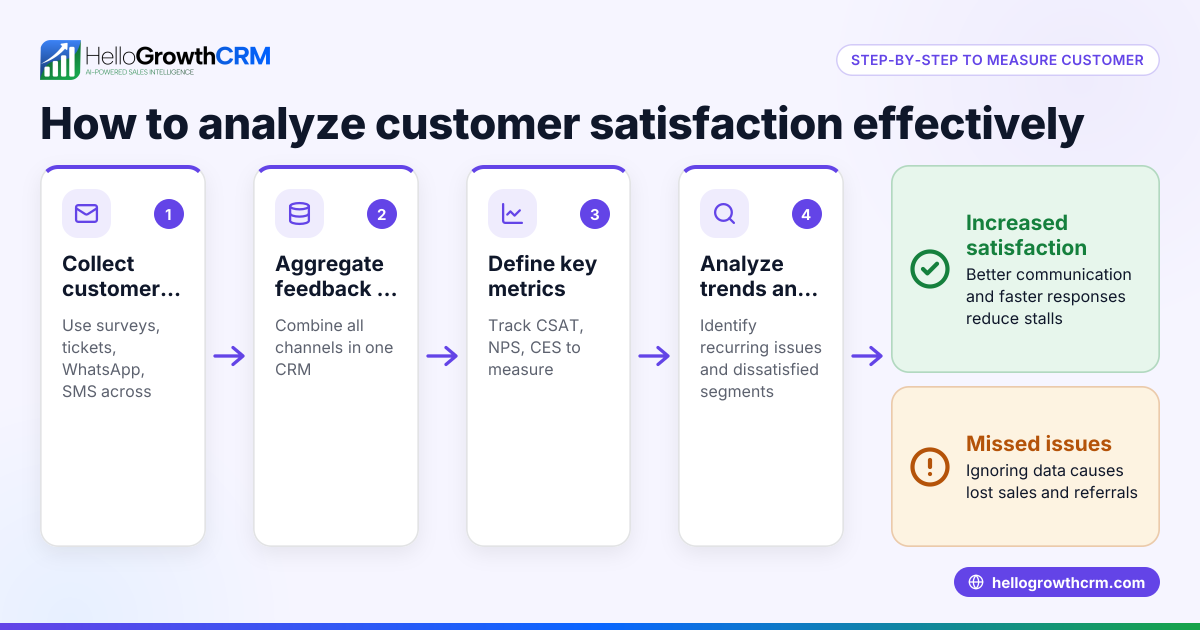
- Collect customer data systematically: Gather information such as purchase history, support tickets, product usage, feedback scores, and communication logs. Check that data is linked to each customer record for a full view.
- Define key customer success metrics: Decide which indicators matter most for your business, like renewal rates, Net Promoter Score (NPS), customer health score, or average resolution time. Check these metrics regularly.
- Analyze customer health and behavior: Use data to identify patterns of engagement or warning signs of churn. Check for stalled deals or frequent service requests that may need intervention.
- Segment customers by risk and opportunity: Group customers into categories like high risk, at risk, and healthy. Check which segments require immediate outreach or upsell efforts.
- Take action based on insights: Prioritize follow-ups, tailor communications, and improve products or services based on what the analytics reveal. Check the impact of these actions over time.
- Review and refine your analytics process: Regularly check data quality, update metrics as your business evolves, and incorporate customer feedback to keep analytics relevant.
Example (fictional figures)
GreenLeaf Landscaping in Charlotte, North Carolina, uses customer success analytics to reduce churn and increase referrals. They track customer health scores based on contract renewal likelihood and service ticket volume.
- Total customers: 120
- Average contract value: $4,500
- Monthly churn rate before analytics: 5%
- Monthly churn rate after 3 months of analytics: 3%
Calculations:
Monthly revenue before analytics = 120 × $4,500 = $540,000
Churned customers per month before = 120 × 5% = 6
Revenue lost monthly before = 6 × $4,500 = $27,000
Churned customers per month after = 120 × 3% = 3.6 (rounded to 4)
Revenue lost monthly after = 4 × $4,500 = $18,000
Revenue saved monthly = $27,000 - $18,000 = $9,000
By focusing on customers with declining health scores and frequent support tickets, GreenLeaf reduced churn and preserved $9,000 in revenue monthly.
Common mistakes
- Ignoring data integration: Prevent this by linking all customer data sources in one system to avoid incomplete insights.
- Tracking too many metrics: Focus on a few key indicators relevant to your business to prevent analysis paralysis.
- Not acting on insights: Analytics are useless without follow-up; schedule regular reviews and assign responsibilities.
- Overlooking customer feedback: Combine quantitative data with direct feedback to understand customer needs better.
- Using spreadsheets only: This can cause errors and delays. Consider a CRM with built-in analytics like HelloGrowthCRM to streamline tracking and manage customer interactions.
For more on measuring customer health, see customer health score.
Doing this in HelloGrowthCRM
HelloGrowthCRM offers pipeline forecast and AI insights that show where deals stall without needing spreadsheets. After the sale, customer service requests, referrals, tickets, and knowledge base entries stay on the same customer record as the deal, making it easier to track customer success all in one place. This centralized approach helps small businesses manage customer relationships and improve retention efficiently. Learn more about HelloGrowthCRM for the United States.
Frequently asked questions
What is a customer health score? A customer health score combines various data points like product usage, support tickets, and payment history to indicate how likely a customer is to stay or churn. It helps prioritize outreach efforts and improve retention strategies. See customer health score for details.
How can I track customer success without complex software? Start by organizing customer data in a simple CRM or spreadsheet, focusing on key metrics like renewal dates and support issues. Regularly review this data and communicate with customers proactively to address concerns early.
Why use WhatsApp and SMS for customer success? Many customers prefer quick, informal communication channels like WhatsApp and SMS. Using a CRM that supports these channels, such as WhatsApp and SMS CRM, helps maintain timely, personal contact that can improve satisfaction and loyalty.
How often should I review customer success analytics? Monthly reviews are typical to spot trends and act promptly. High-risk customers might need weekly check-ins. Adjust frequency based on your business size and customer volume.
Can customer success analytics help increase referrals? Yes. Happy customers identified through analytics can be targeted with referral programs. Tracking referrals in the same CRM system ensures you reward and nurture advocates effectively.
Key takeaways
- Customer success analytics tracks data to improve retention and satisfaction.
- Start by collecting relevant customer data and defining key metrics.
- Analyze customer health to spot risks and growth opportunities.
- Avoid common mistakes like ignoring data integration and neglecting follow-up.
- HelloGrowthCRM centralizes customer data, pipeline insights, and service requests.
- Use communication channels like WhatsApp and SMS for timely customer contact.
Start improving your customer success today with HelloGrowthCRM. Start on the Free Forever plan (200 leads, no credit card).
Ready to put this into practice?
Set up your pipeline, WhatsApp follow-ups, and AI lead scoring in minutes — free, no credit card.
Try HelloGrowthCRM freeGet CRM tips in your inbox
Join thousands of sales professionals who get weekly insights on CRM strategy, AI automation, and pipeline optimization.

The HelloGrowthCRM team publishes guides on CRM strategy, AI sales tools, and revenue operations for small business sales teams.