HelloGrowthCRM software
Built for real small-business sales teams
HelloGrowthCRM helps reps qualify faster, follow up on time, and close more deals—with practical automation in one place.
- AI lead scoring and pipeline visibility
- Built-in dialer, WhatsApp, and email automation
- Sales forecasting and RevOps-ready reporting
An email marketing plan example includes clear goals, a defined target audience, a content schedule, and an automated follow-up process to nurture leads efficiently. This helps small businesses organise their email campaigns to increase engagement and sales. This article explains why you need a plan, provides step-by-step instructions, a UK-specific example, common mistakes to avoid, and how HelloGrowthCRM supports your email marketing efforts.
Why this comes up / what goes wrong
Many small business owners in the UK manage sales and marketing using a mix of WhatsApp, email, and spreadsheets without a clear strategy. Without an email marketing plan, messages can be inconsistent, follow-ups delayed or missed, and audience segmentation ignored. This often leads to lost leads and wasted time. Founders and sales leaders want a structured plan that guides their email campaigns from capturing leads to converting them, ensuring no opportunities slip through the cracks.
Step-by-step
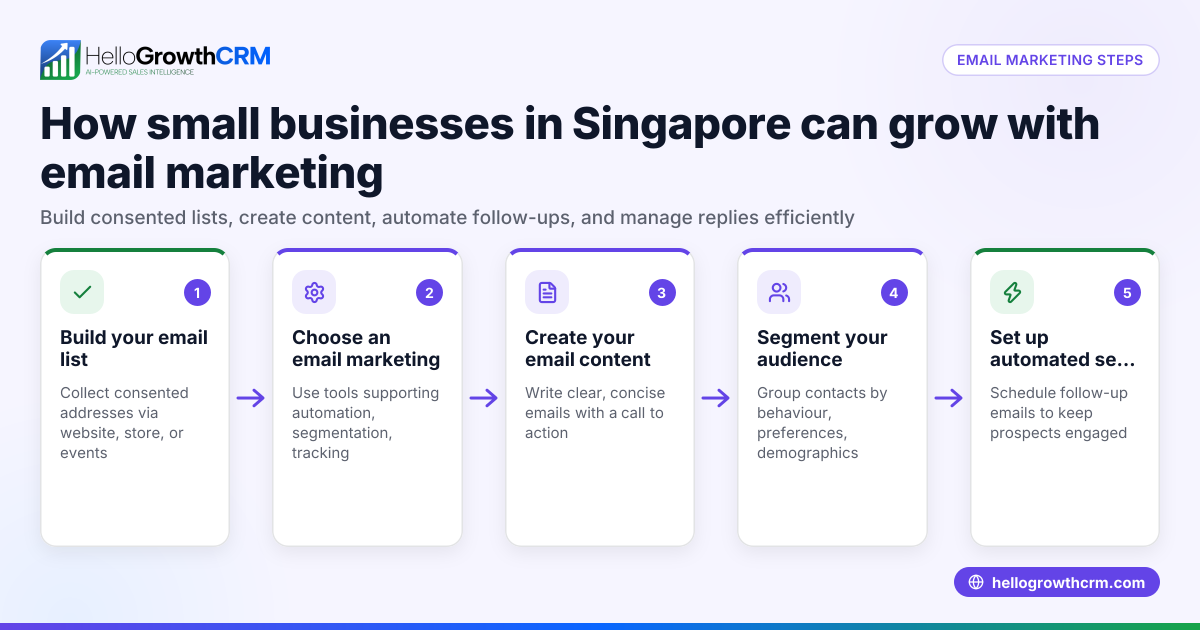
- Define your goals. Decide what you want to achieve with your email marketing, such as increasing enquiries, boosting repeat sales, or raising brand awareness. Check your goals are specific, measurable, and time-bound.
- Identify your target audience. Segment your contacts by criteria like location, interests, or previous purchases. Check your list is clean, up to date, and compliant with GDPR. (ftc.gov)
- Plan your content. Create a schedule outlining email topics, offers, and calls to action. Check that your messages are relevant, personalised, and valuable to each segment.
- Set up sequences and campaigns. Design automated follow-up sequences that send emails in a planned order over days or weeks. Check the timing is appropriate and that sequences stop when a prospect replies. Learn more about email automation and sequences here.
- Choose your sending tools. Use a CRM or email platform that supports shared inboxes and automation to keep your team coordinated. Check that replies to emails are visible to the whole team to avoid duplicated effort.
- Test and optimise. Monitor open rates, click-through rates, and reply rates. Adjust subject lines, content, and timing based on performance.
- Monitor and report. Track conversions and return on investment (ROI) to ensure your email marketing delivers value and meets your goals.
Example (fictional figures)
A letting agency in Manchester wants to increase tenant enquiries for new properties through email marketing.
- Goal: Increase tenant enquiries by 20% within 3 months.
- Target audience: Prospects who signed up on the website in the last 6 months.
- Content plan: Weekly emails featuring new listings, renter tips, and a limited-time discount offer.
- Sequence: A 5-step automated follow-up over 2 weeks after a web form sign-up.
Budget:
- Email platform subscription: £50/month × 3 months = £150
- Content creation (copywriter): £300 total
- Total budget = £150 + £300 = £450
Expected outcome:
- Current monthly enquiries: 100
- Target increase: 20% × 100 = 20 additional enquiries
If each enquiry generates £500 commission:
- Additional revenue = 20 × £500 = £10,000
Return on investment (ROI):
- ROI = £10,000 - £450 = £9,550 profit
This example shows how a structured email marketing plan can produce measurable business growth.
Common mistakes
- No clear goals. Prevent this by setting specific, measurable targets before starting your campaign.
- Ignoring segmentation. Prevent by grouping contacts to send relevant and personalised emails.
- Overloading recipients with emails. Prevent by planning your email frequency carefully and respecting opt-out requests.
- Not tracking replies. Prevent by using a shared inbox so the whole team can see responses and coordinate follow-up. HelloMail supports this.
- Manual follow-ups only. Prevent by automating follow-up sequences that stop when a prospect replies. Learn about sequences and campaigns here.
- Using scattered tools. Prevent by consolidating your email marketing in one CRM to avoid lost leads and duplicated effort. HelloGrowthCRM supports this with WhatsApp and SMS CRM features here.
Doing this in HelloGrowthCRM
HelloGrowthCRM helps small businesses run email marketing plans effectively. Its HelloMail shared inbox lets your team see all replies to quotation emails on each deal, avoiding missed responses and duplicated effort. The sequences and campaigns feature automates a five-step follow-up over two weeks, stopping immediately when a prospect replies, saving time and ensuring timely engagement. For small teams, the Free Forever plan lets two people manage a full sales pipeline at no cost until you need calling or WhatsApp automation. Explore HelloGrowthCRM’s email automation and sequences here and learn about WhatsApp and SMS CRM here.
Frequently asked questions
What should I include in an email marketing plan? Include your goals, target audience, content schedule, automation setup, and metrics to track. This ensures your emails are purposeful and measurable.
How often should I send marketing emails? Typically, once a week or every two weeks is effective. Avoid overwhelming your audience and always provide an easy way to unsubscribe.
Can I automate email follow-ups? Yes. Automation lets you schedule a series of emails that send automatically until a prospect replies, saving time and improving response rates.
Is it important to have a shared inbox for sales emails? Yes. A shared inbox ensures your team can see all replies on deals, preventing missed opportunities and duplicated follow-ups.
How do I measure the success of my email marketing? Track open rates, click-through rates, reply rates, and conversions. Use these metrics to refine your content and timing.
Can I start email marketing without extra cost? Small teams can start with free CRM plans that include email templates and scheduling to manage your pipeline until you need advanced features.
Key takeaways
- Set clear, measurable goals for your email marketing.
- Segment your audience to send relevant, personalised content.
- Use automated sequences that stop on reply to save time.
- Employ a shared inbox to keep your team aligned.
- Track performance and adjust your plan regularly.
- Start small with free tools before scaling up.
Ready to organise your email marketing? Start on the Free Forever plan (200 leads, no credit card) and manage your pipeline with HelloGrowthCRM.
Ready to put this into practice?
Set up your pipeline, WhatsApp follow-ups, and AI lead scoring in minutes — free, no credit card.
Try HelloGrowthCRM freeGet CRM tips in your inbox
Join thousands of sales professionals who get weekly insights on CRM strategy, AI automation, and pipeline optimization.

The HelloGrowthCRM team publishes guides on CRM strategy, AI sales tools, and revenue operations for small business sales teams.