HelloGrowthCRM software
Built for real small-business sales teams
HelloGrowthCRM helps reps qualify faster, follow up on time, and close more deals—with practical automation in one place.
- AI lead scoring and pipeline visibility
- Built-in dialer, WhatsApp, and email automation
- Sales forecasting and RevOps-ready reporting
To create lead scoring rules in New Zealand, you assign points to specific lead attributes or behaviours that indicate how likely they are to convert. These rules help your sales team prioritise leads effectively. This article explains why you need lead scoring, provides step-by-step instructions, a realistic example, common pitfalls, and how HelloGrowthCRM’s AI lead scoring and workflows can automate this process.
Why this comes up / what goes wrong
Small and mid-sized business owners in New Zealand often struggle to follow up leads quickly and consistently. Without clear lead scoring rules, sales teams call or message leads randomly, wasting time on low-potential contacts while missing high-value opportunities. Many run sales on text messages, email, and spreadsheets, which don’t prioritise leads or automate follow-up tasks. This leads to lost sales and inefficient use of resources.
Creating lead scoring rules helps sales teams focus on leads most likely to convert, improving follow-up speed and conversion rates. The challenge is knowing which criteria to use and how to assign scores that reflect your business’s priorities.
Step-by-step
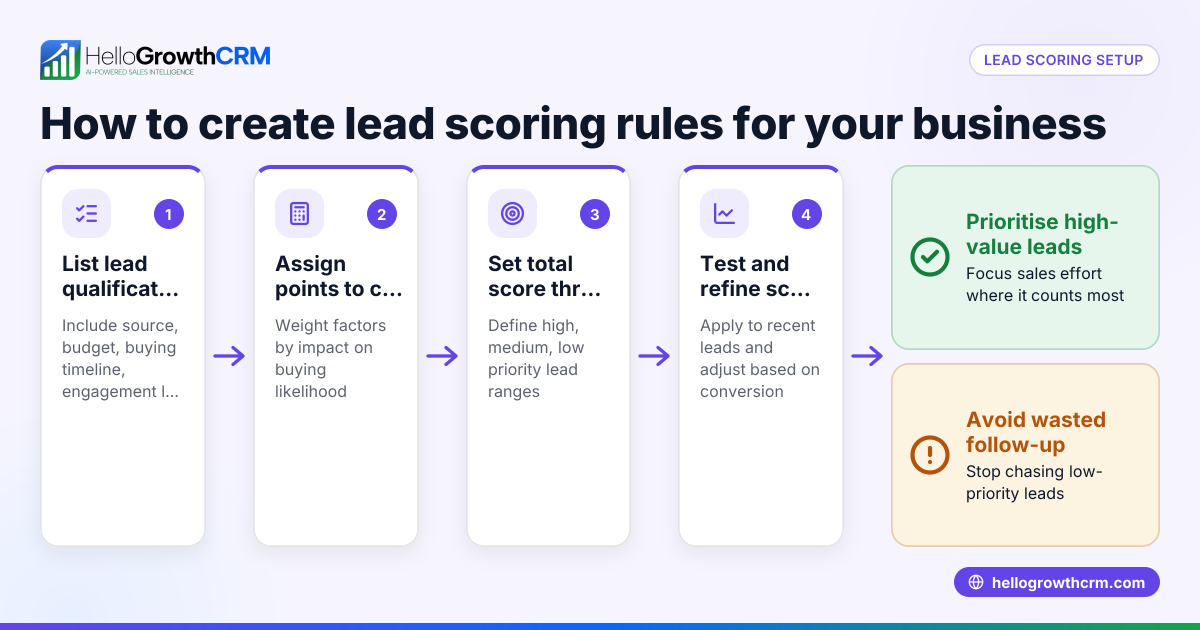
- Identify key criteria that indicate lead quality. These can include:
- Lead source (e.g., website form, referral, event)
- Industry or company size
- Job title or decision-making authority
- Engagement level (e.g., opened emails, clicked links, replied to messages)
- Budget or purchase timeline
- Assign point values to each criterion based on importance. For example, a lead from a referral might score higher than one from a cold website visit.
- Set a scoring scale and threshold. Decide the maximum possible score and the minimum score that qualifies a lead as high priority.
- Create rules to add or subtract points. For example, add 10 points if the lead is a decision-maker, subtract 5 points if the lead has no budget.
- Test your scoring rules on existing leads. Check if high-scoring leads correspond to past successful sales.
- Refine the rules based on feedback and results. Adjust point values and criteria as you learn what predicts conversion best.
- Implement the rules in your CRM or lead management system. Use automation if available to update scores in real time.
- Train your sales team to prioritise leads by score. Make sure they understand what the scores mean and how to act on them.
Example (fictional figures)
An electrical contractor in Wellington wants to score leads to prioritise follow-ups.
Criteria and points:
- Lead source:
- Referral: 20 points
- Website form: 10 points
- Cold call: 5 points
- Job title:
- Decision-maker (owner/manager): 15 points
- Other: 5 points
- Engagement:
- Replied to WhatsApp message: 10 points
- Opened email: 5 points
- Budget:
- Confirmed budget above NZ$5,000: 20 points
- No budget: 0 points
A lead comes from a referral (20), is the owner (15), replied to WhatsApp (10), and confirmed budget NZ$6,000 (20).
Total score = 20 + 15 + 10 + 20 = 65 points.
Threshold for high priority is 50 points, so this lead is high priority.
Common mistakes
- Using too many criteria: Keep scoring rules simple to avoid confusion and errors. Focus on the most predictive factors.
- Assigning arbitrary points: Base point values on actual sales data or logical importance to avoid skewed scores.
- Ignoring negative signals: Subtract points for disqualifying factors like no budget or wrong industry.
- Not testing rules: Always validate scoring rules against past leads to ensure they predict conversion.
- Failing to update rules: Regularly review and adjust scoring as your market or business changes.
- Not integrating with sales workflow: Scores should trigger actions like task creation or lead routing to be effective.
Doing this in HelloGrowthCRM
HelloGrowthCRM helps New Zealand businesses automate lead scoring and follow-up. Every enquiry from a form, call or WhatsApp lands as a lead with an owner and a next step, instead of in a notebook. The AI lead scoring feature prioritises leads so telecallers call those most likely to convert first. Automated workflows and lead routing assign new enquiries round-robin and create first-call tasks automatically, ensuring no lead is missed. Learn more about AI lead scoring and how HelloGrowthCRM supports WhatsApp and SMS CRM for New Zealand businesses at HelloGrowthCRM for New Zealand.
Frequently asked questions
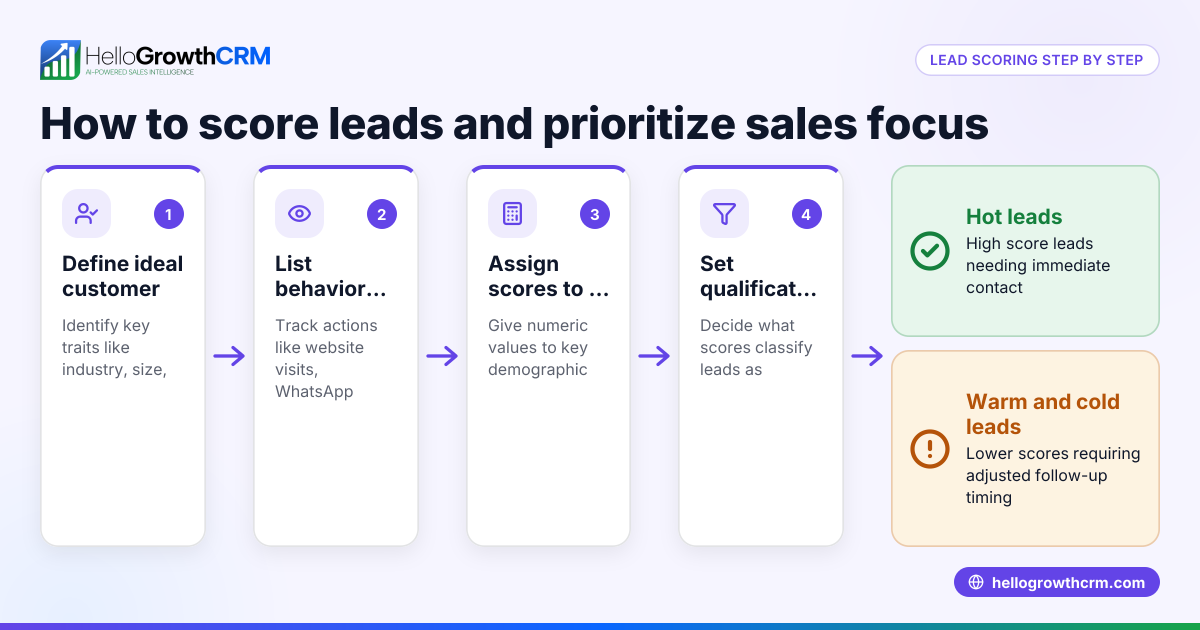
What is lead scoring? Lead scoring is a method of assigning points to leads based on their attributes and behaviour to estimate their likelihood to buy. It helps sales teams prioritise follow-up.
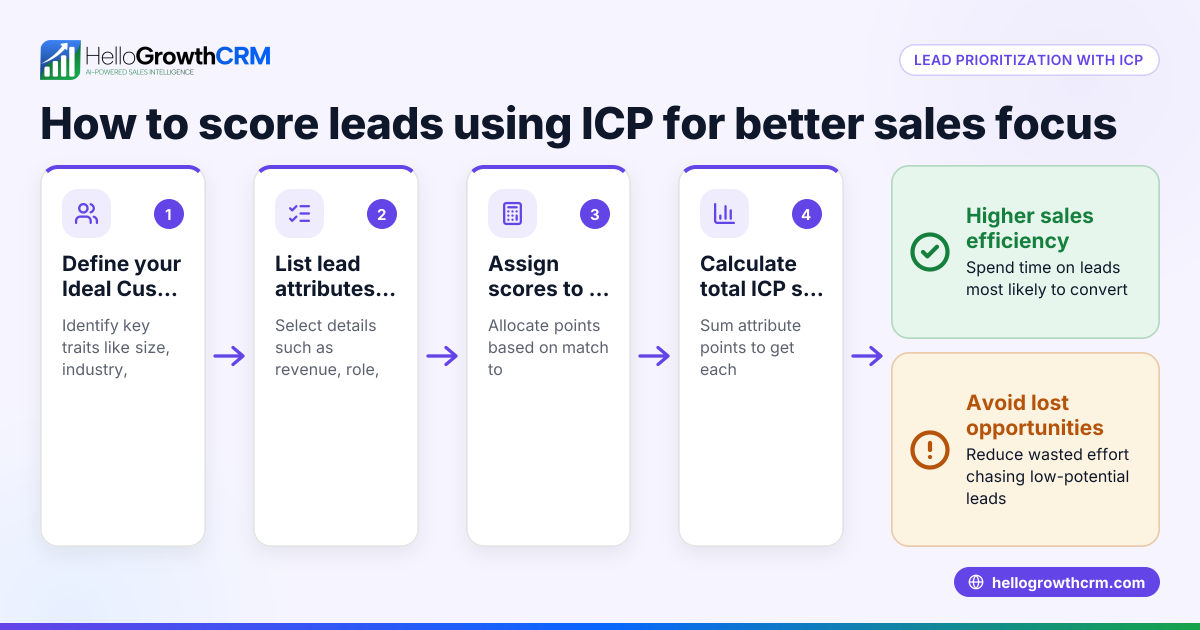
How do I choose criteria for lead scoring? Select criteria that reflect your ideal customer profile and buying signals, such as lead source, job title, engagement, budget, and purchase timeline.
Can lead scoring rules change over time? Yes, review and adjust your rules regularly based on sales results and market changes to keep scoring accurate.
How does AI lead scoring work in HelloGrowthCRM? HelloGrowthCRM’s AI lead scoring analyses lead data and behaviour to prioritise calls automatically, helping sales teams focus on leads most likely to convert.
Is lead scoring useful for small businesses? Absolutely. It helps small teams focus limited time on the best leads, improving conversion rates and sales efficiency.
Key takeaways
- Define clear criteria that reflect your ideal customer and buying signals.
- Assign points logically and test rules against past leads.
- Keep scoring rules simple and update them regularly.
- Use lead scores to prioritise sales follow-up and automate tasks.
- Avoid common mistakes by validating and integrating scoring into workflows.
- HelloGrowthCRM offers AI lead scoring and workflows to automate lead prioritisation and follow-up.
Start creating lead scoring rules today to improve your sales focus and win more business. To get started quickly, try HelloGrowthCRM’s Free Forever plan with 200 leads and no credit card required at Start on the Free Forever plan (200 leads, no credit card).
Ready to put this into practice?
Set up your pipeline, WhatsApp follow-ups, and AI lead scoring in minutes — free, no credit card.
Try HelloGrowthCRM freeGet CRM tips in your inbox
Join thousands of sales professionals who get weekly insights on CRM strategy, AI automation, and pipeline optimization.

The HelloGrowthCRM team publishes guides on CRM strategy, AI sales tools, and revenue operations for small business sales teams.