HelloGrowthCRM software
Built for real small-business sales teams
HelloGrowthCRM helps reps qualify faster, follow up on time, and close more deals—with practical automation in one place.
- AI lead scoring and pipeline visibility
- Built-in dialer, WhatsApp, and email automation
- Sales forecasting and RevOps-ready reporting
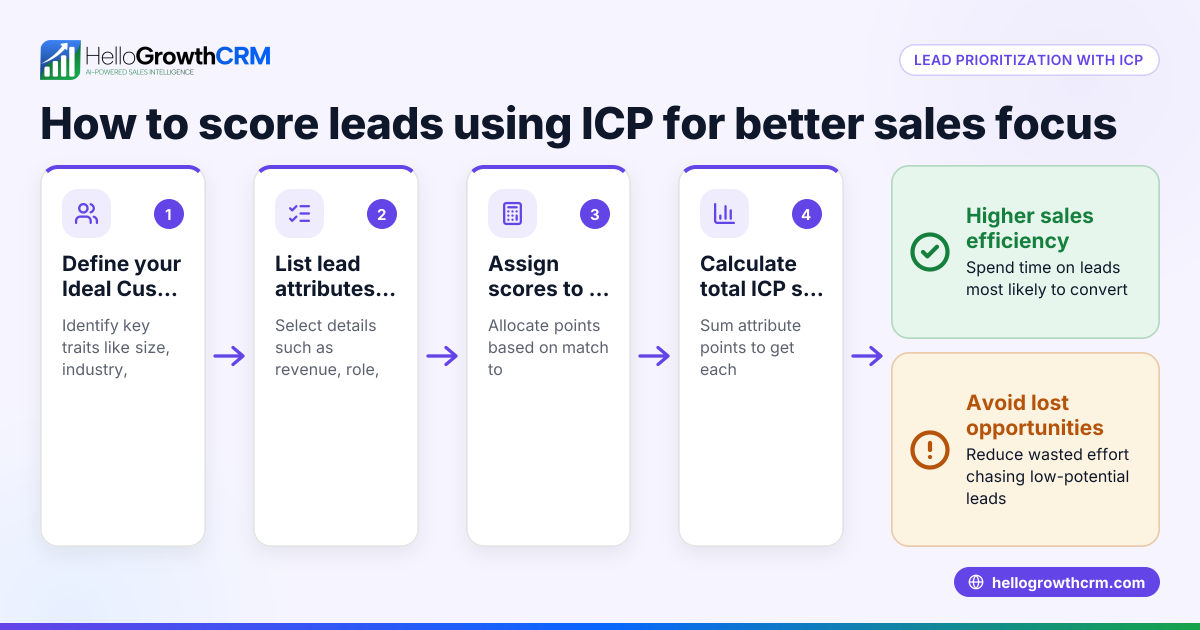
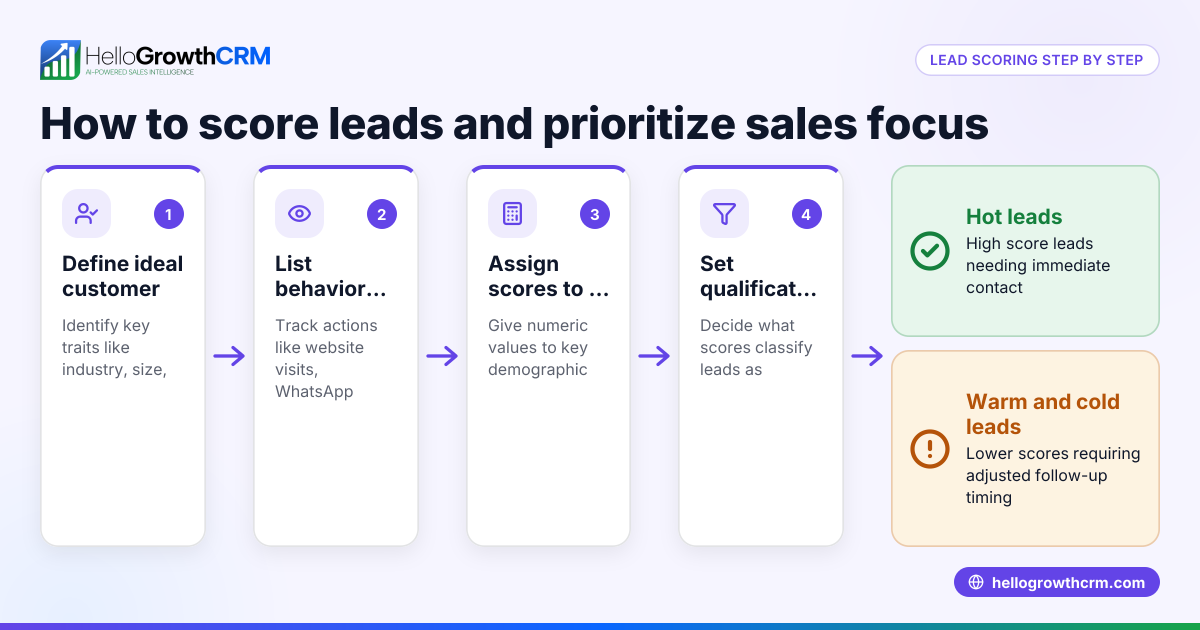
To create lead scoring rules in India, you need to identify key factors that predict a lead’s readiness to buy, assign scores to those factors, and use the total score to prioritise follow-up. This helps your sales team focus on leads most likely to convert, improving efficiency and revenue.
Why this comes up / what goes wrong
Many Indian small-business owners rely on manual tracking of leads via WhatsApp, notebooks, or Excel sheets. This often causes slow follow-up and lost sales opportunities because every lead looks the same. Without clear lead scoring rules, sales teams waste time on low-value leads or miss hot leads altogether. Defining lead scoring rules tailored to your business helps organise leads by priority and ensures faster, smarter follow-up.
Step-by-step
- List your lead qualification criteria: Identify factors that indicate lead quality. Common criteria include:
- Source of enquiry (IndiaMART, JustDial, website form)
- Budget range
- Urgency or buying timeline
- Industry or location
- Engagement level (calls answered, messages replied)
- Assign points to each criterion: Decide how important each factor is. For example, a lead from IndiaMART might get 10 points, while a lead from a cold call gets 3 points.
- Define scoring rules for each criterion:
- For source, assign fixed points.
- For budget, create ranges (e.g., ₹5,00,000+ gets 15 points).
- For timeline, shorter timelines get higher points.
- Set a total score threshold for lead priority:
- Example: Leads scoring 30+ are high priority.
- Leads scoring 15-29 are medium priority.
- Below 15 are low priority.
- Create a scoring sheet or use CRM rules:
- Use Excel or Google Sheets to calculate total scores.
- Or set up automated lead scoring in your CRM if supported.
- Test your rules:
- Apply scoring to recent leads.
- Check if high-scoring leads actually convert better.
- Adjust points and thresholds based on results.
- Train your sales team:
- Explain the scoring system.
- Instruct them to prioritise leads by score.
- Review and update periodically:
- Market and customer behaviour change.
- Update criteria and scores every 3-6 months.
Example (fictional figures)
A Mumbai-based manufacturer wants to score leads based on source, budget, and buying timeline.
| Criterion | Condition | Points |
|---|---|---|
| Source | IndiaMART enquiry | 10 |
| JustDial enquiry | 7 | |
| Website form | 5 | |
| Budget | ₹5,00,000 and above | 15 |
| ₹2,00,000 to ₹4,99,999 | 8 | |
| Below ₹2,00,000 | 3 | |
| Buying timeline | Within 1 month | 10 |
| Within 3 months | 5 | |
| More than 3 months | 2 |
Lead details:
- Source: IndiaMART enquiry = 10 points
- Budget: ₹3,00,000 = 8 points
- Buying timeline: within 1 month = 10 points
Total score = 10 + 8 + 10 = 28 points
Interpretation:
- 28 points falls in medium priority (15-29).
Adjust sales approach accordingly.
Common mistakes
- Assigning equal weight to all criteria
- Prevent by analysing which factors truly predict conversion and weigh them accordingly.
- Using too many criteria making scoring complex
- Prevent by focusing on 3-5 most impactful criteria.
- Not updating scoring rules regularly
- Prevent by scheduling reviews every 3-6 months.
- Ignoring sales team feedback
- Prevent by involving sales reps in rule creation and adjustments.
- Failing to train the team on lead scoring
- Prevent by conducting training sessions and sharing documentation.
- Relying solely on manual scoring without automation
- Prevent by using CRM features like workflows and AI lead scoring to automate.
Doing this in HelloGrowthCRM
HelloGrowthCRM helps Indian SMBs automate lead scoring and routing efficiently. Every enquiry from IndiaMART, JustDial, or web forms lands as a lead with an owner and next step, avoiding lost leads in notebooks. Automated workflows assign new IndiaMART enquiries round-robin and create first-call tasks automatically. AI lead scoring prioritises leads most likely to convert, so telecallers call the best leads first. Learn more about AI lead scoring and the WhatsApp and SMS CRM capabilities that help your team stay organised and responsive.
Frequently asked questions
How do I decide which criteria to include in lead scoring? Start by analysing your past sales data. Look for patterns in lead source, budget, and buying timeline that correlate with successful conversions. Focus on factors your sales team finds useful for prioritising leads.
Can lead scoring rules be different for different products or services? Yes, tailor your lead scoring rules to the product or service type. For example, high-budget leads might be more important for premium products, while urgency might matter more for fast-moving goods.
How often should I update my lead scoring rules? Review and update your rules every 3 to 6 months or whenever you notice changes in customer behaviour or sales results. Regular updates keep your scoring relevant and effective.
Is manual lead scoring enough, or should I use a CRM? Manual scoring can work initially but becomes hard to maintain as leads grow. Using a CRM with automated workflows and AI lead scoring, like HelloGrowthCRM, saves time and improves accuracy.
Can I integrate lead scoring with WhatsApp communication? Yes, HelloGrowthCRM integrates lead scoring with WhatsApp and SMS sequences, helping your sales team follow up on high-priority leads directly within the CRM.
Key takeaways
- Define 3-5 clear lead qualification criteria relevant to your business.
- Assign points to each criterion based on impact on conversion.
- Set total score thresholds to prioritise leads as high, medium, or low.
- Test and refine scoring rules regularly based on sales outcomes.
- Avoid complexity and keep the system easy for your sales team.
- Use CRM automation like HelloGrowthCRM to save time and improve follow-up.
Start improving your lead follow-up today. Start on the Free Forever plan (200 leads, no credit card) with HelloGrowthCRM and organise your leads from IndiaMART, JustDial, calls, and WhatsApp all in one place.
Ready to put this into practice?
Set up your pipeline, WhatsApp follow-ups, and AI lead scoring in minutes — free, no credit card.
Try HelloGrowthCRM freeGet CRM tips in your inbox
Join thousands of sales professionals who get weekly insights on CRM strategy, AI automation, and pipeline optimization.

The HelloGrowthCRM team publishes guides on CRM strategy, AI sales tools, and revenue operations for small business sales teams.