HelloGrowthCRM software
Built for real small-business sales teams
HelloGrowthCRM helps reps qualify faster, follow up on time, and close more deals—with practical automation in one place.
- AI lead scoring and pipeline visibility
- Built-in dialer, WhatsApp, and email automation
- Sales forecasting and RevOps-ready reporting
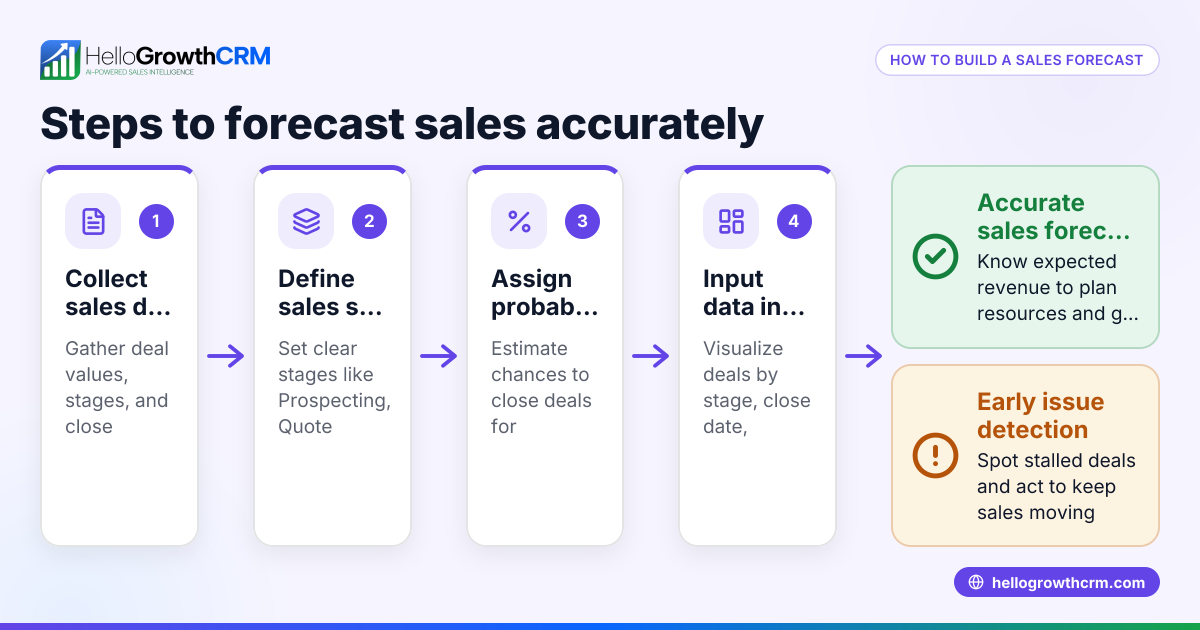
To forecast monthly sales revenue in Singapore, begin by collecting your historical sales figures and current pipeline data. Segment your pipeline into stages such as prospecting, quotation sent, and negotiation. Assign a probability of closing for each stage based on past conversion rates. Multiply each deal's value by its probability to get expected revenue, then sum these to estimate your monthly forecast. Adjust for factors like seasonal demand or market trends.
Why this comes up / what goes wrong
Many small business owners in Singapore struggle to forecast monthly sales revenue because they rely on informal methods like gut feeling or scattered data in WhatsApp chats, emails, and spreadsheets. Without a clear, repeatable process, they miss opportunities to prioritise leads or prepare cash flow. Slow follow-up causes deals to stall unnoticed, leading to inaccurate forecasts and lost revenue. A step-by-step method helps owners organise pipeline data, set realistic expectations, and plan better.
Step-by-step
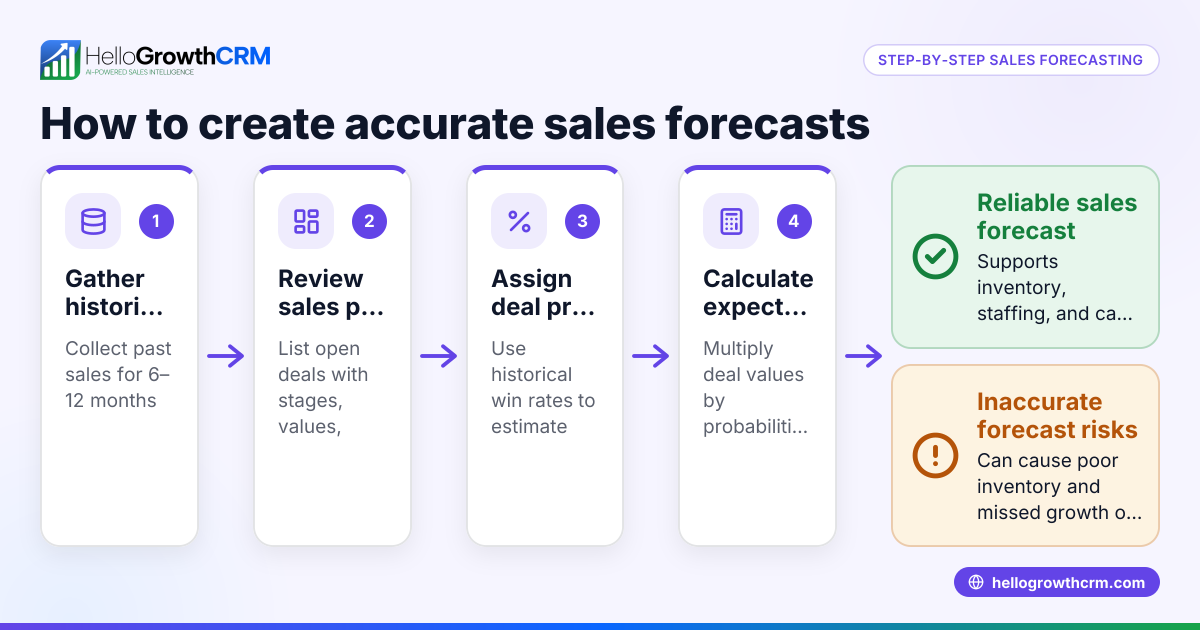
- Gather past sales data: Collect your sales revenue figures for the last 6-12 months from invoices or accounting records.
- List current open deals: Create a list of all current potential sales, including deal value, expected close date, and sales stage.
- Define sales stages: Break down your sales process into clear stages (e.g., lead, qualified, quote sent, negotiation, closed won/lost).
- Assign probabilities: For each stage, estimate the probability of closing based on historical conversion rates. For example, 10% for leads, 50% for quote sent.
- Calculate expected revenue per deal: Multiply each deal's value by its probability of closing.
- Sum expected revenues: Add all expected revenues for deals expected to close in the target month.
- Adjust for seasonality or market conditions: Increase or decrease your forecast based on known trends or events.
- Review and update regularly: Update your forecast weekly or monthly as deals progress or new leads arrive.
Check that your probabilities reflect your actual sales history and that deal values are accurate. Also, ensure you include only deals likely to close in the forecast month.
Example (fictional figures)
An F&B supplier in Woodlands wants to forecast sales revenue for March 2024.
- Past data shows average monthly sales of around S$80,000.
- Current pipeline includes:
- Deal A: S$30,000, quote sent, 50% probability, expected close 15/03/2024
- Deal B: S$20,000, negotiation, 70% probability, expected close 25/03/2024
- Deal C: S$15,000, qualified lead, 30% probability, expected close 28/03/2024
Calculate expected revenue:
Deal A: S$30,000 × 50% = S$15,000 Deal B: S$20,000 × 70% = S$14,000 Deal C: S$15,000 × 30% = S$4,500
Total forecast for March = S$15,000 + S$14,000 + S$4,500 = S$33,500
Adjusting for a known seasonal dip of 10% in March:
S$33,500 × 90% = S$30,150
The supplier’s forecasted sales revenue for March 2024 is S$30,150.
Common mistakes
- Using inaccurate probabilities: Prevent by basing probabilities on your actual past sales conversion rates.
- Including deals unlikely to close soon: Only include deals expected to close in the forecast month to avoid overestimation.
- Ignoring seasonality or market changes: Adjust your forecast to reflect known trends or events.
- Not updating forecasts regularly: Update your forecast weekly or monthly to reflect pipeline changes.
- Relying on scattered data: Consolidate all deals and sales data in one place to avoid missing information.
Avoid these mistakes by following a structured process and reviewing your forecast regularly.
Doing this in HelloGrowthCRM
HelloGrowthCRM helps Singapore small businesses forecast sales revenue with its pipeline forecast and AI insights feature. The AI analyses your sales pipeline stages, deal velocity, and historical conversion patterns to project expected close amounts without needing complex spreadsheets. You can track deals through stages like 'quote sent' with follow-up dates to avoid losing leads. For businesses with field sales teams, territory and visit logging tools help managers monitor daily activity and commissions. Learn more about sales forecasting, AI CRM, and HelloGrowthCRM for Singapore.
Frequently asked questions
How often should I update my sales forecast? Update your sales forecast at least monthly, or weekly if your sales cycle is short or deals move quickly. Regular updates reflect pipeline changes and improve accuracy.
What if I don’t have historical sales data? Start by estimating probabilities based on your sales process and adjust as you gather real data. Use conservative estimates to avoid overforecasting.
How can I improve forecasting accuracy? Use consistent sales stages and probabilities based on past conversion rates. Regularly review and adjust your forecast with new information and market trends.
Can I use HelloGrowthCRM to manage my sales pipeline? Yes, HelloGrowthCRM lets you track deals from first contact to close with stage movement, expected values, and follow-up reminders to keep your pipeline organised.
What is AI-assisted revenue forecasting? It uses AI to analyse your sales pipeline and historical data to predict expected revenue more accurately and identify where deals are stalling.
Key takeaways
- Gather past sales data and current deals to base your forecast on real figures.
- Assign probabilities to sales stages reflecting your actual conversion rates.
- Calculate expected revenue by multiplying deal values by probabilities.
- Adjust forecasts for seasonality and market conditions.
- Update forecasts regularly to reflect pipeline changes.
- Use tools like HelloGrowthCRM to track deals and get AI insights for better forecasting.
Start forecasting your monthly sales revenue today with a clear process. To manage your pipeline and get AI-driven sales forecasts, start on the Free Forever plan (200 leads, no credit card).
Ready to put this into practice?
Set up your pipeline, WhatsApp follow-ups, and AI lead scoring in minutes — free, no credit card.
Try HelloGrowthCRM freeGet CRM tips in your inbox
Join thousands of sales professionals who get weekly insights on CRM strategy, AI automation, and pipeline optimization.

The HelloGrowthCRM team publishes guides on CRM strategy, AI sales tools, and revenue operations for small business sales teams.