HelloGrowthCRM software
Built for real small-business sales teams
HelloGrowthCRM helps reps qualify faster, follow up on time, and close more deals—with practical automation in one place.
- AI lead scoring and pipeline visibility
- Built-in dialer, WhatsApp, and email automation
- Sales forecasting and RevOps-ready reporting
Forecasting monthly sales revenue is essential for UK small businesses to plan cash flow and resources. This guide explains why forecasting can be tricky, then gives clear, numbered steps to create your forecast. You’ll find a realistic example using a Manchester letting agency’s figures, common mistakes to avoid, and how HelloGrowthCRM’s pipeline forecast and AI insights can support your process.
Why this comes up / what goes wrong
Many small business owners in the UK struggle to predict monthly sales revenue accurately. They may rely on gut feeling, incomplete data or spreadsheets that become outdated quickly. Sales often happen through WhatsApp, email or spreadsheets without a unified view, causing missed opportunities and slow follow-up. Without a clear forecast, it’s hard to manage cash flow, staff workloads or supplier payments. This leads to stress and lost revenue.
Step-by-step
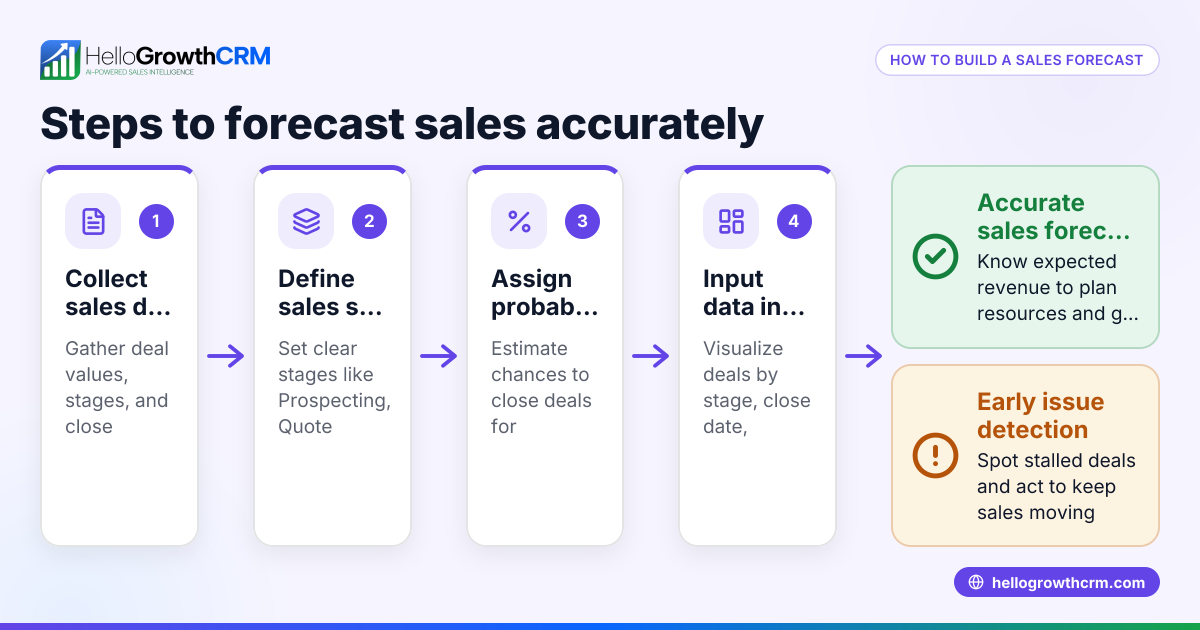
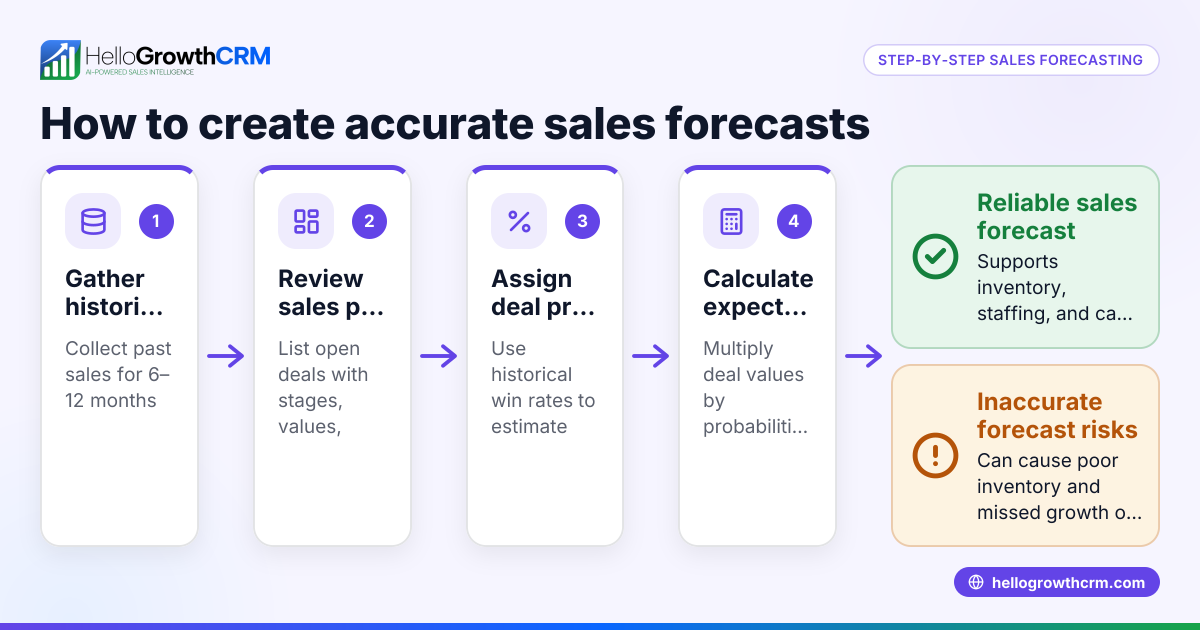
- Gather past sales data Collect monthly sales figures from at least the past 6-12 months. Include all closed deals with their final values and closing dates.
- Review your current sales pipeline List all active deals with their stage (e.g., prospecting, quote sent, negotiation), estimated deal value, and expected close date.
- Assign probabilities to each pipeline stage Estimate the likelihood that a deal in each stage will close this month. For example, ‘quote sent’ might have a 50% chance, ‘negotiation’ 70%, ‘prospecting’ 20%. Adjust these based on your past conversion rates.
- Calculate expected revenue per deal Multiply each deal’s value by its probability of closing this month.
- Sum expected revenues for the month Add all expected revenues of deals likely to close in the forecast month.
- Add confirmed sales Include any sales already confirmed or invoiced for the month.
- Adjust for seasonality or market changes If you know sales fluctuate by season, adjust your forecast accordingly.
- Review and update regularly Update your forecast weekly or biweekly to reflect new deals, closed sales, or changes in pipeline stages.
Check your data for accuracy at each step. Avoid mixing deal values from different currencies or including deals outside the forecast month.
Example (fictional figures)
A Manchester letting agency wants to forecast sales revenue for 01/05/2024. They have these active deals:
| Deal | Stage | Value (£) | Probability (%) | Expected Close Date |
|---|---|---|---|---|
| A | Quote sent | 10,000 | 50 | 15/05/2024 |
| B | Negotiation | 15,000 | 70 | 20/05/2024 |
| C | Prospecting | 8,000 | 20 | 30/05/2024 |
Confirmed sales for May already invoiced: £5,000.
Calculations:
Deal A: £10,000 × 50% = £5,000 Deal B: £15,000 × 70% = £10,500 Deal C: £8,000 × 20% = £1,600
Sum expected pipeline revenue: £5,000 + £10,500 + £1,600 = £17,100 Add confirmed sales: £17,100 + £5,000 = £22,100
Forecasted sales revenue for May 2024 = £22,100
Common mistakes
- Using inaccurate probabilities: Base probabilities on your actual past conversion rates to avoid over- or underestimating.
- Ignoring pipeline stage dates: Only include deals expected to close in the forecast month.
- Mixing confirmed and unconfirmed sales: Keep confirmed sales separate and add them after calculating expected pipeline revenue.
- Not updating forecasts regularly: Sales pipelines change; update forecasts weekly to stay accurate.
- Relying solely on spreadsheets: They can get outdated and error-prone. Consider CRM tools that automate data capture and forecasting.
For more on improving sales forecasting, see our sales forecasting guide.
Doing this in HelloGrowthCRM
HelloGrowthCRM helps UK businesses forecast monthly sales revenue with its pipeline forecast and AI insights. It projects expected close amounts based on current pipeline stages, deal velocity and historical conversion patterns, highlighting where deals stall without requiring spreadsheets. Deals like a quotation sent last week appear in the pipeline at the 'quote sent' stage with follow-up dates, so no opportunity is forgotten. For field sales teams, territories and visit logs keep managers informed of daily activities and commissions. Learn more about these features in our AI CRM and HelloGrowthCRM for the United Kingdom pages.
Frequently asked questions
How often should I update my sales revenue forecast? Update your forecast at least weekly or biweekly. Frequent updates capture new deals, closed sales and changes in deal stages, keeping your forecast accurate.
Can I forecast sales revenue without historical data? You can start with estimates based on current pipeline and market knowledge, but historical data improves accuracy over time. Track your sales carefully to build useful data.
What if my sales are very seasonal? Adjust your forecast for known seasonal trends by increasing or decreasing expected sales accordingly. Use past months’ data from the same season as a guide.
How does AI help in sales forecasting? AI analyses your pipeline stages, deal velocity and past conversions to predict expected revenue and identify deals that may stall, helping you focus your sales efforts better.
Can I include sales from multiple channels like WhatsApp and email? Yes, but centralise your sales data in one system or spreadsheet. HelloGrowthCRM supports WhatsApp and email sales tracking in its pipeline for unified forecasting.
Key takeaways
- Use past sales data and current pipeline deals with assigned probabilities to forecast monthly revenue.
- Calculate expected revenue per deal by multiplying value by probability, then sum for the month.
- Include confirmed sales separately and adjust for seasonality.
- Update forecasts regularly to reflect pipeline changes.
- Avoid common mistakes like inaccurate probabilities and mixing deal dates.
- HelloGrowthCRM’s pipeline forecast and AI insights simplify forecasting and pipeline management.
Start forecasting your monthly sales revenue today with clear steps and checks. To try tools that support this process, start on the Free Forever plan (200 leads, no credit card).
Ready to put this into practice?
Set up your pipeline, WhatsApp follow-ups, and AI lead scoring in minutes — free, no credit card.
Try HelloGrowthCRM freeGet CRM tips in your inbox
Join thousands of sales professionals who get weekly insights on CRM strategy, AI automation, and pipeline optimization.

The HelloGrowthCRM team publishes guides on CRM strategy, AI sales tools, and revenue operations for small business sales teams.