HelloGrowthCRM software
Built for real small-business sales teams
HelloGrowthCRM helps reps qualify faster, follow up on time, and close more deals—with practical automation in one place.
- AI lead scoring and pipeline visibility
- Built-in dialer, WhatsApp, and email automation
- Sales forecasting and RevOps-ready reporting
Managing repeat customer complaints is crucial for small businesses in the USA to maintain customer satisfaction and prevent revenue loss. Repeat complaints often indicate unresolved issues or poor communication. This article explains why repeat complaints occur, provides a clear step-by-step method to handle them, offers a worked example with fictional figures, highlights common mistakes, and shows how HelloGrowthCRM can support your process.
Why this comes up / what goes wrong
Small-business owners often face repeat customer complaints because the initial complaint was not fully resolved or the solution was not communicated clearly. Sometimes, complaints recur because the business lacks a centralized way to track customer issues or fails to analyze complaint patterns. This leads to frustrated customers who feel ignored and may damage your business reputation or reduce referrals.
Step-by-step
- Record Every Complaint Immediately: Use a system or log to capture the customer’s contact info, complaint details, date, and product or service involved. Check that all fields are complete.
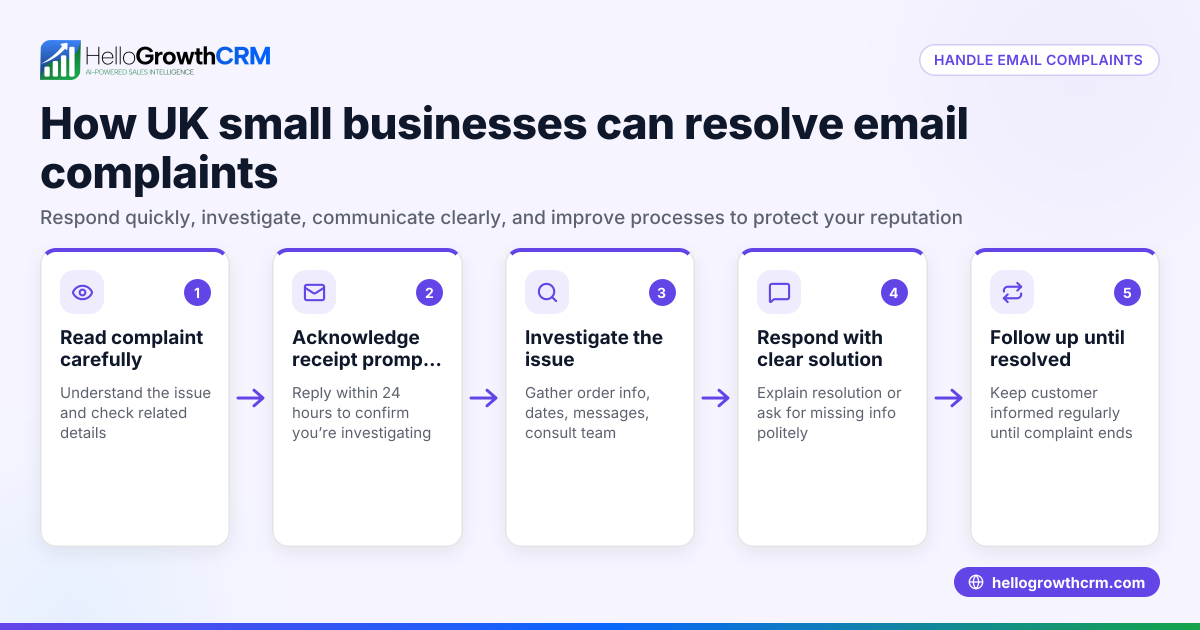
- Acknowledge the Complaint Quickly: Contact the customer within 24 hours to confirm you received their complaint. Check that your message is clear and polite.
- Investigate the Root Cause: Review the complaint details and check any previous complaints from the same customer or about the same product. Verify if the issue is recurring.
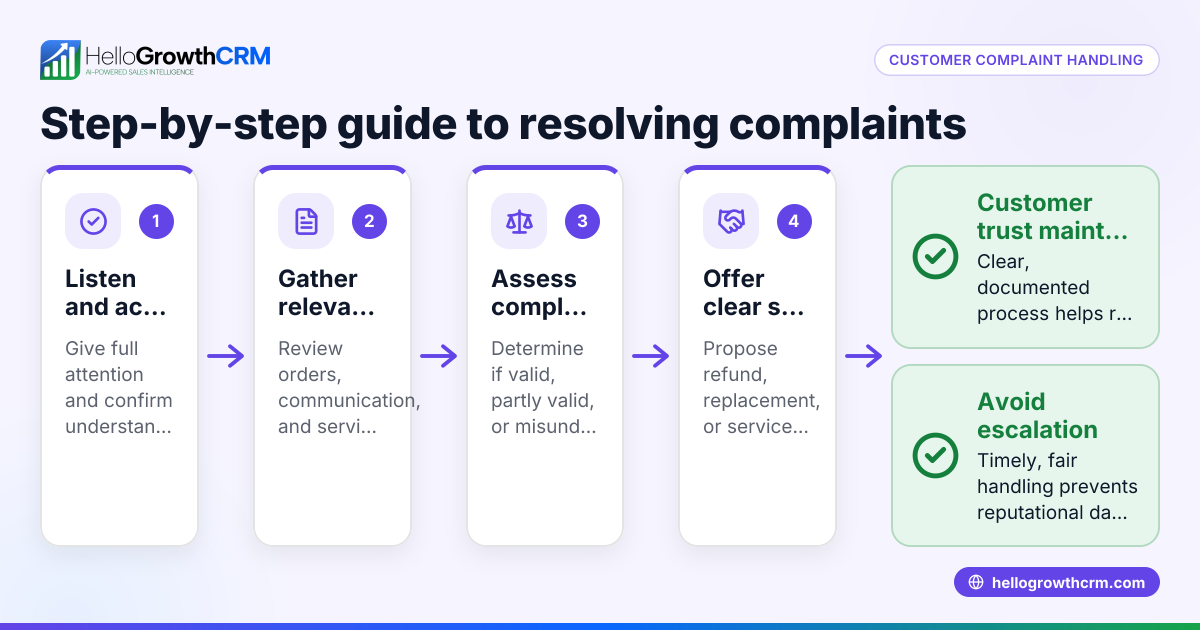
- Resolve the Issue: Offer a clear solution—refund, replacement, or repair. Confirm with the customer that this solution is acceptable. Check that the resolution is documented.
- Follow Up After Resolution: Contact the customer after a few days to ensure the problem is fully resolved and they are satisfied. Check for any further concerns.
- Log and Analyze Complaints Regularly: Weekly or monthly, review complaints for patterns in product defects, service issues, or staff errors. Check that this review is documented and action plans are created.
- Train Staff and Improve Processes: Based on complaint analysis, train your team and update procedures to prevent recurrence. Check that training records and process updates are maintained.
- Use a Centralized CRM System: Ensure all complaints and follow-ups are stored on the same customer record for easy access and history tracking. Check that your CRM supports tickets and knowledge base features.
Incorporate reminders and task boards to keep follow-ups on schedule and prevent complaints from slipping through.
Example (fictional figures)
A B2B software reseller in Denver, Colorado, receives a repeat complaint about delayed software delivery.
- Complaint logged on 05/01/2024 with customer name, contact, and order number.
- Acknowledge complaint on 05/02/2024 by email.
- Investigate and find previous similar complaint on 04/15/2024.
- Resolution offered: expedited shipping plus 10% refund on $5,000 order.
Calculation for refund:
$5,000 × 10% = $500
Total refund = $500
- Follow up on 05/10/2024 to confirm delivery and satisfaction.
- Log all interactions in the customer record.
This process prevents future complaints by addressing the root cause—shipping delays—and compensating the customer.
Common mistakes
- Ignoring or delaying acknowledgement: Prevent this by setting automated alerts for new complaints.
- Not tracking complaints centrally: Use a CRM with tickets to keep all info linked to the customer.
- Failing to analyze complaint patterns: Schedule regular reviews to spot recurring issues.
- Poor communication on resolution: Confirm solutions clearly with customers and document their agreement.
- No follow-up after resolution: Set reminders to check customer satisfaction post-resolution.
- Not training staff on complaint handling: Provide regular training based on complaint data.
Avoid these mistakes to reduce repeat complaints and improve customer trust. See how a customer health score can also help monitor satisfaction trends.
Doing this in HelloGrowthCRM
HelloGrowthCRM helps manage repeat customer complaints by keeping service requests and support tickets on the same customer record as the deal. Its branded customer portal allows customers to submit complaints directly and access a knowledge base for self-service. Referral tracking and ticket management simplify follow-up and resolution. Learn more about HelloGrowthCRM’s WhatsApp and SMS CRM features and how it supports US businesses on HelloGrowthCRM for the United States.
Frequently asked questions
How quickly should I respond to a repeat customer complaint? Respond within 24 hours to acknowledge receipt and show the customer you take their issue seriously. Prompt responses reduce frustration and prevent escalation.
What is the best way to track repeat complaints? Use a centralized CRM system with ticketing and customer records to log every complaint and link them to customer profiles. This helps identify repeat issues and customer history easily.
How can I prevent repeat complaints from the same customer? Analyze root causes, communicate clearly on resolutions, follow up after fixes, and update staff training and processes based on complaint trends.
Can customers submit complaints themselves? Yes, a branded customer portal lets customers submit and track complaints directly, improving transparency and reducing response time.
Why is follow-up important after resolving a complaint? Follow-up confirms the issue is fully resolved and the customer is satisfied, which helps rebuild trust and reduces chances of repeat complaints.
Key takeaways
- Record and acknowledge complaints promptly and completely.
- Investigate root causes and resolve issues clearly with documented agreements.
- Follow up after resolution to confirm customer satisfaction.
- Use a centralized CRM with tickets and customer portals to track complaints.
- Analyze complaint patterns regularly and train staff accordingly.
- Avoid common mistakes like delayed responses and poor communication.
Managing repeat customer complaints effectively protects your business reputation and improves customer loyalty.
Start managing your customer complaints better today. Start on the Free Forever plan (200 leads, no credit card).
Ready to put this into practice?
Set up your pipeline, WhatsApp follow-ups, and AI lead scoring in minutes — free, no credit card.
Try HelloGrowthCRM freeGet CRM tips in your inbox
Join thousands of sales professionals who get weekly insights on CRM strategy, AI automation, and pipeline optimization.

The HelloGrowthCRM team publishes guides on CRM strategy, AI sales tools, and revenue operations for small business sales teams.