HelloGrowthCRM software
Built for real small-business sales teams
HelloGrowthCRM helps reps qualify faster, follow up on time, and close more deals—with practical automation in one place.
- AI lead scoring and pipeline visibility
- Built-in dialer, WhatsApp, and email automation
- Sales forecasting and RevOps-ready reporting
To set customer service SLA (Service Level Agreement) targets in the UK, start by defining measurable response and resolution time goals that align with your customers' expectations and your team's capacity. These targets should be clear, achievable, documented, and regularly reviewed. This article explains why setting SLAs is important, provides step-by-step instructions, a detailed example with GBP figures and arithmetic, common pitfalls to avoid, and how HelloGrowthCRM can assist in managing SLAs effectively.
Why this comes up / what goes wrong
Many small and mid-sized UK businesses face challenges with inconsistent customer service response times, often resulting in dissatisfied customers and lost business. Without clear SLA targets, teams may not prioritise urgent issues or may respond too slowly, damaging the company’s reputation. Business owners frequently struggle to balance customer expectations with available resources. Setting clear SLA targets helps align team efforts, improve customer satisfaction, and track performance systematically.
Step-by-step
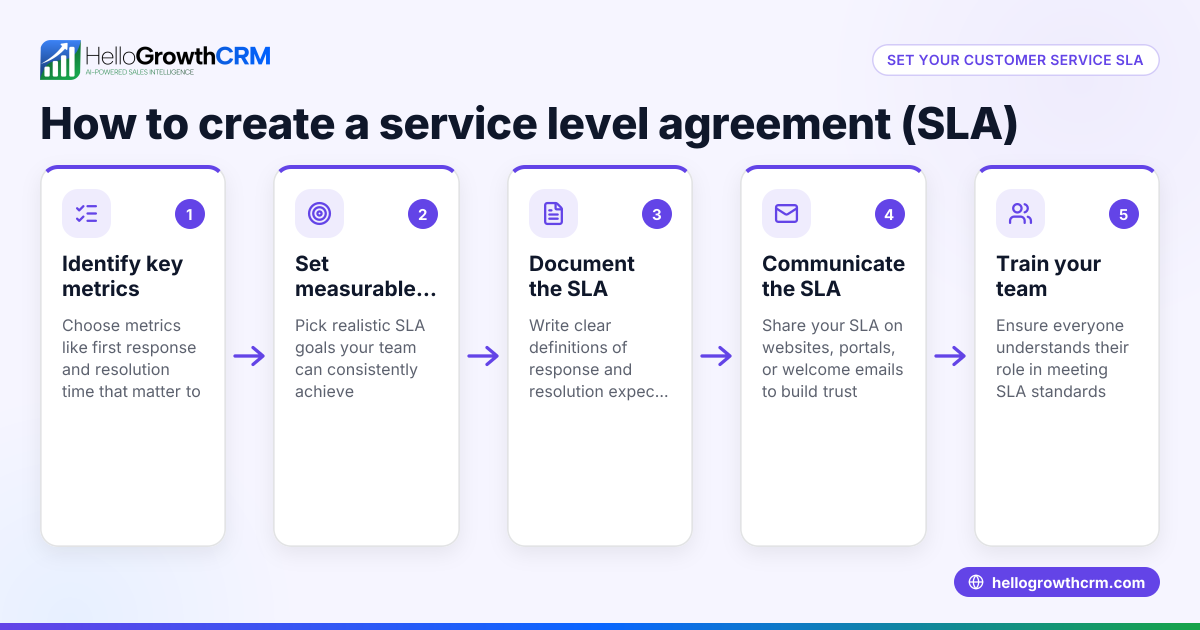
- Identify customer service processes: List all types of customer requests you handle, such as inquiries, complaints, technical support, or returns. Check that these categories cover all common interactions.
- Gather data on current response times: Review past customer service records or tickets to find average response and resolution times. This helps set realistic targets.
- Understand customer expectations: Survey customers or use feedback to learn how quickly they expect responses and resolutions.
- Set measurable SLA targets: For each request type, define clear targets such as "initial response within 4 hours" or "issue resolved within 24 hours." Ensure these targets are achievable with your current resources.
- Document SLAs clearly: Write the SLA targets in simple language and share them with your team and customers.
- Assign responsibility: Specify who in your team is responsible for meeting each SLA target.
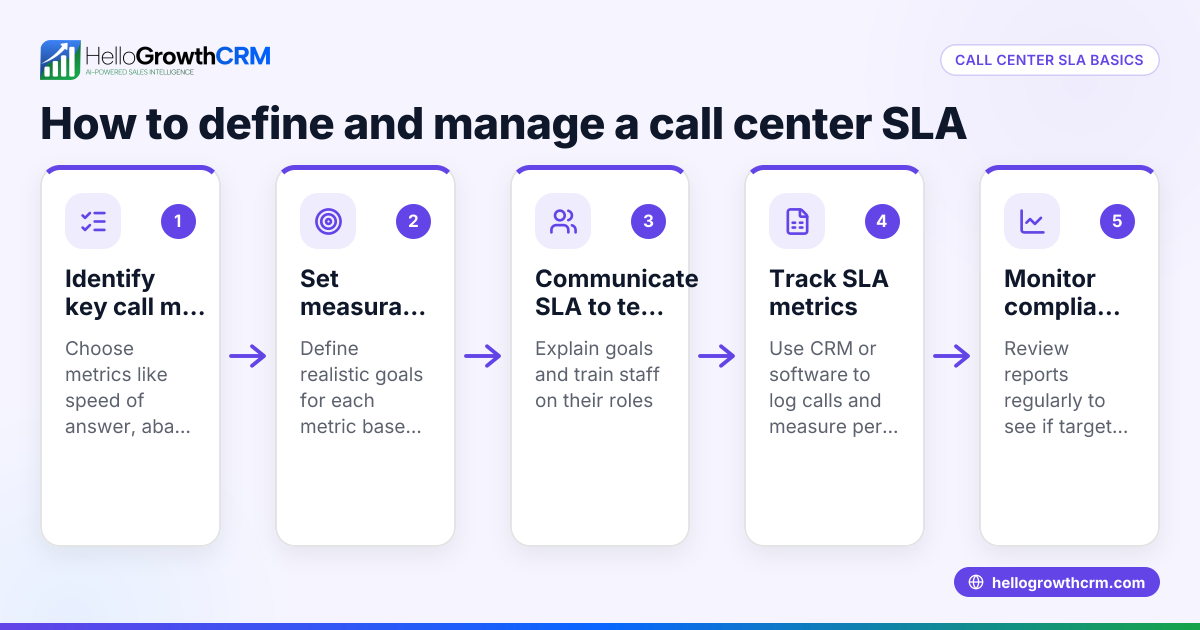
- Implement monitoring tools: Use software or spreadsheets to track SLA compliance and alert teams when targets are close to being missed.
- Review and adjust regularly: Set a schedule (e.g., quarterly) to review SLA performance and update targets based on changing customer needs or business capacity.
- Communicate SLAs to customers: Make SLA targets visible through your website, customer portal, or support communications.
- Train your team: Ensure everyone understands the SLA targets and how to meet them.
For more on tracking customer satisfaction alongside these targets, see the customer health score feature.
Example (fictional figures)
A letting agency in Manchester handles tenant inquiries and maintenance requests. They want to set SLA targets based on current data and tenant expectations.
- Current average initial response time for tenant inquiries: 8 hours
- Current average resolution time for maintenance requests: 72 hours
- Tenant expectations:
- Initial response within 6 hours
- Maintenance issues resolved within 48 hours
They decide on these SLA targets:
- Initial response to tenant inquiries: within 6 hours
- Resolution of maintenance requests: within 48 hours
Calculations to check feasibility:
If the team handles 120 tenant inquiries weekly, each requiring a 6-hour response window, they assess workload capacity.
For maintenance requests, 60 requests come weekly:
- Target resolution time = 48 hours
- Team capacity allows resolving 70 requests per week
Arithmetic:
Tenant inquiries handled per week = 120 Maintenance requests handled per week = 60 Team capacity for maintenance = 70
Since 60 ≤ 70, the team can meet maintenance request targets.
They document:
"We will respond to tenant inquiries within 6 hours and resolve maintenance issues within 48 hours."
They assign team members to monitor tickets and use a CRM with ticket tracking to ensure compliance.
Common mistakes
- Setting unrealistic targets: Avoid targets too ambitious for your current resources. Prevent this by analysing past data and capacity.
- Not documenting SLAs clearly: Prevent confusion by writing simple, accessible SLA statements.
- Failing to assign responsibility: Ensure every SLA target has a designated owner to avoid missed deadlines.
- Ignoring customer feedback: Regularly update SLAs based on changing customer needs.
- Not monitoring performance: Use tools or reports to track SLA compliance and act on breaches.
- Communicating SLAs poorly: Share SLAs openly with customers and teams to set clear expectations.
For managing tickets and SLA policies efficiently, explore the WhatsApp and SMS CRM capabilities.
Doing this in HelloGrowthCRM
HelloGrowthCRM offers a branded self-service customer portal, referrals, tickets, and a knowledge base. After the sale, service requests stay on the same customer record as the deal, making it easy to track issues and responses in one place. This helps ensure SLA targets are transparent and service requests are tracked effectively. Learn more about HelloGrowthCRM for the United Kingdom here.
Frequently asked questions
What is a reasonable SLA target for customer service in the UK? Reasonable targets depend on your industry and customer expectations. Common targets include initial response within 4-6 hours and resolution within 24-48 hours. Use your current data and customer feedback to set achievable goals.
How often should I review SLA targets? Review SLA targets at least quarterly or whenever customer feedback or business capacity changes significantly. Regular reviews help keep targets relevant and achievable.
Can small businesses track SLA compliance without software? Yes, small businesses can use spreadsheets or manual logs to track response and resolution times. However, software like HelloGrowthCRM can automate tracking, alerts, and reporting for better efficiency.
How do I communicate SLA targets to customers? Publish SLA targets on your website, customer portal, and in support communications. Clear communication sets expectations and builds trust.
What if my team frequently misses SLA targets? Identify bottlenecks or resource shortages causing delays. Adjust targets if needed, provide training, or improve processes. Monitoring tools help spot issues early.
Key takeaways
- Set SLA targets based on customer expectations and your team’s capacity.
- Make SLA targets measurable, clear, and documented.
- Assign responsibility and monitor compliance regularly.
- Communicate SLAs openly to customers and staff.
- Use tools like HelloGrowthCRM to track tickets and manage SLAs.
Start setting your customer service SLA targets today to improve satisfaction and efficiency. You can start on the Free Forever plan (200 leads, no credit card) with HelloGrowthCRM.
Ready to put this into practice?
Set up your pipeline, WhatsApp follow-ups, and AI lead scoring in minutes — free, no credit card.
Try HelloGrowthCRM freeGet CRM tips in your inbox
Join thousands of sales professionals who get weekly insights on CRM strategy, AI automation, and pipeline optimization.

The HelloGrowthCRM team publishes guides on CRM strategy, AI sales tools, and revenue operations for small business sales teams.