HelloGrowthCRM software
Built for real small-business sales teams
HelloGrowthCRM helps reps qualify faster, follow up on time, and close more deals—with practical automation in one place.
- AI lead scoring and pipeline visibility
- Built-in dialer, WhatsApp, and email automation
- Sales forecasting and RevOps-ready reporting
Credit card data offers US B2B sales teams direct insights into real purchasing behavior. Integrating this data with AI credit card analysis tools improves sales forecasting accuracy and pipeline prioritization. This combination helps predict revenue more reliably and focus sales efforts where they matter most.
Key takeaways
- Credit card data provides real-time, transactional information that enhances sales forecasting accuracy.
- Using credit card insights helps prioritize leads based on actual purchasing behaviors.
- Integrating credit card trends into pipeline management reduces guesswork and boosts sales velocity.
- AI-powered analysis of credit card data uncovers hidden patterns to improve decision-making.
- Compliance with US data privacy laws and regulations is essential when handling credit card information.
- HelloGrowthCRM’s AI CRM and managed RevOps services can help leverage credit card data for smarter sales operations.
Why US B2B Sales Teams Should Use Credit Card Data for Sales Forecasting
Credit card data offers a direct view into buyer transactions, providing real-time indicators of purchasing intent. US B2B sales teams can use this insight to improve forecasting by basing predictions on actual spend patterns rather than assumptions or delayed reports.
This transactional data delivers value in several ways:
- Real-time visibility: Instead of waiting for deal closes or sales rep updates, you get immediate insight into when a customer spends money.
- Behavioral confirmation: Paying customers and prospects who frequently transact show stronger buying intent than those who only appear in lead databases.
- Seasonal and cyclical patterns: Many industries in cities like Chicago or Houston have predictable spending cycles influenced by fiscal quarters or operational needs. Credit card data helps uncover these trends.
- Early warning system: Delays or drops in payment activity may signal churn risks or budget issues before sales reps learn of problems.
Example: Manufacturing Supplier in Chicago
Imagine a manufacturing supplier nationwide with a large concentration of clients in Chicago. By monitoring credit card transactions tied to purchase orders, the sales team detects a consistent surge in equipment spending each January and July. The forecasting team adjusts pipeline targets for those months and engages clients with preemptive outreach focused on planned maintenance or upgrades. Without direct payment data, these insights might come too late or be missed entirely.
How does AI credit card data analysis improve sales forecasts?
AI credit card data analysis automates the detection of patterns in payment transactions to enhance forecasting accuracy and lead prioritization.
AI processes vast credit card datasets quickly, revealing trends and anomalies that manual reviews miss. It helps sales teams predict buyer behavior and focus on leads with higher conversion potential.
Key benefits of AI for credit card data analysis
- Identifying nuanced patterns: AI algorithms detect changes in transaction sizes, frequency, and merchant categories that might precede a sale or signal softening demand.
- Anomaly detection: Sudden spikes or drops in payments for certain clients are immediately flagged for sales rep follow-up.
- Segmentation and clustering: AI groups buyers with similar payment behaviors, helping customize sales tactics by segment.
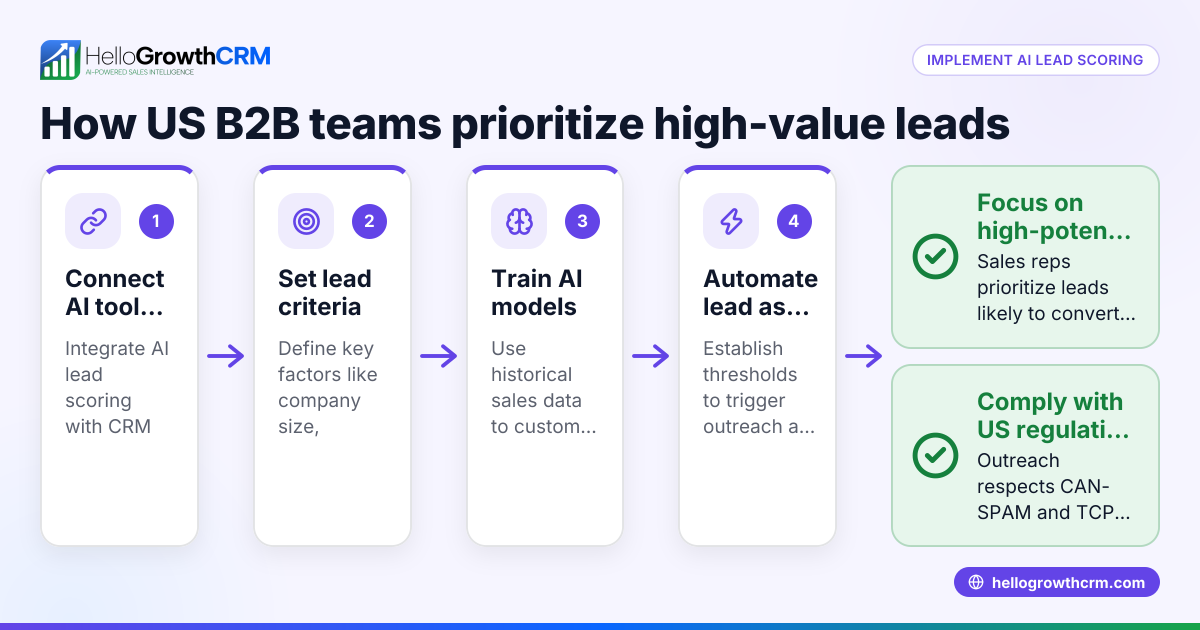
- Predictive scoring: Machine learning models assign lead scores based on credit card indicators combined with CRM data, so the sales team focuses on prospects who show the highest conversion likelihood.
For example, a SaaS company selling to law firms may use AI to find that firms increasing software-related credit card spend over the past 3 months tend to close deals 25% faster and with higher average contract value. Sales forecasts incorporating those signals deliver higher confidence and precision.
AI credit card data and lead scoring
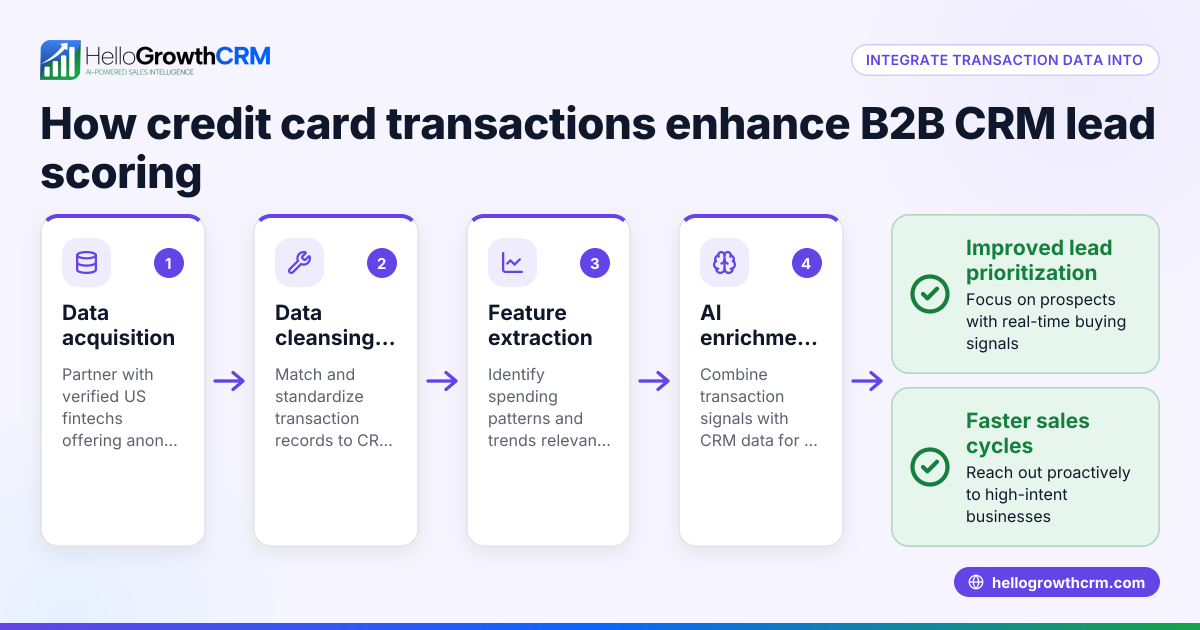
Lead scoring traditionally uses firmographics, web engagement, or sales rep input. Adding credit card transaction patterns provides an objective, purchase-driven filter. Leads with recent payments or growing transactional footprints score higher because they demonstrate financial commitment.
For example, a regional distributor in Detroit might find that customers with regular monthly purchases over a threshold value convert at twice the rate as dormant accounts. AI models can automatically bump such profiles in sales queues, so reps do not waste time on unqualified leads.
Integrating credit card data deeply within AI lead scoring ensures resources are allocated to the most promising opportunities. This drives faster pipeline velocity and raises win rates.
What are the risks and legal considerations of using credit card data in sales?
Handling credit card data requires strict compliance with US laws and industry standards to protect privacy and avoid penalties.
Companies must follow PCI DSS standards for secure data storage and transmission. Using payment data for outreach demands consent due to TCPA and CAN-SPAM regulations. The Fair Credit Reporting Act (FCRA) may apply if creditworthiness is evaluated, and many buyers expect SOC 2 compliance for vendor data security.
Best practices to mitigate risks
- Acquire credit card data only through legal, transparent means (e.g., integrated payment systems or customer self-disclosure).
- Store payment-related info separately from general CRM data, encrypted and accessible only to authorized users.
- Establish clear internal governance policies around who can access, share, or action credit card information.
- Avoid blending credit card data with marketing outreach unless customers have opted in under relevant laws.
- Train sales and RevOps teams on compliance and ethical handling of financial data.
Following these safeguards lets B2B sales teams responsibly leverage valuable purchase insights.
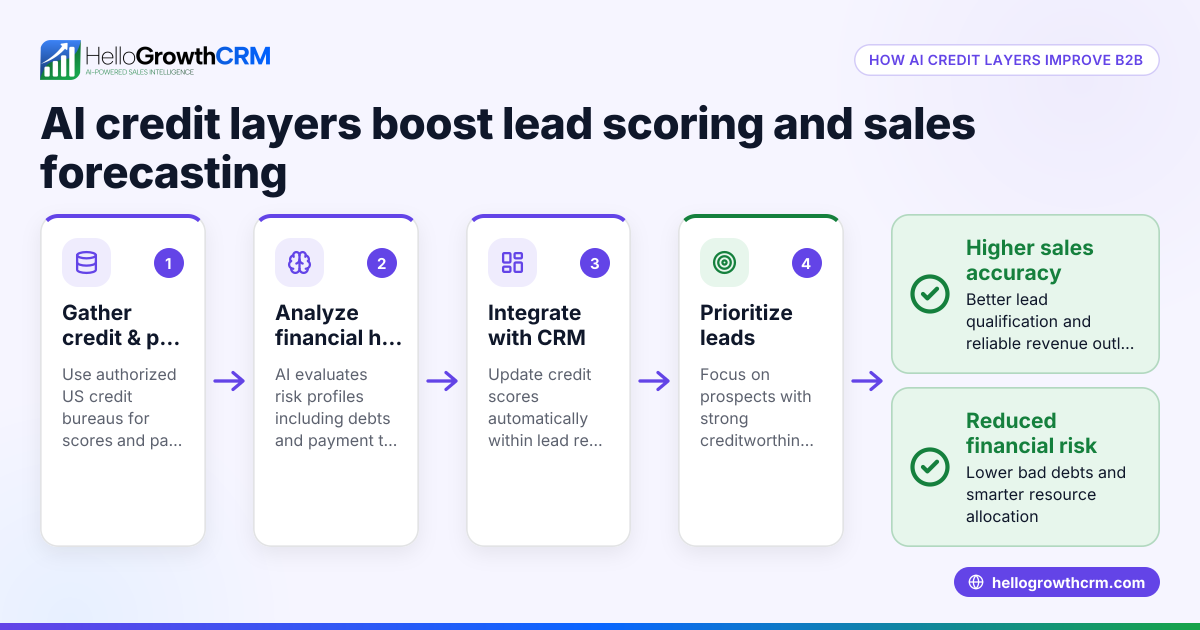
How to integrate credit card data into your sales pipeline management
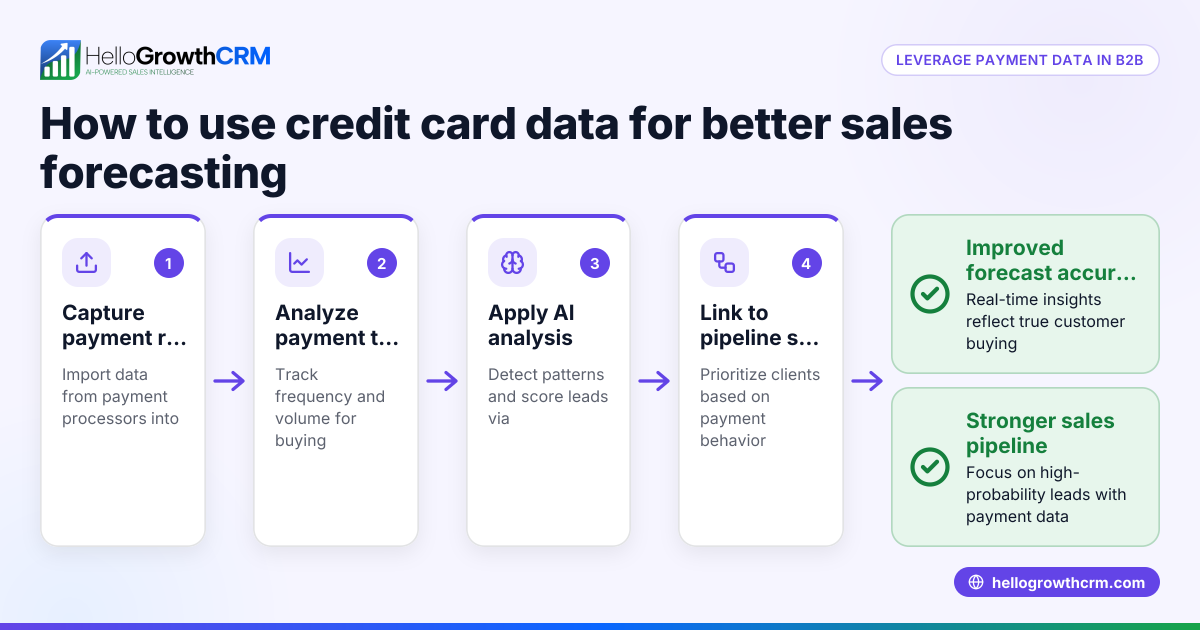
To use credit card data effectively, follow these steps:
Step 1: Collect data securely
Partner with PCI DSS-compliant payment processors like Stripe or QuickBooks Payments. These provide APIs to share transaction data securely without exposing raw card numbers.
Step 2: Enrich CRM records
Use CRM integrations to link payment transactions with customer profiles. This enrichment adds purchase histories to accounts, deepening sales context.
Step 3: Analyze with AI tools
Leverage AI features such as AI lead scoring and sales forecasting to extract meaningful insights from credit card data. AI can highlight customers with increased spend or flag risk indicators.
Step 4: Prioritize pipeline activities
Sequence sales outreach based on credit card purchase signals. Focus first on contacts with recent large payments; deprioritize leads without recent transactions to optimize resources.
Step 5: Monitor and refine forecasts regularly
Update sales forecasts weekly or monthly by comparing predicted revenue with actual transaction data. Use dashboards to track credit card activity alongside pipeline health.
Pitfall to avoid: Overreliance on credit card data alone
Combine payment insights with CRM activity, rep feedback, and market intelligence for balanced forecasting.
What is the role of managed RevOps in leveraging credit card data?
Managed RevOps brings operational expertise to integrate and act on credit card data within the sales process, especially for small and mid-sized US B2B companies.
How does managed RevOps support credit card data use?
Managed RevOps teams handle data integration, ensure data hygiene, automate workflows triggered by payment events, optimize forecasting models, and enforce compliance policies. They also train sales teams on responsible data use.
Example: Coordination in Houston
A Houston-based wholesaler used managed RevOps to integrate credit card transaction data into Salesforce workflows. The team implemented AI-based lead scoring and automated sales alerts for significant payments, improving forecast accuracy by 15% in one quarter.
HelloGrowthCRM offers managed RevOps designed to help you safely unlock the power of credit card data.
How can B2B sales teams measure success after adopting credit card data for forecasting?
Track these KPIs:
- Forecast accuracy: Reduced variance between predicted and actual revenue.
- Pipeline velocity: Faster deal cycles after prioritizing leads based on payment data.
- Win rates: Higher closed deal ratios from credit card data-informed outreach.
- Sales efficiency: Increased revenue per sales hour focusing on payment-qualified leads.
- Compliance health: Zero data breaches or regulatory complaints.
Dashboards in HelloGrowthCRM let you monitor these metrics in real time.
Conclusion
US B2B sales teams can boost forecast accuracy and sales productivity by integrating credit card data with AI credit card analysis tools. When supported by managed RevOps, this approach delivers smarter pipeline management and reliable revenue predictions.
Start leveraging credit card insights now with a free trial or book a demo of HelloGrowthCRM’s AI-powered platform.
Frequently asked questions
Can credit card data alone predict my sales revenue accurately?
Credit card data offers direct purchasing evidence that grounds forecasts. Still, you get the best results by combining it with CRM data, sales team input, and market trends for a complete view.
Is it legal to use credit card transaction data for sales outreach in the US?
You must have explicit consent and comply with TCPA and CAN-SPAM rules. Unsolicited outreach using payment data without permission can lead to fines and legal action.
How do I ensure credit card data is secure when integrating with a CRM?
Use PCI DSS-compliant payment processors that encrypt data transit and storage. Enforce strong access controls and audit trails within your CRM to protect sensitive financial info.
What specific AI features help analyze credit card data for sales teams?
AI detects trends, anomalies, and clusters in payment data. It generates predictive lead scores that highlight prospects with growing purchase activity to prioritize sales efforts.
Can small businesses afford to implement AI-powered credit card data analysis?
Yes, AI CRM platforms like HelloGrowthCRM offer scalable pricing for small to mid-sized US businesses to unlock powerful sales insights affordably.
How often should sales forecasts be updated using credit card data?
For fast sales cycles, update forecasts weekly; monthly updates suit longer cycles. Frequent refreshes ensure forecasts reflect current buying behavior rather than outdated data.
Read next
This article covers one part of a bigger topic. For the complete picture, read our guide to credit card.
Frequently Asked Questions
Ready to put this into practice?
Set up your pipeline, WhatsApp follow-ups, and AI lead scoring in minutes — free, no credit card.
Try HelloGrowthCRM freeGet CRM tips in your inbox
Join thousands of sales professionals who get weekly insights on CRM strategy, AI automation, and pipeline optimization.

The HelloGrowthCRM team publishes guides on CRM strategy, AI sales tools, and revenue operations for small business sales teams.