HelloGrowthCRM software
Built for real small-business sales teams
HelloGrowthCRM helps reps qualify faster, follow up on time, and close more deals—with practical automation in one place.
- AI lead scoring and pipeline visibility
- Built-in dialer, WhatsApp, and email automation
- Sales forecasting and RevOps-ready reporting
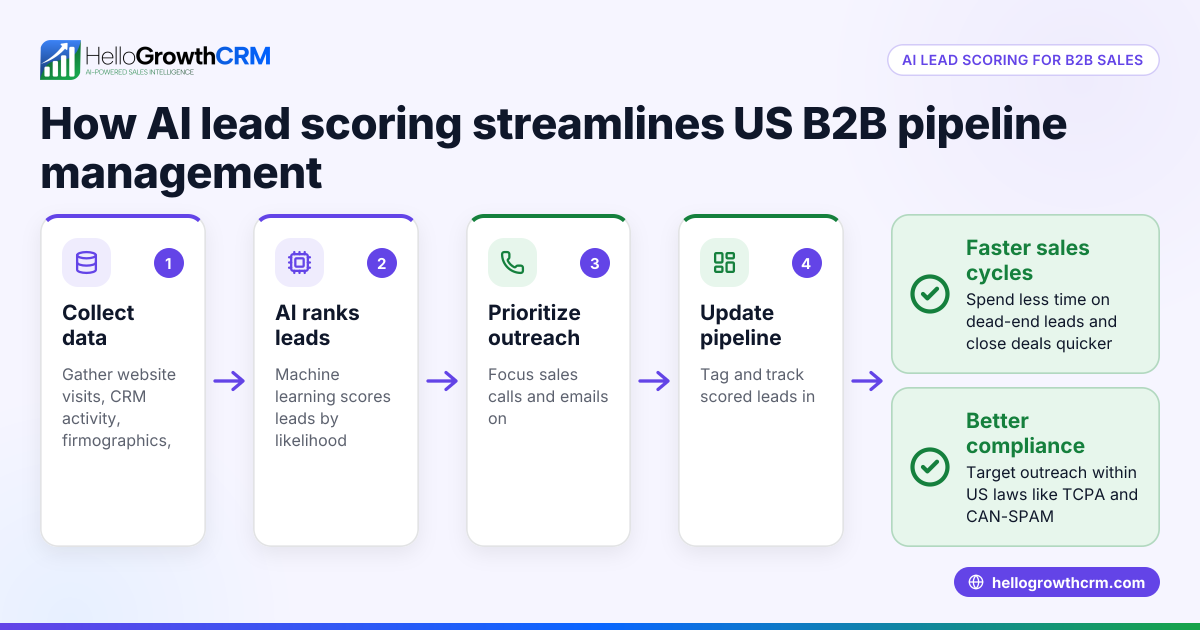
Credit card transaction data can revolutionize how US B2B sales teams score leads by providing timely, behavior-based insights into a prospect's financial activities. When integrated with AI-driven CRM tools, this data helps sales teams prioritize the hottest prospects who demonstrate real purchasing intent, enhancing pipeline management and closing deals faster.
Key takeaways - Credit card transaction data offers real-time insights into a business’s spending patterns and financial stability. - Integrating transaction data with AI in your CRM leads to more accurate, dynamic lead scoring. - US B2B sales teams benefit from combining transaction data with traditional fields to fine-tune pipeline priorities. - Compliance with US laws like CAN-SPAM and TCPA is essential when using transaction-based insights for outreach. - Sales automation driven by enriched data reduces manual qualification work and accelerates sales cycles. - HelloGrowthCRM supports seamless integration of credit card transaction data into AI lead scoring and forecasting.
Why is credit card transaction data valuable for US B2B sales teams?
Traditional lead scoring relies heavily on static business data such as company size, industry classification, or location. But these factors do not always indicate if a company has an immediate need for your products or services. Credit card transaction data fills this gap by providing current information on what a business is actually purchasing.
For example, consider a manufacturing company in Detroit whose credit card transactions show steady purchases from industrial equipment vendors. This implies ongoing capital investment and an active vendor relationship, signaling buying intent relevant to your offering. If your company supplies industrial automation solutions, this actionable insight lets you focus on leads where your product fits current purchasing behavior.
Furthermore, transaction data shows not only categories but also spending velocity. A Chicago-based IT firm increasing monthly software license payments may be scaling operations or adopting new technology — a prime opportunity for sales outreach.
This behavioral data reduces reliance on assumptions and guesswork, minimizing wasted effort on leads unlikely to convert. Instead, sales teams can target prospects with proven financial activity linked to your products or services, improving close rates and shortening sales cycles.
How can credit card transaction data be integrated into a CRM lead scoring model?
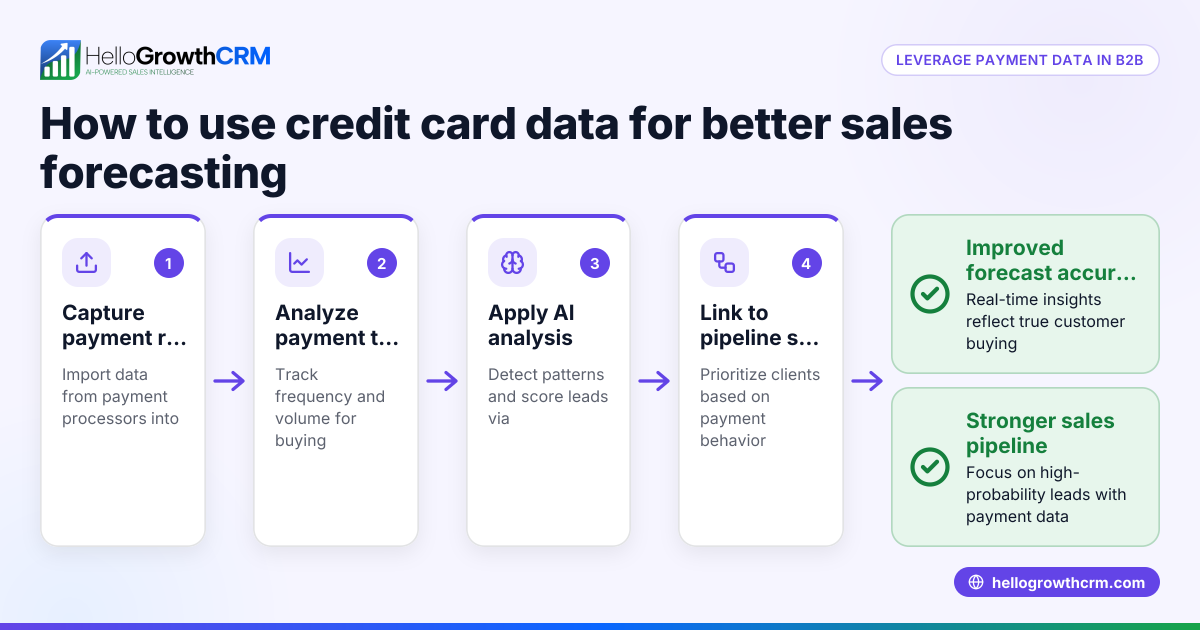
Incorporating transaction data into your CRM requires data acquisition and intelligent processing. Here’s a practical step-by-step approach:
- Data Acquisition
- Partner with US-based fintechs or authorized credit card data aggregators who provide anonymized business transaction data.
- Ensure these providers can filter and aggregate data for B2B spending relevant to your sales markets.
- Verify SOC 2 compliance and data privacy certifications before onboarding. - Data Cleansing and Normalization
- Map transaction records to your existing CRM accounts based on identifiers such as business name, address, or tax ID.
- Cleanse data to remove duplicates, normalize vendor names, and standardize spending categories.
- Address data gaps or latency, noting that transaction data may lag 24-72 hours depending on the source. - Feature Extraction
- Identify key spend attributes influencing buying signals, including:
- Total monthly spend within relevant vendor categories (e.g., office supplies, software subscriptions).
- Frequency and recency of transactions indicating active purchasing.
- Spend growth trends over past months, highlighting scaling businesses.
- Extract features suitable for AI analysis, avoiding personally identifiable information (PII). - AI Enrichment and Model Integration
- Feed cleaned transaction features into an AI-powered lead scoring model.
- Combine transaction signals with traditional CRM data like industry, company size, and past engagement.
- Apply machine learning algorithms to weigh spending patterns and predict purchase intent dynamically. - Lead Score Update and Automation
- Automatically refresh lead scores in your CRM based on the latest transaction behavior.
- Use updated scores to trigger sales workflows such as automated email outreach, task assignment, or call reminders.
HelloGrowthCRM’s AI lead scoring functionality streamlines these steps by ingesting transaction data alongside traditional fields. The platform continuously adapts scores to reflect emerging buyer signals, helping sales teams prioritize effectively.
Worked example: Lead scoring update with transaction data
Imagine a Houston-based software reseller's lead profile with these attributes:
- Company size: 150 employees
- Industry: Finance
- Recent interactions: One downloaded whitepaper three months ago
- Credit card transactions show increasing monthly spend on cloud infrastructure services (+20% over three months).
Using AI enrichment, the model factors the transaction trend as a strong buying signal. The lead’s score increases from 50/100 to 75/100, prompting a sales rep to initiate contact proactively. This targeted approach is far more effective than relying solely on demographic data or historic engagement.
What privacy and compliance considerations apply when using this data?
Handling credit card transaction data in US B2B sales demands strict compliance with privacy and outreach regulations:
- Data Anonymization and Aggregation
Sales teams never receive raw cardholder data. Instead, they access anonymized or aggregated spending signals provided by vetted vendors. This reduces privacy risks and meets standards such as SOC 2 cybersecurity controls. - CAN-SPAM Compliance
When outreach results from transaction data insights, all marketing emails must provide clear opt-out mechanisms. Content should not be misleading and must include accurate sender identification. - Telephone Consumer Protection Act (TCPA)
Automated or prerecorded calls and certain texts require prior express written consent. When transaction data triggers calls or texts, contact teams should follow TCPA consent rules carefully. - Vendor Due Diligence
Partner only with providers legally authorized to share transaction data and whose practices meet US data privacy expectations. - Internal Controls and Documentation
Maintain a compliance checklist detailing data sources, consent processes, and communication opt-out tracking.
Failing to comply risks legal penalties and damages the company’s reputation, especially with tightening US data privacy enforcement.
How does AI credit card data improve lead scoring accuracy compared to traditional methods?
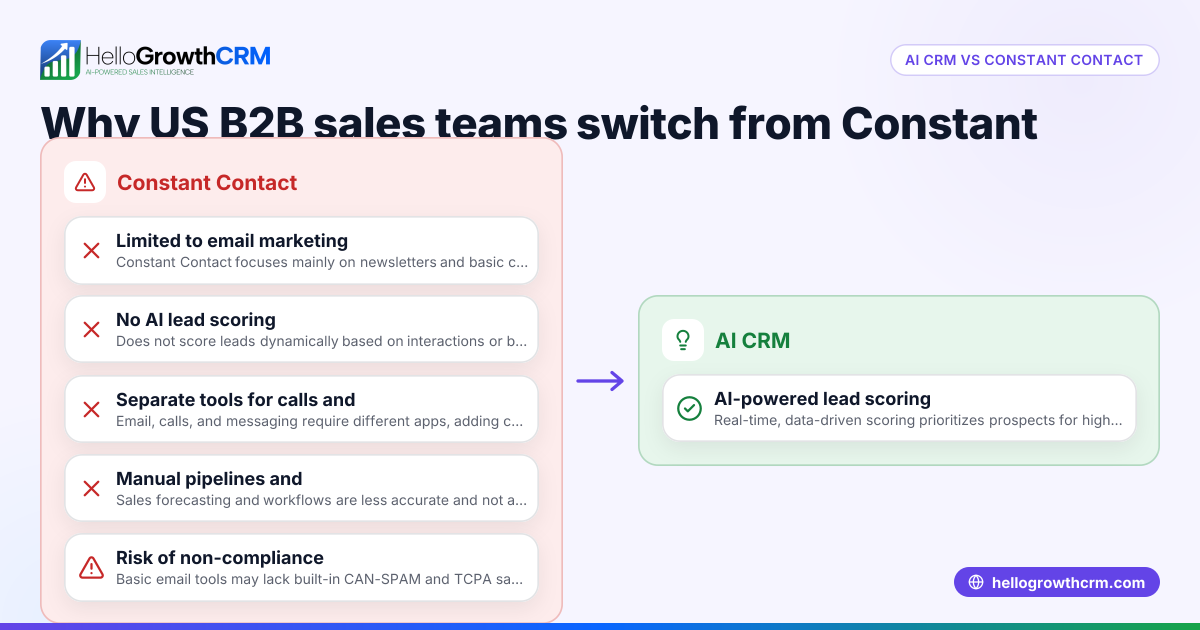
Traditional lead scoring often depends on static factors: firmographics like company size or location, and interaction history—the usual suspects in CRM fields. While useful, these metrics rarely capture current intent or financial capacity to buy.
AI credit card transaction data adds a dynamic, behavior-driven dimension:
- Real-time Spending Activity
Rather than assuming buying interest based on sector, AI models analyze actual purchase transactions, showing what the lead is spending money on right now. - Spend Velocity and Patterns
Increasing spending in relevant categories indicates growth and potential budget availability. - Category Relevance
Purchases linked to your product’s industry (e.g., recurring software subscriptions for SaaS vendors) reveal higher intent than generic firmographics. - Reduced False Positives
Leads that meet demographic thresholds but lack buying signals get lower scores, focusing sales efforts on genuinely active clients.
For example, a Detroit industrial supplier previously scored highly by industry criteria but with zero relevant purchases now scores lower. Conversely, a Chicago IT service with rising cloud transaction volume gets a boost.
This dynamic scoring improves sales efficiency by focusing outreach on leads truly “in-market,” decreasing time spent chasing cold prospects.
How can I start using credit card transaction data with HelloGrowthCRM?
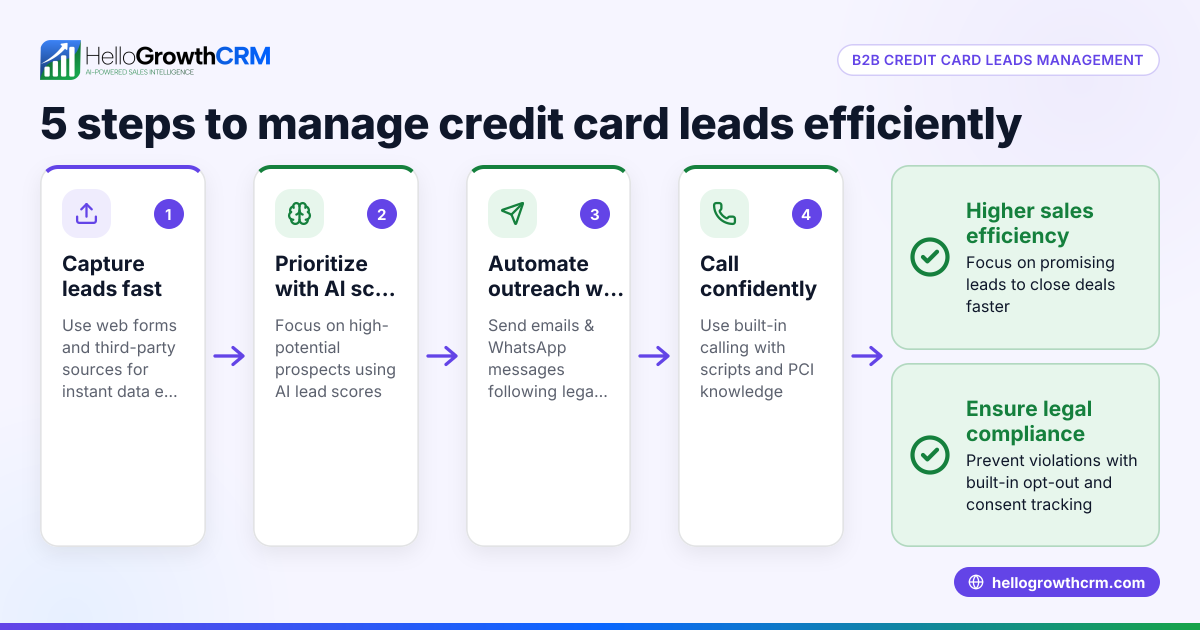
Integrating credit card transaction data with HelloGrowthCRM’s AI tools is designed to be straightforward:
- Discover Compatible Integrations
Visit the platform’s integrations page to explore supported data providers and connect your HelloGrowthCRM account. - Activate AI Lead Scoring
Enable AI-powered lead scoring from your CRM settings. This initiates continuous enrichment of lead profiles with transaction signals. - Configure Automated Workflows
Set up sales triggers based on lead score thresholds, including campaign enrollments, outbound calling sequences, or personalized email outreach using HelloGrowthCRM’s email automation features. - Leverage Managed RevOps Support
Allow HelloGrowthCRM’s managed RevOps team to assist with mapping transaction data fields, establishing compliance checks, and optimizing workflows for your sales process. - Monitor and Optimize
Use in-platform reporting to track how transaction-informed lead scores improve conversion rates, refining thresholds based on results.
Starting with a pilot group of leads can help measure tangible benefits before full rollout.
How does this approach affect sales forecasting?
Sales forecasting depends greatly on the accuracy of lead qualification and pipeline health. Incorporating credit card transaction data into AI lead scoring makes these factors more reliable:
- Improved Pipeline Quality
Leads with strong spending signals get appropriately weighted higher, reflecting genuine revenue potential. - Better Predictive Accuracy
AI models estimate win probabilities based on spending patterns, reducing guesswork. - Shortened Sales Cycles
By identifying actively buying prospects, forecasting includes deal velocity improvements. - City-Specific Insights
For sales leaders managing territories in places like Houston or Chicago, enriched forecasting accounts for regional market dynamics as reflected in transaction trends.
HelloGrowthCRM integrates these AI-enriched scores directly into its sales forecasting tools, delivering data-driven revenue projections. This helps sales managers plan resource allocation and quota adjustments with greater confidence.
What are the biggest challenges in using credit card transaction data for CRM?
While the benefits are significant, several challenges arise:
- Data Accuracy and Timeliness
Transaction data may be incomplete or delayed. Relying on stale data risks misprioritizing leads. Continuous data validation routines are necessary. - Integration Complexity
Connecting external data providers with your CRM demands technical expertise. Data normalization and mapping require care. - Maintaining Regulatory Compliance
Violating privacy or outreach laws can incur penalties. Sales and marketing teams must understand legal boundaries. - Data Overload
High-volume transaction streams risk overwhelming CRM users if not appropriately filtered or scored. - Cost and Vendor Selection
Choosing compliant and reliable data providers involves cost considerations and due diligence.
Choosing a CRM platform like HelloGrowthCRM that couples AI-driven scoring with managed RevOps support addresses these hurdles. The platform provides secure integration options, automated cleaning, ongoing data enrichment, and built-in compliance workflows to help US businesses maximize value with peace of mind.
Using credit card transaction data for CRM lead scoring unlocks powerful real-time buying intent insights for US B2B sales teams. Combined with AI-driven scoring and sales automation, this approach improves lead qualification, accelerates outreach, and sharpens sales forecasting accuracy. To start transforming your sales pipeline today, launch your free trial or book a demo of HelloGrowthCRM.
Frequently asked questions
What is credit card transaction data for CRM?
It is aggregated information about business spending captured from credit card transactions. When integrated into CRMs, it enriches lead profiles by showing actual purchasing behaviors, helping sales teams identify prospects with active buying intent.
Is credit card transaction data legal to use for sales prospecting?
Yes, provided it is obtained from authorized vendors who supply anonymized or aggregated data. Sales outreach must comply with US laws like CAN-SPAM for emails and TCPA for calls and texts, ensuring proper consent and opt-out options.
How does AI credit card data enhance lead scoring in HelloGrowthCRM?
HelloGrowthCRM’s AI models analyze spending trends found in transaction data alongside traditional firmographics. This dynamic insight refines lead scores regularly, emphasizing leads increasing relevant purchases and improving sales prioritization.
Can credit card transaction data improve sales forecasting?
Indeed. Since forecasting depends on pipeline quality, using actual spending signals to weight lead scores makes forecasts more accurate and dependable, reflecting real potential revenue.
What integrations are needed to use this data in HelloGrowthCRM?
You connect HelloGrowthCRM with compatible payment data providers through its integrations framework. This enables automatic data enrichment and AI-based scoring.
How do I ensure compliance with privacy laws when using transaction data?
Work only with SOC 2-compliant vendors who anonymize data sets. Follow CAN-SPAM rules for email marketing and TCPA requirements for calls and texts. Always track consent and provide clear opt-out mechanisms during outreach.
Read next
This article covers one part of a bigger topic. For the complete picture, read our guide to credit card.
Frequently Asked Questions
Ready to put this into practice?
Set up your pipeline, WhatsApp follow-ups, and AI lead scoring in minutes — free, no credit card.
Try HelloGrowthCRM freeGet CRM tips in your inbox
Join thousands of sales professionals who get weekly insights on CRM strategy, AI automation, and pipeline optimization.

The HelloGrowthCRM team publishes guides on CRM strategy, AI sales tools, and revenue operations for small business sales teams.