HelloGrowthCRM software
Built for real small-business sales teams
HelloGrowthCRM helps reps qualify faster, follow up on time, and close more deals—with practical automation in one place.
- AI lead scoring and pipeline visibility
- Built-in dialer, WhatsApp, and email automation
- Sales forecasting and RevOps-ready reporting
International buyer leads can be valuable for US B2B sales teams, but they need tighter qualification and smarter routing than domestic leads. The goal is simple: identify which international prospects can actually buy from a US company, send them to the right rep fast, and avoid wasting time on deals that will stall in legal, finance, or operations.
Key takeaways
- International buyer leads should be qualified on fit, buying ability, time zone, language, and US selling readiness.
- Routing rules should use territory, product line, deal size, compliance risk, and handoff speed.
- A good CRM should capture source, region, buying signals, and required follow-up steps in one place.
- Sales and RevOps should agree on clear disqualification reasons, not just lead scores.
- AI can help prioritize international buyer leads, but human review still matters for edge cases.
- Fast response matters, especially when leads come in outside your normal US business hours.
Why international buyer leads need a different process
Many US B2B teams treat all inbound leads the same way. That creates problems when the buyer is outside your normal selling motion.
International buyer leads often bring extra variables. The contact may work in a very different time zone. Their company may need vendor paperwork early. Payment terms may need more review. Product access, implementation support, or contract approval may take longer than your normal process.
That does not mean these leads are low quality. It means your team needs a qualification and routing process built for them.
For a US business, the first question is not just, "Is this a good fit?" The better question is, "Can we realistically sell, contract, onboard, and support this account from the United States?"
If your CRM does not capture that answer early, reps waste time chasing meetings that never become revenue.
What should US sales teams check first?
Start by checking whether the lead can buy from your US company, fit your ideal customer profile, and move through your actual sales process. If those answers are unclear, the lead should go to a review queue, not straight to a rep.
Under that quick screen, build a consistent first-pass process. This is where many teams lose good leads. One rep books every meeting. Another rep ignores the same type of account. RevOps needs to remove that guesswork.
The five first-pass qualification checks
- Business fit
Confirm the company matches your target segment. Check industry, company size, use case, and likely contract value. - Buyer role
Find out whether the contact can influence or approve the purchase. A researcher or junior coordinator may be useful, but they should not be treated like a sales-ready opportunity. - US selling readiness
Verify that your US team can legally and operationally sell to this account. This includes contract flow, support coverage, and finance process. - Urgency and intent
Separate active buyers from passive interest. Demo requests, pricing page visits, or implementation questions usually signal stronger intent. - Practical sales friction
Look for issues that may slow the deal. Common examples include missing phone numbers, unclear time zones, no business email, or vague project ownership.
A strong CRM intake form and lead enrichment process can gather most of this data before a rep ever touches the lead.
How should you qualify international buyer leads?
Qualify international buyer leads by asking whether the account fits your offer, can buy from a US vendor, has a real buying motion, and can be supported by your team. Then score urgency and route based on the next best action, not just geography.
That short answer matters because most teams overfocus on country or region and underfocus on deal viability. Good qualification looks at commercial reality first.
Build a qualification framework your reps can actually use
Most qualification systems fail because they ask reps to remember too much. Keep your framework short and tied to real sales decisions.
Use these fields in your CRM:
- Company name
- Website
- Buyer role
- Industry
- Employee count or revenue band
- Product interest
- Source channel
- Time zone
- Preferred contact method
- Need for procurement or security review
- Estimated deal size
- Target go-live date
- Qualification status
- Routing owner
- Disqualification reason
Those fields should support action. For example, if a lead requests a fast rollout but your support team cannot cover the needed hours, that should affect routing.
Questions reps should ask early
Your team does not need a long script. It needs the right questions.
Ask:
- What problem are you trying to solve?
- What team will use the product?
- What timeline are you working against?
- Who else is involved in approval?
- Have you bought from a US software or services vendor before?
- Will procurement, legal, or security review be required?
- What does implementation need to look like on your side?
These questions surface fit and friction at the same time. That is much more useful than collecting generic discovery notes.
Add qualification rules for finance and operations
A lead can look strong on paper and still be a poor fit for your current operation. This is why RevOps should help define qualification rules.
Examples include:
- Minimum expected deal size for rep-assisted sales
- Product lines available for cross-border delivery
- Required payment method support
- Contract review thresholds
- Support hour limitations
- Need for SOC 2 documentation during the deal cycle
In US B2B sales, those details often decide whether a lead should go to an account executive, sales development rep, channel team, or manual review queue.
What data should your CRM capture before routing?
Your CRM should capture enough lead data to decide owner, priority, and next step without making the rep do detective work. At minimum, store source, intent, company fit, buyer role, region, time zone, and any known legal, security, or payment friction.
That summary is important because routing fails when data is incomplete. If your form only collects name, email, and company, routing becomes guesswork.
The minimum routing dataset
Before routing international buyer leads, try to capture:
- Lead source
- First conversion page
- Product or service interest
- Company headquarters location
- Contact time zone
- Business email domain
- Annual revenue or employee range
- Number of expected users
- Requested timeline
- Demo or trial request status
- Notes on procurement or vendor onboarding
- Language preference if relevant to your team
- Existing systems, such as QuickBooks, Stripe, or an ERP
If you use integrations, connect form fills, ad platforms, email engagement, and meeting activity so the record updates automatically.
Why source quality matters more than volume
Not all international buyer leads come with the same intent. A partner referral usually behaves differently from a list upload or a broad content download.
Your CRM should track source patterns over time:
- Which sources lead to booked meetings
- Which sources lead to qualified pipeline
- Which sources create long legal or finance delays
- Which regions show stronger close rates
- Which products travel best across your target markets
This helps RevOps tighten routing rules and reduce false positives.
Build a routing system that matches how your team sells
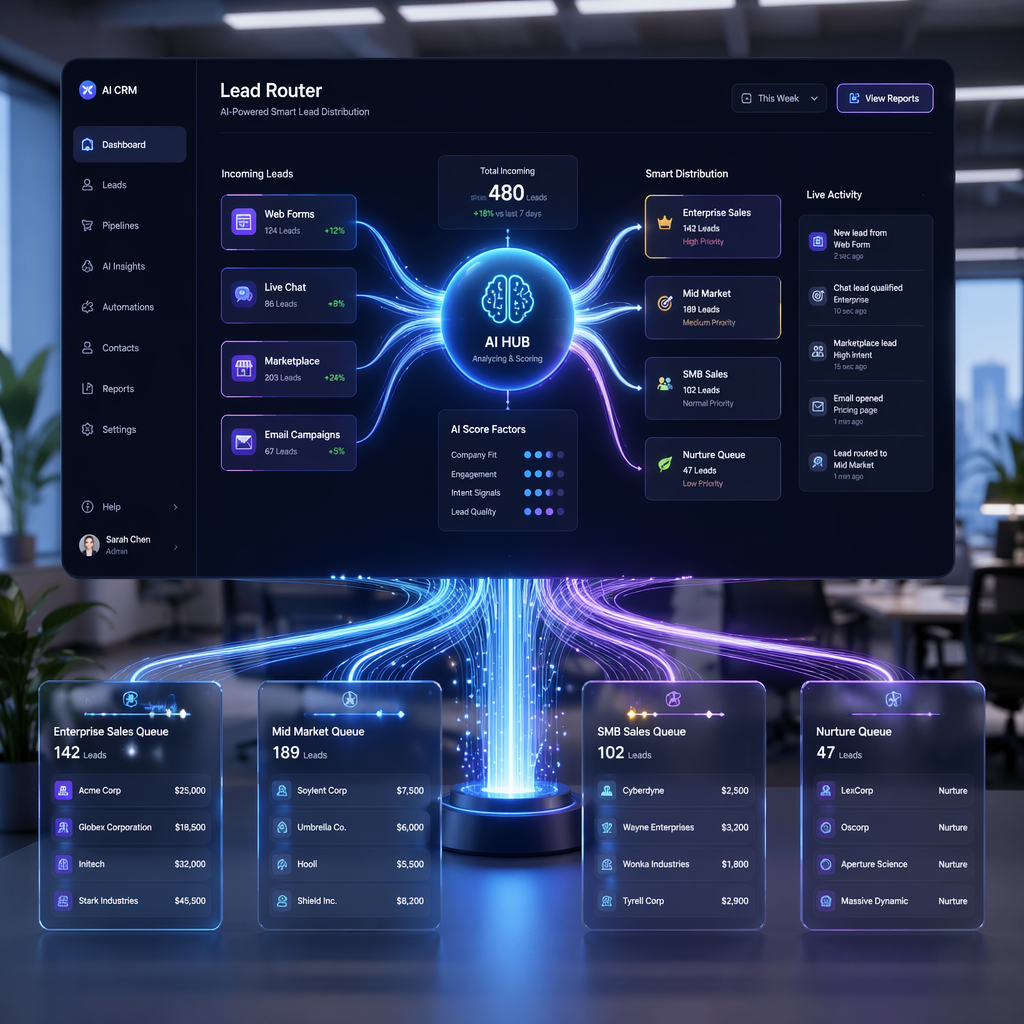
Routing should send each lead to the person or queue most likely to move it forward. That sounds obvious, but many US teams still route only by geography or company size.
A better model uses multiple layers.
Step 1: Route by sales motion
Start with the right motion:
- Self-serve or low-touch for small accounts with clear intent.
- SDR qualification for medium-fit leads that need more validation.
- AE direct routing for high-intent, high-value opportunities.
- Ops or review queue for leads with compliance, payment, or support questions.
- Partner or channel routing if your business uses indirect sales.
This keeps expensive rep time focused on the best opportunities.
Step 2: Add business rules
Then apply your routing logic:
- By estimated deal size
- By product line
- By account segment
- By buyer type
- By time zone coverage
- By strategic account list
- By named account ownership
- By language support availability
This is where CRM automation becomes useful. An AI CRM can help combine fit, intent, and operational data so routing happens faster.
Step 3: Create a manual review path
Some leads should never be auto-assigned. Give RevOps or a sales manager a review queue for:
- Incomplete lead records
- Conflicting account ownership
- High-risk contract requirements
- Very large potential deals
- Requests involving custom security review
- Buyer records that look suspicious or duplicate
Manual review prevents bad assignments that hurt conversion and internal trust.
Where AI helps and where it does not
AI is useful for sorting, scoring, and recommending next actions on large volumes of international buyer leads. It is less useful when your team has not defined qualification criteria, ownership rules, or disqualification reasons.
In other words, automation works best after process design.
Good AI use cases
A practical ai international buyer workflow can help your team:
- Score intent based on behavior
- Detect likely company size and segment
- Flag missing fields
- Recommend owner based on past conversions
- Summarize lead context for the rep
- Suggest follow-up times based on time zone
This can reduce response times and improve rep focus. Tools like AI lead scoring are most helpful when paired with clear routing rules.
Where human judgment still matters
Keep people involved when the lead needs judgment across teams. For example:
- Security review expectations are unclear
- The buyer wants unusual terms
- The product fit is real, but support requirements are heavy
- Account ownership is disputed
- The lead may belong in enterprise, channel, or customer expansion
AI should support decisions, not hide them.
How fast should US teams respond to international buyer leads?
US teams should respond as fast as possible, ideally within the same business day, and faster for demo requests or high-intent forms. If a lead arrives outside US business hours, use automation to confirm receipt and schedule the next step immediately.
Speed matters because international buyer leads often compare vendors quickly. A slow response can feel like a lack of readiness.
Set response standards by lead type
Use simple service levels:
- Demo request: immediate confirmation and rep follow-up fast.
- Pricing request: routed same day to a qualified owner.
- Contact us form: triaged quickly based on fit and intent.
- Content lead: enrolled in nurture unless high-intent signals appear.
With email automation, you can send a useful confirmation message without pretending a rep is available live.
Do not confuse speed with pressure
Fast does not mean aggressive. The first touch should:
- Confirm the request
- Set expectations
- Offer a booking option
- Ask one or two useful qualifying questions
- Avoid long sales copy
That creates momentum without turning off serious buyers.
Common mistakes US B2B teams make
Routing everything by region alone
Region matters, but it is not enough. A small, unclear lead in one region may be weaker than a large, urgent lead somewhere else.
Letting reps invent their own rules
When qualification happens in each rep's head, pipeline quality becomes inconsistent. RevOps should define common stages and disqualification reasons.
Ignoring operational fit
A lead is not qualified just because it wants a demo. If finance, onboarding, or support cannot handle the account, routing should reflect that reality.
Missing compliance and outreach basics
If your team follows up by email or phone, your process should respect US rules like CAN-SPAM and TCPA where they apply. This is especially important when automation is involved.
Measuring only meeting volume
The real metric is qualified pipeline and close potential. High meeting counts can hide poor routing.
A simple operating model for Sales and RevOps
If you want a cleaner process, assign clear ownership.
Sales leadership owns
- Qualification standards
- Rep response expectations
- Territory exceptions
- Enterprise escalation rules
RevOps owns
- CRM field design
- Routing logic
- Lead source tracking
- Duplicate management
- Reporting and dashboards
Finance and customer-facing operations advise on
- Payment process
- Contract friction
- Onboarding constraints
- Security documentation requests
- Support coverage
This shared model keeps lead handling practical.
What to measure each month
Track a small set of metrics first:
- International buyer leads by source
- Speed to first response
- Meeting booked rate
- Qualification rate
- Opportunity creation rate
- Pipeline created
- Win rate
- Average sales cycle
- Disqualification reasons
- Reassignment rate after first routing
If you already use forecasting, fold these opportunities into your sales forecasting process separately so you can spot conversion differences.
How HelloGrowthCRM can support the process
If your team is growing, the hardest part is not collecting more leads. It is making sure the right lead reaches the right person with enough context to act.
HelloGrowthCRM helps by combining lead capture, AI-assisted scoring, routing logic, pipeline visibility, and managed RevOps support in one system. That can help your team standardize qualification, reduce manual triage, and improve response time without creating a heavy admin burden. You can also review features to see how the workflow fits your sales process.
If you want a CRM your team will actually use for international buyer leads and everyday pipeline work, start a free trial or book a demo.
Frequently asked questions
Are international buyer leads usually lower quality than US leads?
Not necessarily. Some are excellent fits and move quickly. The key difference is that they often need more careful qualification around buying process, support, and operational fit.
Should every international buyer lead go to a senior rep?
No. High-value or high-complexity leads may need senior ownership, but many leads belong in an SDR or review queue first. Routing should match deal potential and sales complexity.
What is the best way to score international buyer leads?
Use a mix of fit, intent, and execution risk. A lead with strong buying signals but heavy operational friction should not be scored the same as one your team can close and onboard smoothly.
What should be an automatic disqualification reason?
Use reasons tied to business reality. Examples include no product fit, no realistic buying authority, unsupported implementation requirements, or inability to meet your standard contracting process.
Do I need separate CRM fields for international buyer leads?
Usually yes. You need enough data to route and qualify correctly. Time zone, support needs, procurement expectations, and source quality often matter more for these leads than for standard domestic inbound.
Read next
This article covers one part of a bigger topic. For the complete picture, read our guide to international buyer.
Frequently Asked Questions
Ready to put this into practice?
Set up your pipeline, WhatsApp follow-ups, and AI lead scoring in minutes — free, no credit card.
Try HelloGrowthCRM freeGet CRM tips in your inbox
Join thousands of sales professionals who get weekly insights on CRM strategy, AI automation, and pipeline optimization.

The HelloGrowthCRM team publishes guides on CRM strategy, AI sales tools, and revenue operations for small business sales teams.