HelloGrowthCRM software
Built for real small-business sales teams
HelloGrowthCRM helps reps qualify faster, follow up on time, and close more deals—with practical automation in one place.
- AI lead scoring and pipeline visibility
- Built-in dialer, WhatsApp, and email automation
- Sales forecasting and RevOps-ready reporting
Lead follow up automation means using software tools to send scheduled follow-up messages to leads automatically, across channels like SMS, WhatsApp, and email. The automation continues until the lead replies or converts, ensuring no lead is forgotten or delayed in the sales process. This article covers why small businesses need it, how to implement it in clear steps, a worked example with Indian figures, common pitfalls, and how HelloGrowthCRM helps with automated sequences, AI agents, and workflows.
Why this comes up / what goes wrong
Small and mid-sized business owners in India often struggle with timely lead follow-up. Leads come from multiple sources like IndiaMART, JustDial, or website forms and are tracked manually on spreadsheets or WhatsApp chats. Without automation, follow-up calls or messages are delayed or missed, causing lost sales opportunities. Sales teams waste time figuring out who to call next or what message to send. This leads to inconsistent customer experience and lower conversion rates. Automation helps by standardising and speeding up follow-up so leads are contacted promptly and persistently.
Step-by-step
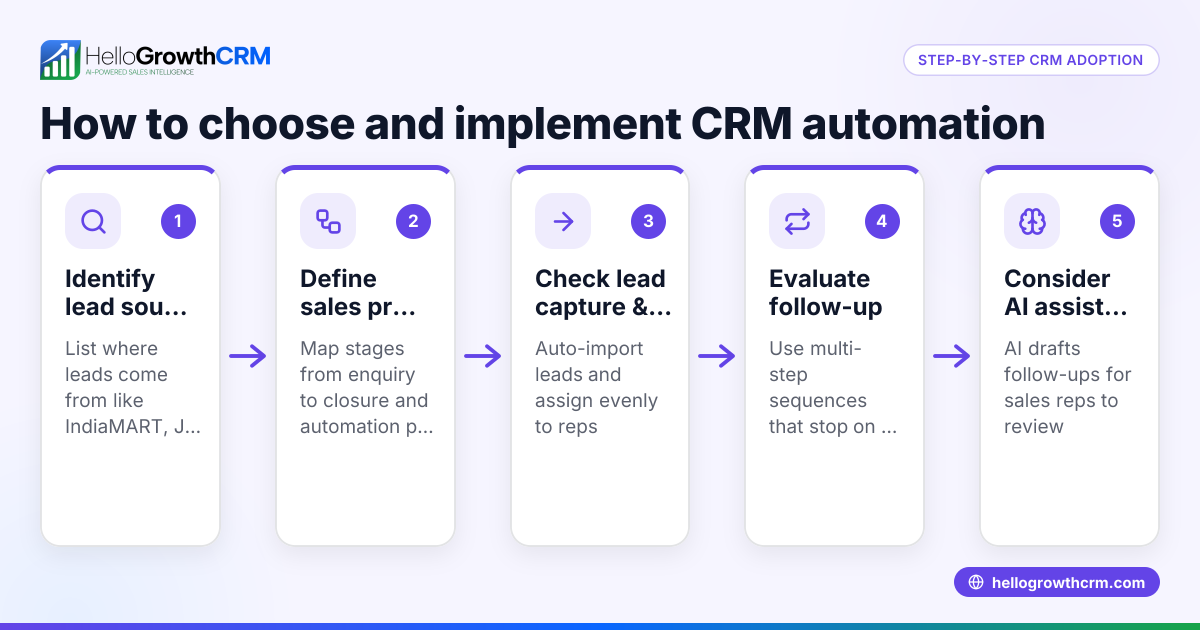
- Collect and centralise leads: Gather all leads from sources like IndiaMART, JustDial, and your website into one CRM or database to avoid losing any.
- Segment leads by source or priority: Group leads based on origin or quality to tailor follow-up sequences.
- Design a multi-step follow-up sequence: Plan a series of 4-5 messages spaced over 1-2 weeks using SMS, WhatsApp, or email.
- Set triggers and conditions: Configure automation to stop the sequence as soon as the lead replies or converts.
- Assign leads automatically: Use round-robin or territory-based rules to assign leads to sales reps evenly.
- Create follow-up tasks automatically: Generate reminders or call tasks linked to each lead for the sales team.
- Use AI to draft messages after calls: Let AI agents prepare follow-up drafts for reps to review and send quickly.
- Monitor and adjust sequences: Track open rates, replies, and conversions to improve messaging and timing.
Check that your automation integrates with your communication channels and CRM to ensure smooth operation. Also, verify data accuracy and timely lead assignment.
Example (fictional figures)
A Delhi-based small business receives 50 leads weekly from IndiaMART. They plan a 5-step SMS follow-up over 14 days, stopping if the lead replies.
- Week 1 leads: 50
- Follow-up messages per lead: 5
- Total messages sent if no replies: 50 × 5 = 250
Assuming a ₹2 per SMS cost:
₹2 × 250 = ₹500
If 20% of leads reply before all messages are sent, messages saved:
20% of 50 leads = 10 leads
Messages saved per lead (average 3 messages saved) = 10 × 3 = 30
Cost saved:
₹2 × 30 = ₹60
Net SMS cost:
₹500 - ₹60 = ₹440
This automation ensures all leads get timely follow-up, increasing chances of conversion while controlling messaging costs.
Common mistakes
- Not centralising leads: Leads scattered across WhatsApp, Excel, and emails cause missed follow-ups. Prevent by using a CRM that captures all leads in one place.
- Sending too many messages too fast: Overwhelming leads can annoy them. Space messages reasonably over 1-2 weeks.
- Not stopping automation on reply: Continuing to message a lead who already responded wastes effort and harms reputation. Use triggers to stop sequences immediately on reply.
- Manual lead assignment: This causes delays and uneven workload. Automate lead routing by round-robin or territory.
- Ignoring follow-up tasks: Without task reminders, reps may forget calls. Automate task creation for each follow-up.
- Not reviewing message drafts: Automated messages should be personalised and checked. Use AI agents to draft messages but review before sending.
Use WhatsApp and SMS CRM and sales task boards to avoid these mistakes.
Doing this in HelloGrowthCRM
HelloGrowthCRM offers sequences and campaigns that automate a five-step follow-up over two weeks and stop the moment the prospect replies. AI agents draft follow-up messages after calls, so reps only review and send them, saving time. Workflows and lead routing assign new IndiaMART enquiries round-robin and create first-call tasks automatically, ensuring no lead is missed or delayed. Learn more about these features at email automation and sequences and AI CRM.
Frequently asked questions
What is lead follow-up automation? Lead follow-up automation is software-driven scheduling and sending of follow-up messages to sales leads across channels like SMS, WhatsApp, and email. It runs multi-step sequences until the lead replies, improving response rates and saving sales effort.
How does SMS automation for lead follow-ups work? SMS automation sends pre-planned messages at set intervals to leads. The system tracks replies and stops messaging once the lead responds, ensuring timely and persistent contact without manual effort.
Can lead follow-up automation be used for leads from IndiaMART or JustDial? Yes, automation tools can capture leads from IndiaMART, JustDial, and web forms, assign them automatically to sales reps, and start follow-up sequences without manual input.
How do I prevent spamming leads with automation? Design your sequences with reasonable spacing between messages and always stop the sequence as soon as the lead replies. Personalise messages and avoid sending too many messages too fast.
Is lead follow-up automation suitable for small businesses in India? Yes, especially for SMBs with small sales teams who handle multiple leads daily, automation ensures no lead is forgotten and follow-ups happen promptly, increasing sales efficiency.
Key takeaways
- Lead follow up automation sends scheduled multi-step messages until the lead replies, preventing lost leads.
- Centralise leads from all sources and assign them automatically to sales reps.
- Use sequences spaced over days or weeks and stop immediately on lead response.
- Automate follow-up tasks and use AI to draft messages for faster sales action.
- Avoid common mistakes like manual lead assignment, ignoring replies, and over-messaging.
- HelloGrowthCRM supports these features with sequences, AI agents, and workflows for Indian SMBs.
Start automating your lead follow-ups today. Start on the Free Forever plan (200 leads, no credit card) to see how HelloGrowthCRM can help your team follow up faster and close more deals.
Ready to put this into practice?
Set up your pipeline, WhatsApp follow-ups, and AI lead scoring in minutes — free, no credit card.
Try HelloGrowthCRM freeGet CRM tips in your inbox
Join thousands of sales professionals who get weekly insights on CRM strategy, AI automation, and pipeline optimization.

The HelloGrowthCRM team publishes guides on CRM strategy, AI sales tools, and revenue operations for small business sales teams.