HelloGrowthCRM software
Built for real small-business sales teams
HelloGrowthCRM helps reps qualify faster, follow up on time, and close more deals—with practical automation in one place.
- AI lead scoring and pipeline visibility
- Built-in dialer, WhatsApp, and email automation
- Sales forecasting and RevOps-ready reporting
A lead scoring template helps small businesses rank their leads by assigning numerical values to key factors such as lead source, interaction level, company size, and budget. This prioritizes leads most likely to convert and prevents slow follow-up or missed opportunities. Below, you’ll find a practical, step-by-step lead scoring template tailored for Canadian small and mid-sized businesses, common mistakes to watch for, a worked example, and how HelloGrowthCRM supports lead scoring.
Why this comes up / what goes wrong
Many Canadian small-business owners rely on manual tracking of leads using spreadsheets, text messages, or email threads. This leads to slow or inconsistent follow-up and lost sales. Without a clear lead scoring system, teams waste time chasing low-value leads while hot prospects cool off. A ready-to-use lead scoring template provides a consistent, easy-to-apply method to prioritize leads and focus efforts where they matter most.
Step-by-step
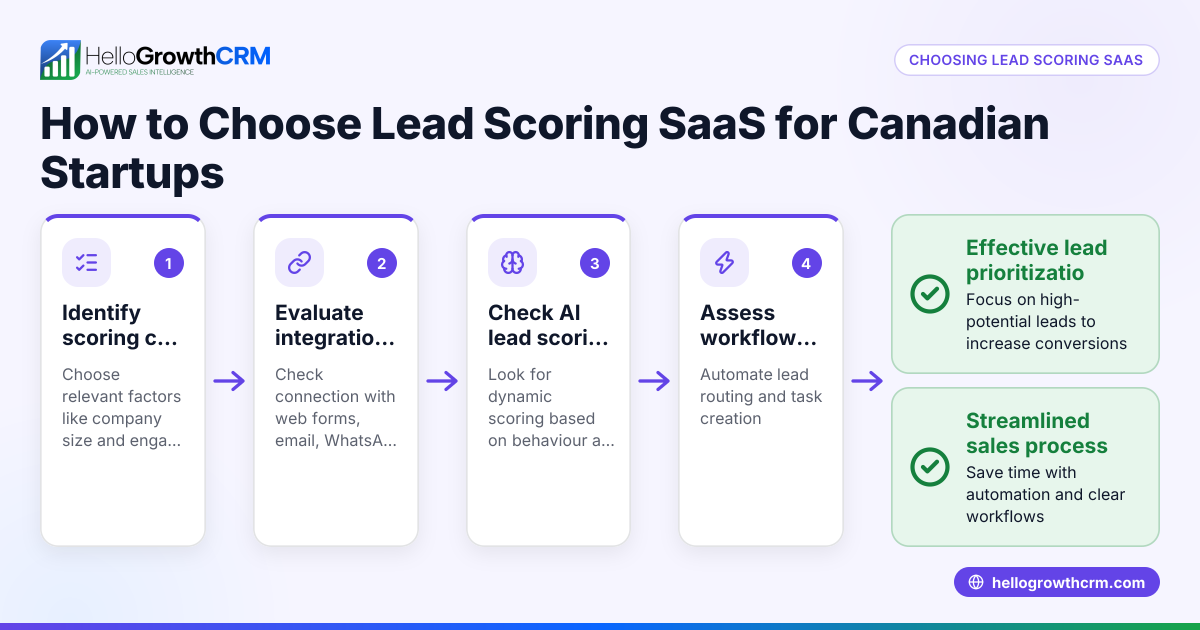
- Identify lead attributes to score: Choose criteria relevant to your business, such as lead source (website form, referral), company size, budget, timeline, and engagement level (calls, emails, WhatsApp messages). Check that each attribute is measurable and available.
- Assign point values: Allocate points based on impact on conversion likelihood. For example, a lead from a referral might get 10 points, a budget over C$50,000 gets 8 points, and recent engagement adds 5 points. Check that the total possible score is balanced.
- Create a scoring table: Build a simple table or spreadsheet listing attributes and point values. This is your lead scoring template. Check it is clear and easy for your team to use consistently.
- Set a threshold score: Decide the minimum score that qualifies a lead as “hot” or high priority. Check this threshold by reviewing past leads and outcomes.
- Apply the template to new leads: Score each incoming lead using the template. Check scores regularly and adjust points or thresholds based on results.
- Use scores to prioritise follow-up: Focus calls, emails, or WhatsApp messages on leads with the highest scores first. Check that your sales team understands and follows this prioritization.
- Review and update periodically: Lead behaviour and market conditions change. Check and refine your scoring template every 3-6 months for accuracy.
You can download free sales templates and calculators, including pipeline templates, from HelloGrowthCRM’s free sales tools and calculators.
Example (fictional figures)
A staffing agency in Halifax, Nova Scotia, scores leads based on source, company size, budget, and recent engagement.
| Attribute | Criteria | Points |
|---|---|---|
| Lead source | Referral | 10 |
| Website form | 7 | |
| Cold call | 3 | |
| Company size | 50+ employees | 8 |
| 10-49 employees | 5 | |
| <10 employees | 2 | |
| Budget | Over C$100,000 | 10 |
| C$50,000 to C$100,000 | 6 | |
| Under C$50,000 | 3 | |
| Engagement | Contacted in last 7 days | 5 |
| Contacted in last 30 days | 3 | |
| No recent contact | 0 |
A lead from a referral, with 60 employees, a budget of C$75,000, and contacted 5 days ago scores:
Lead source: Referral = 10 Company size: 50+ employees = 8 Budget: C$50,000 to C$100,000 = 6 Engagement: Contacted in last 7 days = 5 Total score = 10 + 8 + 6 + 5 = 29
If the threshold for hot leads is 20, this lead is high priority.
Common mistakes
- Overcomplicating the template: Too many criteria make scoring slow and inconsistent. Prevent by limiting to 4-6 key attributes.
- Using subjective criteria: Avoid vague factors like “lead looks interested.” Use measurable data such as form submissions or budget range.
- Not updating the template: Market and customer behaviour change. Prevent by scheduling regular reviews and adjustments.
- Ignoring low-scoring leads completely: Some low-scoring leads may convert later. Prevent by setting a secondary follow-up schedule.
- Failing to train the sales team: Without buy-in and understanding, scoring won’t be applied correctly. Prevent by training and sharing the scoring template clearly.
- Relying solely on manual scoring: Manual updates can cause delays and errors. Prevent by using tools with AI lead scoring to automate prioritization.
Doing this in HelloGrowthCRM
HelloGrowthCRM captures every enquiry from web forms, calls, or WhatsApp directly as a lead with an assigned owner and next step, avoiding lost leads in notebooks. Its AI lead scoring feature helps telecallers focus on leads most likely to convert first, streamlining follow-up. You can also download free sales templates and calculators, including follow-up cadences and pipeline templates, without needing an account. Learn more about AI lead scoring, explore free sales tools and calculators, or browse sales templates.
Frequently asked questions
What is a lead scoring template? A lead scoring template is a structured format that assigns points to leads based on specific criteria like budget, company size, and engagement. It helps sales teams prioritize leads that are more likely to convert.
How do I choose criteria for my lead scoring template? Select criteria that reflect your sales process and customer behaviour, such as lead source, budget, company size, and recent contact. Ensure these are measurable and consistently available for each lead.
How often should I update my lead scoring template? Review and adjust your lead scoring template every 3 to 6 months to reflect changes in market conditions or sales results. Regular updates keep scoring accurate and effective.
Can I automate lead scoring? Yes, tools like HelloGrowthCRM offer AI lead scoring that automatically ranks leads by likelihood to convert, saving time and reducing errors compared to manual scoring.
What if some low-scoring leads still convert? Not all low-scoring leads should be ignored. Set a secondary follow-up plan for these leads to capture late conversions without diverting focus from hot leads.
Key takeaways
- Use a simple, measurable lead scoring template with 4-6 key criteria.
- Assign clear point values and set a threshold for hot leads.
- Regularly review and update your scoring template.
- Train your sales team to apply scoring consistently.
- Avoid ignoring low-scoring leads completely.
- Consider AI lead scoring with HelloGrowthCRM to automate prioritization.
Start prioritizing your leads efficiently today. Start on the Free Forever plan (200 leads, no credit card) with HelloGrowthCRM and use AI lead scoring to call your best leads first.
Ready to put this into practice?
Set up your pipeline, WhatsApp follow-ups, and AI lead scoring in minutes — free, no credit card.
Try HelloGrowthCRM freeGet CRM tips in your inbox
Join thousands of sales professionals who get weekly insights on CRM strategy, AI automation, and pipeline optimization.

The HelloGrowthCRM team publishes guides on CRM strategy, AI sales tools, and revenue operations for small business sales teams.