HelloGrowthCRM software
Built for real small-business sales teams
HelloGrowthCRM helps reps qualify faster, follow up on time, and close more deals—with practical automation in one place.
- AI lead scoring and pipeline visibility
- Built-in dialer, WhatsApp, and email automation
- Sales forecasting and RevOps-ready reporting
Machine learning lead scoring is a method that uses AI algorithms to analyse data from your leads and assign each a score representing their probability to become customers. This score helps sales teams prioritise follow-up calls and messages, improving conversion rates and saving time.
Why this comes up / what goes wrong
Many Indian small-business owners struggle with managing numerous leads coming from multiple sources like IndiaMART, JustDial, WhatsApp, and web forms. Without a clear system, leads get lost, follow-ups slow down, and sales opportunities slip away. Traditional manual scoring or gut feeling often leads to calling less promising leads first, wasting effort and reducing sales efficiency. Machine learning lead scoring automates and improves this prioritisation based on patterns in your own sales data.
Step-by-step
- Collect and Organise Lead Data
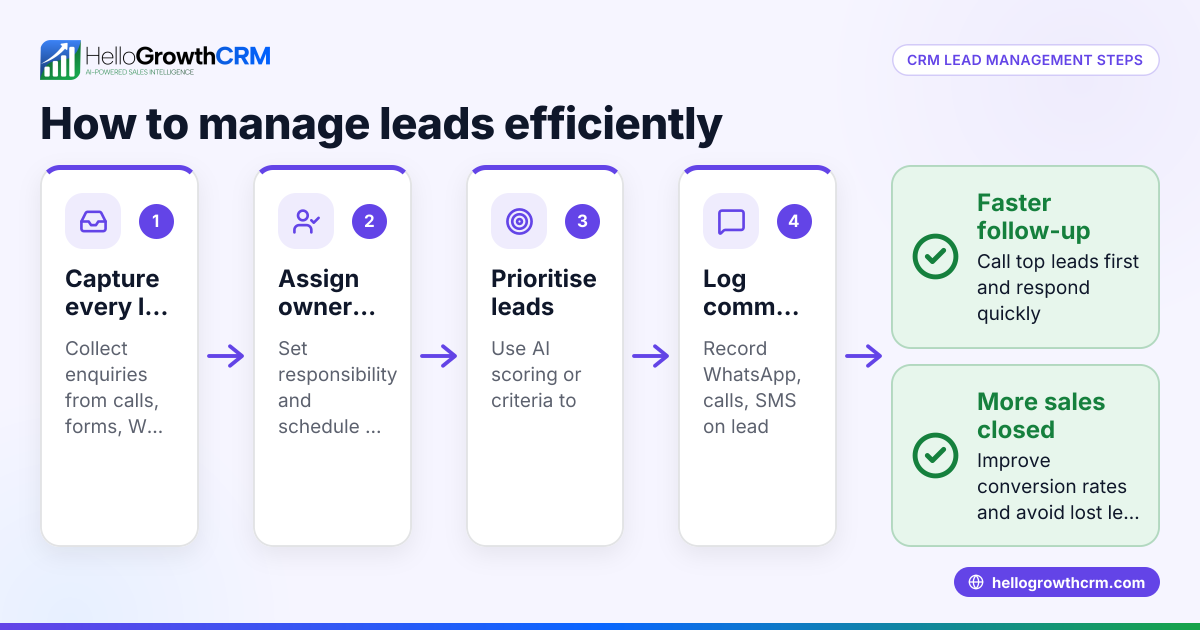
- Gather lead information from all channels such as enquiry forms, calls, and WhatsApp messages.
- Check that each lead has key details like contact info, enquiry source, product interest, and past interactions.
- Integrate Data into a CRM
- Use a CRM system that captures every enquiry as a lead with an assigned owner and next step.
- Verify that leads are not scattered in notebooks or spreadsheets but are centrally stored.
- Set Up Machine Learning Lead Scoring
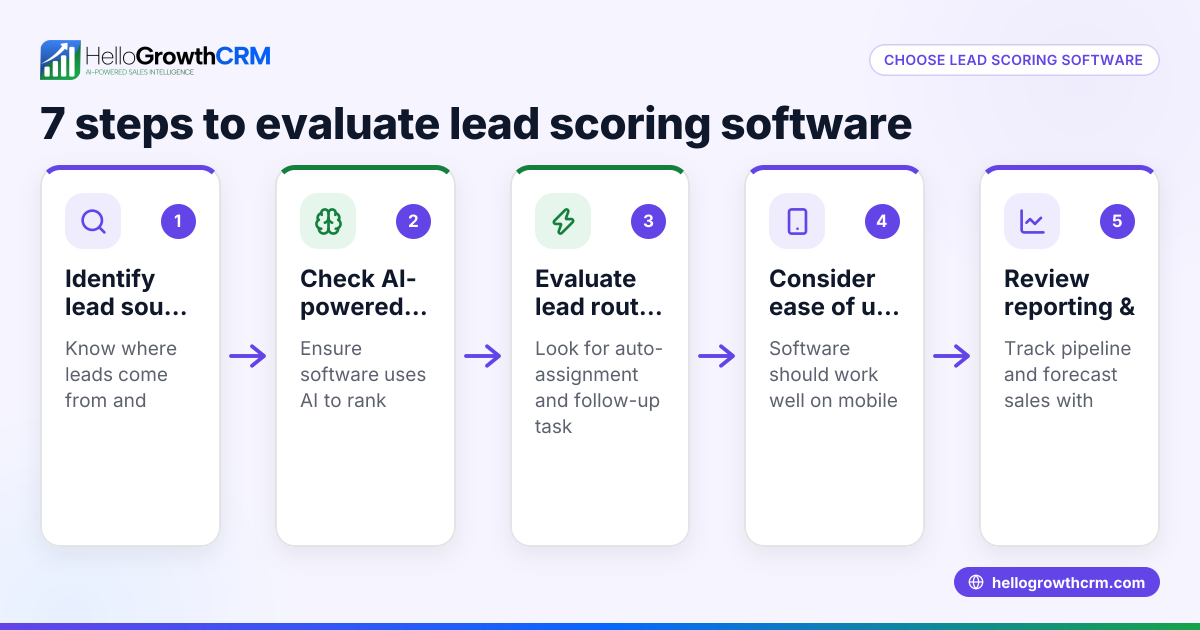
- Enable AI lead scoring in your CRM to automatically analyse lead attributes and behaviour.
- Confirm the system scores leads based on likelihood to convert, prioritising high-potential leads.
- Automate Lead Assignment and Follow-up Tasks
- Use workflows and lead routing rules to assign leads automatically to sales reps based on score, source, or territory.
- Ensure the system creates follow-up tasks like first-call reminders immediately after lead capture.
- Train Your Sales Team
- Educate telecallers and sales staff to focus on calling leads with the highest AI score first.
- Monitor their follow-ups and update lead statuses in the CRM.
- Review and Adjust
- Regularly check lead scoring effectiveness by comparing scores with actual conversions.
- Tweak scoring parameters or data inputs if needed to improve accuracy.
- Use Reporting and Forecasting Tools
- Analyse sales pipeline reports to understand lead quality trends and forecast revenue.
- Use insights to refine marketing and sales strategies.
Example (fictional figures)
A Mumbai-based manufacturer receives 1,000 leads monthly from IndiaMART and web forms. They use machine learning lead scoring to prioritise calls.
- Total leads: 1,000
- AI scores classify 200 leads as high priority (score > 80)
- Conversion rate for high-priority leads: 20%
- Average order value: ₹50,000
Calculations:
High-priority leads expected to convert = 200 × 20% = 40
Expected revenue from high-priority leads = 40 × ₹50,000 = ₹20,00,000
If the sales team called leads randomly without scoring, the conversion rate might be 5%:
Expected conversions without scoring = 1,000 × 5% = 50
But calling all leads takes more time and effort than focusing on 200 high-priority leads.
This example shows machine learning lead scoring helps focus resources on leads that bring higher revenue faster.
Common mistakes
- Ignoring Data Quality: Poor or incomplete lead data reduces scoring accuracy. Prevent by validating lead fields on capture.
- Not Using a Central CRM: Leads scattered in notebooks or Excel cause missed follow-ups. Prevent by using a CRM that captures and organises leads automatically.
- Overlooking Sales Team Training: Without training, telecallers may ignore scores. Prevent by educating teams on using AI scores to prioritise calls.
- Not Automating Lead Routing: Manual assignment delays follow-ups. Prevent by setting up workflows and lead routing rules.
- Failing to Review Scores: Lead scoring models can drift over time. Prevent by regularly reviewing scores against actual conversions.
- Relying Solely on Scores: Use scores as a guide, not a guarantee. Combine with sales judgment.
Doing this in HelloGrowthCRM
HelloGrowthCRM helps Indian SMBs implement machine learning lead scoring effectively. Every enquiry from a form, call, or WhatsApp lands as a lead with an owner and a next step, instead of in a notebook. AI lead scoring lets telecallers call the leads most likely to convert first. Workflows, lead routing, and validation rules automate lead assignment— for example, a new IndiaMART enquiry is assigned round-robin and a first-call task is created automatically. Learn more about AI lead scoring and how to improve your sales process with HelloGrowthCRM.
Frequently asked questions
What is machine learning lead scoring? Machine learning lead scoring uses AI to analyse lead data and behaviour patterns to assign scores indicating the likelihood of conversion. This helps sales teams prioritise leads more effectively than manual methods.
How does machine learning lead scoring improve sales? By focusing on leads with higher scores first, sales teams spend time on prospects more likely to buy, increasing conversion rates and reducing wasted effort.
Can small businesses use machine learning lead scoring without technical skills? Yes, many CRMs offer built-in AI lead scoring that requires no coding. Businesses just need to capture leads properly and use the scores to guide follow-up.
What data is needed for machine learning lead scoring? Key data includes lead contact details, source, enquiry type, interaction history, and any demographic or firmographic info available.
How often should lead scoring models be reviewed? Regular reviews every few months help ensure scores remain accurate as market conditions and customer behaviour change. Adjustments can be made based on conversion data.
Is machine learning lead scoring the same as customer scoring? Customer scoring often refers to evaluating existing customers’ health or upsell potential, while lead scoring focuses on new prospects’ likelihood to convert. Both can use similar AI techniques. See more on customer health score.
Key takeaways
- Machine learning lead scoring uses AI to rank leads by conversion likelihood.
- It helps Indian SMBs prioritise follow-ups, saving time and increasing sales.
- Steps include organising lead data, using a CRM, enabling AI scoring, automating workflows, and training sales teams.
- Common mistakes include poor data quality, scattered leads, lack of training, and ignoring score reviews.
- HelloGrowthCRM offers AI lead scoring, automated lead capture, and routing to streamline this process.
Start improving your sales follow-up by using AI lead scoring today. Start on the Free Forever plan (200 leads, no credit card).
Ready to put this into practice?
Set up your pipeline, WhatsApp follow-ups, and AI lead scoring in minutes — free, no credit card.
Try HelloGrowthCRM freeGet CRM tips in your inbox
Join thousands of sales professionals who get weekly insights on CRM strategy, AI automation, and pipeline optimization.

The HelloGrowthCRM team publishes guides on CRM strategy, AI sales tools, and revenue operations for small business sales teams.