HelloGrowthCRM software
Built for real small-business sales teams
HelloGrowthCRM helps reps qualify faster, follow up on time, and close more deals—with practical automation in one place.
- AI lead scoring and pipeline visibility
- Built-in dialer, WhatsApp, and email automation
- Sales forecasting and RevOps-ready reporting
Multilingual customer support means providing assistance to customers in their preferred languages, improving satisfaction and reducing communication barriers. For small businesses in the US serving diverse communities, this approach helps retain customers and increase sales. This article covers why multilingual support is important, how to set it up step-by-step, a practical example, common mistakes to avoid, and how HelloGrowthCRM supports customer service management.
Why this comes up / what goes wrong
Small business owners often serve customers from different language backgrounds, especially in diverse US cities. Without multilingual support, customers may struggle to communicate issues or understand product details, leading to lost sales or negative reviews. Many small businesses start with English-only support and later find they miss opportunities or waste time clarifying. They also face challenges coordinating support across channels like text, email, and WhatsApp, especially when using spreadsheets or separate apps.
Step-by-step
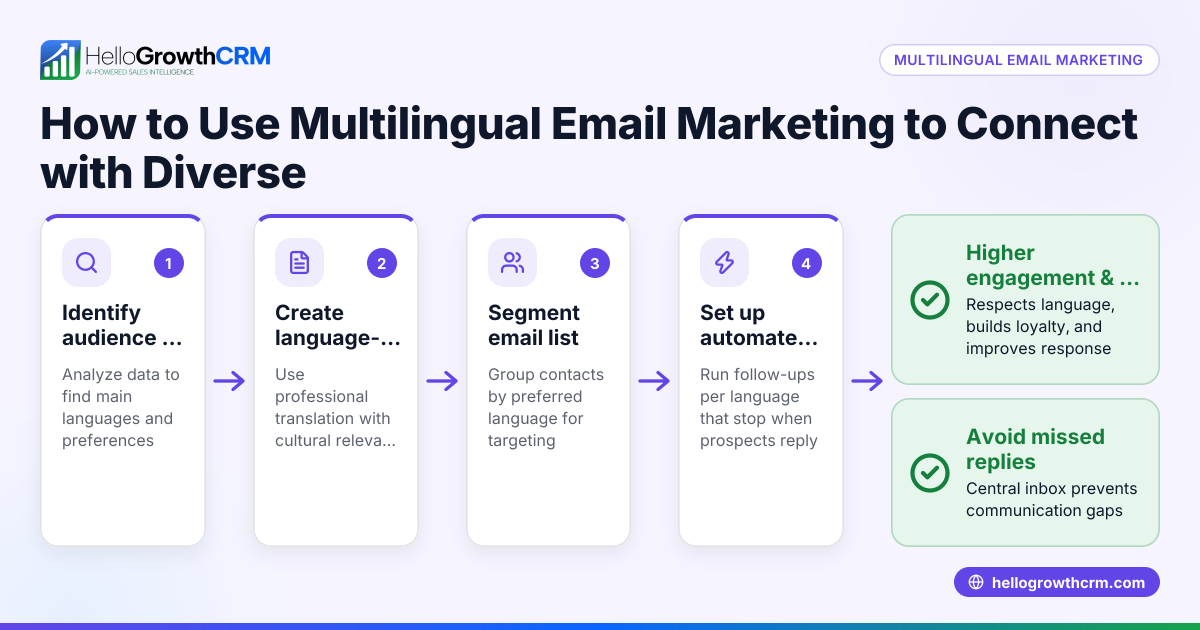
- Identify your customers’ languages. Review your sales data, website analytics, and customer inquiries to find the top languages spoken by your customers. Focus on the top 2-3 languages to start.
- Hire or train multilingual staff. If budget allows, hire customer support agents fluent in those languages. Alternatively, train existing staff or use professional translation services for key communications.
- Set up communication channels in multiple languages. Ensure your phone, email, WhatsApp, and SMS support can handle messages in these languages. Use templates or scripts translated accurately. HelloGrowthCRM’s WhatsApp and SMS CRM features can help manage these channels.
- Create a multilingual knowledge base. Develop help articles, FAQs, and guides in each language your customers speak. This reduces repetitive questions and empowers customers to self-serve.
- Track language preferences in your CRM. Tag each customer’s preferred language to route inquiries to the right agent and personalize communication. HelloGrowthCRM keeps all service requests linked on the same customer record as the deal, improving follow-up.
- Monitor and adjust. Collect feedback, track resolution times, and customer satisfaction by language. Adjust staffing and resources accordingly.
- Maintain consistency across platforms. Make sure your website, social media, and customer service all reflect the multilingual support you offer. The customer health score can help track overall customer engagement.
Example (fictional figures)
A B2B software reseller in Denver, Colorado, noticed a significant portion of their leads speak Spanish. They decided to add Spanish-language support starting 07/01/2026.
- Monthly support calls: 1,000
- Estimated Spanish calls: 300 (assumed for example)
- Cost to hire bilingual agent: $4,000/month
- Translation service for emails and knowledge base: $500/month
Calculations:
$4,000 + $500 = $4,500 total monthly cost
Cost per Spanish call for support:
$4,500 ÷ 300 = $15 per Spanish call
If improved support increases Spanish customer retention by 10 clients/month, each worth $500 revenue:
10 × $500 = $5,000 additional revenue
This example shows how investing in multilingual support can pay off by retaining and growing revenue from customers who prefer Spanish.
Common mistakes
- Ignoring language preferences in your CRM. Prevent by tagging customers’ preferred languages and routing accordingly.
- Using poor or automated translations without review. Prevent by employing professional translators or bilingual staff.
- Not training staff on cultural nuances. Prevent by providing cultural awareness training to avoid misunderstandings.
- Overcomplicating with too many languages at once. Prevent by focusing on top languages first and expanding gradually.
- Failing to update multilingual content regularly. Prevent by scheduling regular reviews and updates of translated materials.
- Separating customer service data by language in different systems. Prevent by using a CRM that keeps all customer info and service requests in one place, improving tracking and follow-up.
Doing this in HelloGrowthCRM
HelloGrowthCRM supports multilingual customer service with its Customer portal, referrals, tickets, and knowledge base features. After the sale, all service requests stay linked on the same customer record as the deal, making it easier to track support history across languages. You can build and manage a knowledge base with articles in multiple languages and handle tickets efficiently. Learn more about the customer health score and how HelloGrowthCRM helps US businesses manage diverse customer needs in one platform.
Frequently asked questions
What is multilingual customer support? Multilingual customer support means providing service and communication in multiple languages to meet customers’ linguistic preferences. It improves customer satisfaction and accessibility.
How can small businesses start offering multilingual support? Start by identifying key customer languages, then hire or train staff, translate key materials, and use CRM tools to track language preferences. Focus on top languages first.
Can technology replace human multilingual support? Technology like translation software helps but cannot fully replace human agents for nuanced communication. Combining both yields better results.
How does HelloGrowthCRM help with multilingual support? HelloGrowthCRM centralizes customer records, tickets, and knowledge base articles, allowing you to manage service requests in any language on the same platform, improving response times and tracking.
Is it expensive to implement multilingual customer support? Costs vary by languages, staff, and tools. Start small with your top languages and scale as you see returns. The example section shows how investment can pay off.
How do I measure success in multilingual support? Track customer satisfaction, resolution times, retention rates, and revenue from customers served in different languages.
Key takeaways
- Multilingual customer support means serving customers in their preferred languages to improve satisfaction.
- Identify your customers’ top languages before investing resources.
- Use multilingual knowledge bases and CRM tagging for efficient service.
- Avoid common mistakes like poor translations and separating data by language.
- HelloGrowthCRM helps manage multilingual support with unified customer records, tickets, and knowledge base.
Start providing better support today by starting on the Free Forever plan (200 leads, no credit card).
Ready to put this into practice?
Set up your pipeline, WhatsApp follow-ups, and AI lead scoring in minutes — free, no credit card.
Try HelloGrowthCRM freeGet CRM tips in your inbox
Join thousands of sales professionals who get weekly insights on CRM strategy, AI automation, and pipeline optimization.

The HelloGrowthCRM team publishes guides on CRM strategy, AI sales tools, and revenue operations for small business sales teams.