HelloGrowthCRM software
Built for real small-business sales teams
HelloGrowthCRM helps reps qualify faster, follow up on time, and close more deals—with practical automation in one place.
- AI lead scoring and pipeline visibility
- Built-in dialer, WhatsApp, and email automation
- Sales forecasting and RevOps-ready reporting
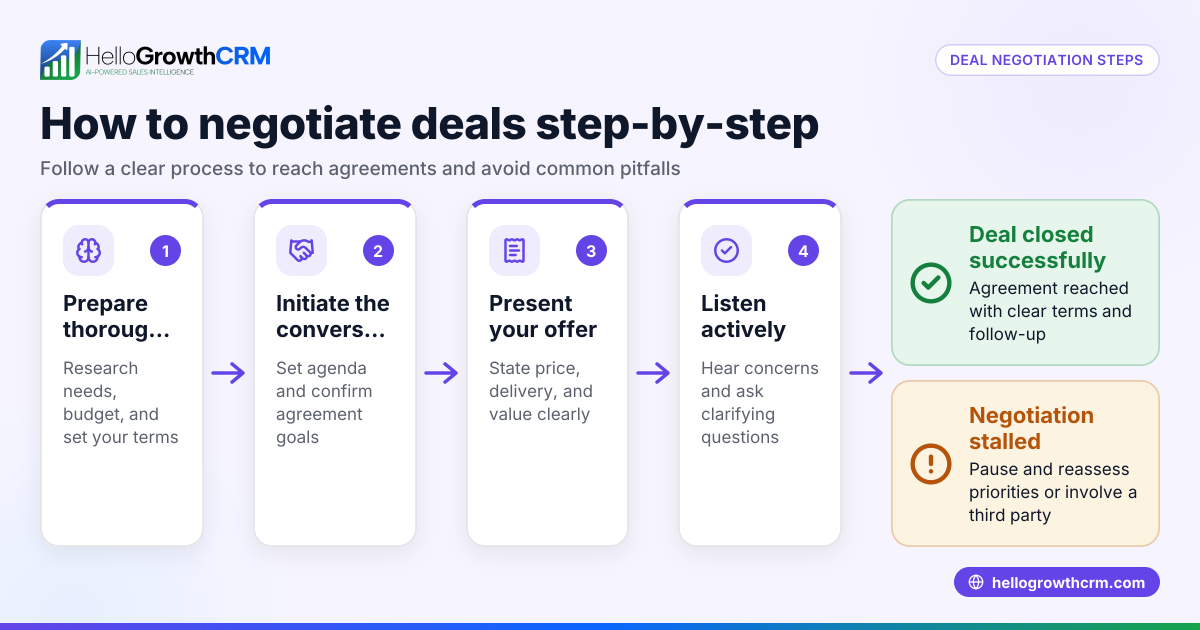
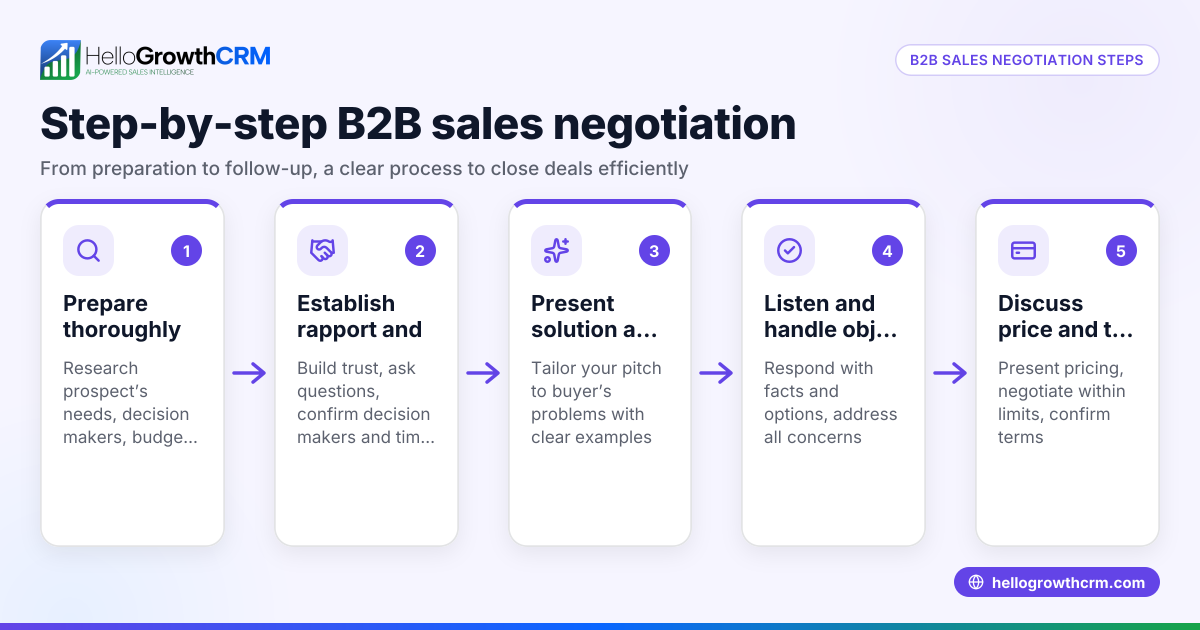
Preparing for negotiation means gathering all relevant information, setting clear goals, anticipating the other party’s position, and planning your approach. This article covers why preparation matters, detailed steps to get ready, a worked example with realistic figures, common mistakes to avoid, and how HelloGrowthCRM’s Managed RevOps can support your sales follow-up during negotiation.
Why this comes up / what goes wrong
Small-business owners often face negotiation situations with vendors, customers, or partners where the outcome impacts revenue, costs, or contract terms. Without preparation, they may accept unfavorable terms, miss key concessions, or lose credibility. Common problems include unclear objectives, insufficient data on pricing or alternatives, and failing to anticipate objections or counteroffers. This leads to rushed decisions or lost deals, especially when negotiations happen over text messages, email, or spreadsheets without a coordinated system.
Step-by-step
- Define your negotiation goals clearly. Write down your ideal outcomes and minimum acceptable terms. Check that these goals align with your business priorities.
- Gather all relevant information. Collect data on pricing, competitor offers, contract terms, and your own cost structure. Verify the accuracy of this information.
- Identify the other party’s interests and constraints. Research their business, needs, and possible negotiation limits to anticipate their position.
- Prepare your value proposition and concessions. Decide what benefits you offer and what you can concede if needed. List your priorities for trade-offs.
- Plan your negotiation strategy and tactics. Choose your opening offer, fallback positions, and communication style. Decide whether to negotiate in person, by phone, or text/email.
- Organize your documents and communication tools. Have contracts, price lists, and notes ready. Use tools that consolidate communication to avoid lost messages or delays.
- Rehearse your negotiation. Practice key points and responses to possible objections to build confidence.
- Set a timeline and next steps. Know when to follow up and how to document agreements.
Checklists at each step help ensure no detail is overlooked.
Example (fictional figures)
A B2B software reseller in Denver, Colorado, plans to negotiate a volume discount with a supplier on 07/15/2026.
- Goal: Secure a 10% discount on orders over $50,000.
- Current average order: $40,000.
- Supplier’s standard discount: 5% for orders over $30,000.
Step 1: Define goals
- Ideal: 10% discount on $50,000+ orders
- Minimum: 7% discount on $50,000+ orders
Step 2: Gather info
- Competitor discounts: 8% average
- Supplier’s cost margin: estimated 20%
Step 3: Identify supplier’s interests
- Wants to increase order size
- Avoids discounts that cut margin below 15%
Step 4: Prepare concessions
- Will commit to $60,000 minimum order if discount granted
Step 5: Strategy
- Opening offer: 12% discount
- Fallback: 7% discount
Step 6: Organize documents
- Purchase history spreadsheet
- Supplier contract draft
Step 7: Rehearse
- Practice explaining volume benefits
Step 8: Timeline
- Schedule call on 07/15/2026
- Follow-up email within 24 hours
Calculations:
- Current order: $40,000
- Target order: $60,000
- Discount at 10%: $60,000 × 10% = $6,000
- Cost saving compared to 5% discount: $60,000 × 5% = $3,000
- Additional saving: $6,000 - $3,000 = $3,000
This preparation supports a strong negotiation position.
Common mistakes
- Not setting clear goals. Prevent by writing down and reviewing objectives before negotiation.
- Ignoring the other party’s perspective. Research their needs and constraints to avoid surprises.
- Failing to organize documents and communication. Use a CRM or centralized system so no messages or contracts are lost.
- Underestimating the value of rehearsing. Practice improves confidence and response quality.
- Rushing follow-up. Set reminders to ensure timely next steps.
Using tools like HelloGrowthCRM’s WhatsApp and SMS CRM and built-in CRM dialer can help avoid communication errors during negotiation.
Doing this in HelloGrowthCRM
HelloGrowthCRM offers Managed RevOps, which provides done-for-you revenue operations support. This means a named revenue specialist works your follow-up queue every week, ensuring no lead or negotiation opportunity is missed. With weekly pipeline cleanup, hygiene, and KPI reports, you stay on top of your negotiation pipeline even without a dedicated sales manager. Learn more about Managed RevOps at /services/managed-revops.
Frequently asked questions
What is the most important step when preparing for negotiation? Setting clear goals is the most important step. Knowing your ideal outcome and minimum acceptable terms helps guide your strategy and decisions throughout the negotiation.
How can I anticipate the other party’s position? Research their business, recent deals, and industry trends. Understanding their needs and constraints allows you to predict their likely offers and objections.
Should I negotiate by email or phone? Choose the method based on complexity and relationship. Phone or WhatsApp calls allow faster back-and-forth and tone clarity, while email is better for detailed documentation. HelloGrowthCRM’s WhatsApp and SMS CRM supports both.
How do I avoid losing track of negotiation communication? Use a CRM that consolidates all messages, calls, and notes in one place. HelloGrowthCRM’s built-in CRM dialer and messaging sequences help keep your negotiation organized.
Can I get help if I don’t have a sales manager? Yes, HelloGrowthCRM’s Managed RevOps provides a revenue specialist who manages follow-ups and pipeline hygiene weekly, helping founders stay on top of negotiations.
Key takeaways
- Clearly define your negotiation goals and minimum acceptable terms.
- Gather comprehensive information about pricing, competitors, and the other party.
- Anticipate the other party’s interests to prepare effective strategies.
- Organize all documents and communication tools before negotiating.
- Practice your negotiation points to improve confidence and outcomes.
- Use HelloGrowthCRM’s Managed RevOps to keep your sales pipeline and follow-ups on track.
Start your negotiation preparation with HelloGrowthCRM's lead capture and pipeline tools. Try the Free plan with 200 leads and no credit card to organize your contacts and communications today.
Ready to put this into practice?
Set up your pipeline, WhatsApp follow-ups, and AI lead scoring in minutes — free, no credit card.
Try HelloGrowthCRM freeGet CRM tips in your inbox
Join thousands of sales professionals who get weekly insights on CRM strategy, AI automation, and pipeline optimization.

The HelloGrowthCRM team publishes guides on CRM strategy, AI sales tools, and revenue operations for small business sales teams.